WELCOME to JEREMY RANCH a LUXURY GOLF COMMUNITY
Set in the rolling foothills of the Wasatch Mountains along Upper East Canyon, Jeremy Ranch is one of the Park City area's most established residential communities—a landscape shaped by mountain terrain, the winding waters of East Canyon Creek, an Arnold Palmer-designed golf course, mature neighborhoods and immediate access to Interstate 80.
Jeremy Ranch occupies the western gateway to the greater Park City and Snyderville Basin area. Summit County's planning documents place Jeremy Ranch on the north side of I-80, opposite Pinebrook, extending north into the rolling terrain beyond Daybreaker Drive. The area includes predominantly detached single-family residential neighborhoods along with some attached and multifamily properties and a small commercial component near Rasmussen and Homestead Roads. Much of the original neighborhood is established and substantially built out.
That location gives Jeremy Ranch a character unlike Park City's resort-centered neighborhoods.
It is close enough to skiing, Main Street, Canyons Village, Kimball Junction and the rest of Park City to remain thoroughly connected to the mountain lifestyle, yet geographically positioned to provide direct access toward Parley's Summit, Parley's Canyon and the Salt Lake Valley via I-80. UDOT treats Jeremy Ranch as a major point along the I-80 corridor connecting Park City with the Salt Lake side of the Wasatch.
The result is a neighborhood that feels unmistakably mountain-oriented without being organized around a ski base.
Jeremy Ranch is not primarily about stepping from a condominium into a gondola line.
It is about waking to rolling Wasatch hillsides, golf-course fairways, open-space views and a landscape that transitions quickly from residential streets into the quieter terrain of East Canyon.
The name Jeremy Ranch predates the golf course, subdivisions and modern Park City resort era.
The surrounding lands were historically associated with the Jeremy family's ranching operations. Summit County records note that Jeremy family holdings eventually encompassed more than 22,000 acres, with the family operating agricultural and sheep-ranching lands through multiple generations between the nineteenth century and the late 1970s. The historic ranch landscape extended through the East Canyon country north of today's residential neighborhood.
That agricultural history is important because Jeremy Ranch still feels connected to the geography from which it emerged.
Even after decades of residential development, the surrounding hills, canyon, creek corridors and large expanses of undeveloped land prevent the neighborhood from feeling like conventional suburbia transplanted into the mountains.
The roads follow terrain rather than a rigid grid.
Homes climb gently across hillsides.
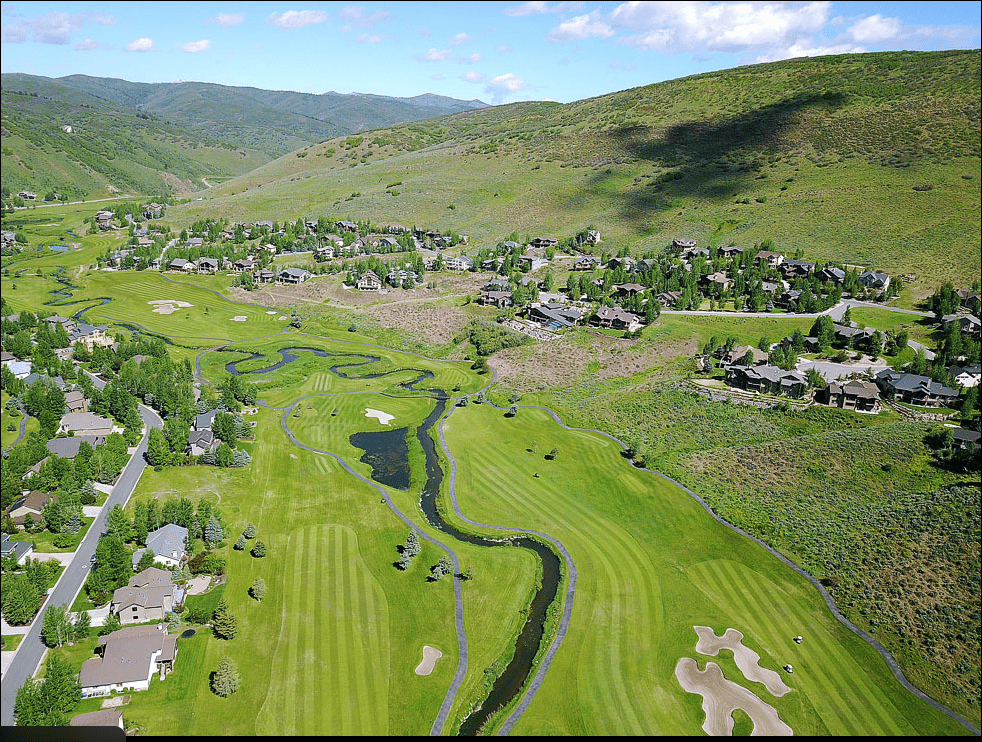
Golf fairways occupy the lower canyon landscape.
Native sagebrush covers exposed slopes.
Aspens and evergreens soften established properties.
And beyond the residential streets, East Canyon continues north into dramatically more open country.
Jeremy Ranch therefore carries a Western character that is grounded in landscape and history rather than architectural symbolism alone.
At the physical and visual heart of Jeremy Ranch is Jeremy Ranch Golf & Country Club.
The course opened in the fall of 1981 and was designed by Arnold Palmer and Ed Seay. The club identifies it as the only Arnold Palmer-designed golf course in Utah. East Canyon Creek winds through nine of the course's eighteen holes, making the creek a fundamental part of both the golf experience and the visual landscape.
The course became an important part of Utah golf history almost immediately.
Beginning in 1982, Jeremy Ranch hosted a Senior PGA Tour event that ultimately ran through 1992. Over those years, the property welcomed some of golf's most recognizable names, including Arnold Palmer, Jack Nicklaus, Billy Casper, Chi Chi Rodriguez, Ben Crenshaw, Lee Trevino and others. In 1992, Jeremy Ranch Golf Club transitioned into Jeremy Ranch Golf & Country Club as a private equity club.
That history gives Jeremy Ranch a different golf identity from many newer Park City communities.
This is not a course created yesterday as an amenity for a luxury real-estate project.
The course has been part of the neighborhood for more than four decades.
It has matured with the community.
The club's three-story clubhouse sits above the course and contains dining, outdoor dining areas, locker facilities, a golf shop, fitness facilities and event spaces. The club also maintains separate golf and social membership structures.
For homeowners considering Jeremy Ranch specifically because of the club, it is important to distinguish neighborhood ownership from club membership. Jeremy Ranch Golf & Country Club is a private membership organization; buyers should verify current membership categories, availability, initiation requirements and privileges directly with the club rather than assuming that ownership of a nearby home automatically conveys membership.
The club's presence nevertheless shapes the entire neighborhood whether a particular homeowner plays golf or not.
Fairways provide large areas of maintained open landscape.
East Canyon Creek introduces water and riparian vegetation through the valley floor.
The clubhouse becomes an architectural landmark.
And many homes enjoy views across terrain that remains visually open because of the golf course.
That is an important real-estate asset.
Jeremy Ranch real estate is not one homogeneous collection of homes.
Decades of development have produced substantial variety in architecture, lot orientation, elevation, views and scale. Summit County planning documents describe the Jeremy Ranch/Pinebrook area as predominantly detached single-family residential, with some multifamily development interspersed throughout.
Within Jeremy Ranch itself, buyers may encounter original mountain residences, extensively remodeled homes, golf-course properties, larger contemporary residences, townhome or condominium opportunities, and more substantial custom homes on the elevated edges of the community.
This creates a market where micro-location matters considerably.
A property near the golf course can live very differently from a home farther up the hillside.
A residence oriented toward the fairway may emphasize manicured views and mature vegetation.
A higher property may exchange immediate golf-course frontage for longer mountain views, greater elevation and a stronger sense of separation.
Another property may be valued for easier access to Rasmussen Road and I-80.
Still another may be positioned near the quieter northern edge of the neighborhood where the developed landscape begins giving way to East Canyon.
There is no single Jeremy Ranch experience.
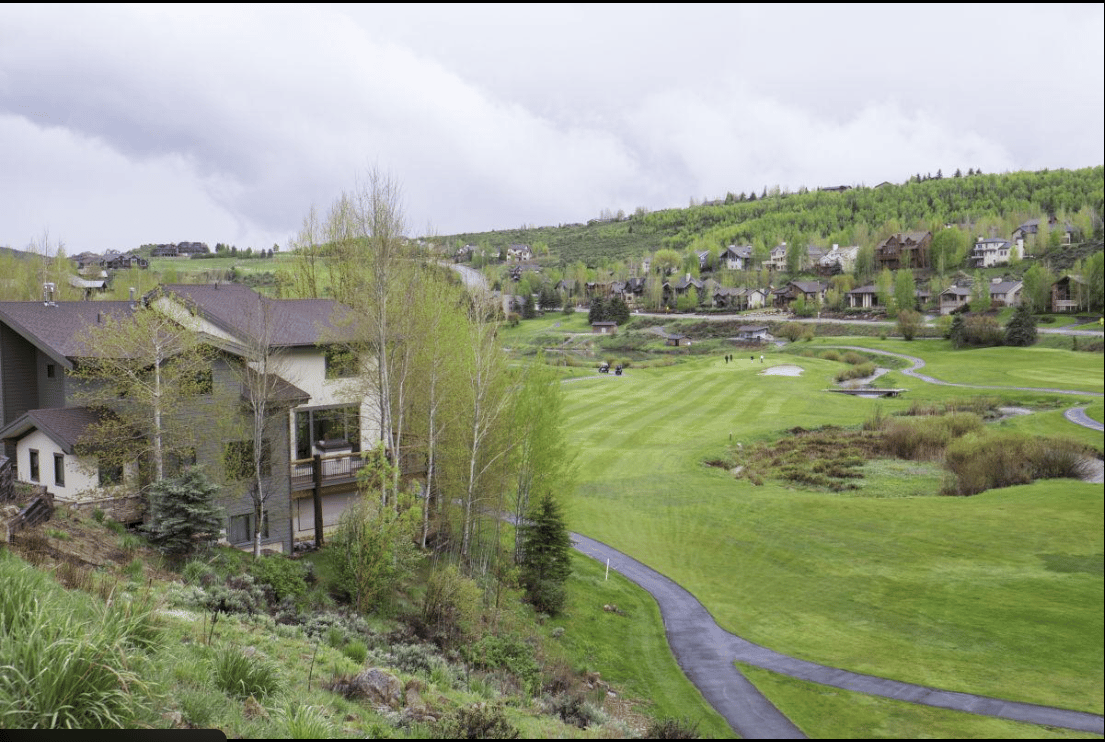
The lower portions of Jeremy Ranch are most closely associated with the golf course, clubhouse and the more established streets surrounding the valley floor.
Here, the landscape tends to feel greener and more sheltered during the warmer months.
Mature trees line portions of the residential streets.
Fairways create long visual corridors.
East Canyon Creek and its associated vegetation introduce an unexpected softness into the mountain setting.
Homes closer to this portion of the neighborhood may appeal to buyers prioritizing golf proximity, relatively convenient neighborhood access and an established residential atmosphere.
Depending upon the individual parcel, views may extend over fairways, toward surrounding hillsides or across neighboring mature landscaping.
As roads climb away from the golf-course floor, Jeremy Ranch becomes increasingly expansive.
Higher properties can command views over the lower neighborhood, golf course and surrounding Wasatch terrain. The landscape becomes more openly mountain-oriented, with sage-covered hillsides, natural vegetation and broader horizon lines.
The experience changes accordingly.
Lower Jeremy Ranch is often about the intimacy of the golf landscape.
Upper Jeremy Ranch is frequently more about elevation, sunlight, mountain perspectives and space.
Site orientation becomes particularly important at these elevations. A property's relationship to prevailing weather, winter sun, driveway grade, snow storage and distant views can make a meaningful difference in day-to-day living.
That is one reason Jeremy Ranch cannot be accurately evaluated solely by square footage and bedroom count.
The lot itself is a significant component of the property.
The broader Jeremy Ranch area also includes more estate-oriented residential opportunities.
The Trails at Jeremy Ranch, for example, was developed with considerably larger homesites than the traditional golf-course neighborhood. Current neighborhood information describes properties there on approximately one-to-three-acre lots with substantial custom residences, illustrating the wider spectrum of housing available under the broader Jeremy Ranch identity.
These larger settings create an experience closer to estate-style mountain living while retaining the strategic access that defines Jeremy Ranch.
That diversity is useful for luxury buyers.
One person may want a remodeled residence immediately above the golf course.
Another may prioritize acreage, larger garages, recreation storage and greater separation from neighboring homes.
Both can potentially find their version of Jeremy Ranch.
Jeremy Ranch's architectural character reflects the evolution of Park City residential design over several decades.
Earlier homes often feature the mountain vocabulary familiar throughout the Wasatch Back: pitched rooflines, timber, stone, large masonry fireplaces, decks, vaulted ceilings and generous windows oriented toward surrounding terrain.
Renovated properties increasingly combine those traditional exteriors with cleaner interiors and more contemporary floor plans.
Newer custom residences tend to emphasize a more refined mountain-modern aesthetic:
natural stone paired with steel and glass, larger expanses of glazing, broad open-plan living spaces, oversized kitchens, indoor-outdoor entertaining areas, sophisticated primary suites, home offices, fitness spaces, recreation rooms and substantial garages designed for the equipment that accompanies a Park City lifestyle.
Because the neighborhood developed over time rather than as one architectural project, the streetscape retains individuality.
Jeremy Ranch is not visually monolithic.
For many buyers, that is part of the appeal.
One of the most consequential changes to the landscape surrounding Jeremy Ranch occurred in January 2026, when Summit County finalized the acquisition of the historic 910 Ranch immediately north of the Jeremy Ranch area.
The acquisition permanently protects approximately 8,588 acres across Summit and Morgan Counties. Summit County describes it as the largest conservation acquisition in county history and one of the last major contiguous expanses of undeveloped land in the greater Snyderville Basin. The protected property also connects with national forest, state land and other protected properties, creating a much larger conservation landscape and wildlife corridor.
For Jeremy Ranch, this is significant.
Few established residential communities on the western edge of a major resort market can point toward thousands of acres of newly protected land directly beyond them.
The conservation of the 910 Ranch reinforces Jeremy Ranch's enduring connection to open landscape, East Canyon and the agricultural history from which the community emerged.
Importantly, the property is not currently a conventional public recreation park. Summit County states that, pending adoption of a formal recreational management plan, public access remains restricted primarily to East Canyon Road and other specifically permitted uses.
The value of the acquisition today is therefore as much about permanent conservation and landscape protection as recreation.
East Canyon is central to Jeremy Ranch's identity.
East Canyon Creek moves through the golf course before continuing north through the surrounding canyon landscape. The historic East Canyon corridor connects the neighborhood visually and geographically with a much larger mountain environment extending toward the protected 910 Ranch and, farther beyond, East Canyon State Park.
The unpaved Jeremy Ranch/East Canyon road has long been known among cyclists and outdoor enthusiasts as a route through this quieter backcountry corridor. Utah's tourism materials also describe riding from Jeremy Ranch toward East Canyon Reservoir as a high-elevation gravel and paved cycling experience.
This produces an unusual contrast.
At one end of Jeremy Ranch is Interstate 80, one of the most important transportation corridors in the Intermountain West.
At the other is East Canyon, where the landscape rapidly becomes rural and undeveloped.
Very few Park City neighborhoods straddle those two worlds so clearly.
Jeremy Ranch does not sit inside Park City's historic core, and that distinction should be presented as an advantage rather than obscured.
The neighborhood offers straightforward access east toward the greater Park City area while allowing residents to avoid living amid the density and visitor activity surrounding Main Street and the resort bases.
From Jeremy Ranch, the broader Snyderville Basin, Kimball Junction and the Highway 224 corridor are readily accessible, while Canyons Village provides the nearest major resort gateway into Park City Mountain.
Historic Main Street, Park City Mountain and Deer Valley remain part of the broader lifestyle, but Jeremy Ranch itself retains a much stronger residential identity.
In other words:
the resorts are nearby destinations rather than the neighborhood's front yard.
For certain buyers, that is exactly the point.
One of Jeremy Ranch's most important differentiators is its immediate relationship with Interstate 80.
UDOT's Wasatch Back transportation system specifically identifies Jeremy Ranch along the I-80 corridor between Park City and Parley's Canyon.
For residents whose lives regularly extend west toward Salt Lake City, the airport, University of Utah, business centers or other Salt Lake Valley destinations, that position can be materially important.
A residence deeper inside Park City requires traveling back toward the interstate before beginning the journey through Parley's Canyon.
Jeremy Ranch begins near that corridor.
That location is one reason the neighborhood appeals to buyers who want a Park City-area mountain residence without severing practical connections to the Salt Lake Valley.
Actual drive times naturally vary with weather, traffic and construction conditions, particularly during winter or periods of I-80 work.
Jeremy Ranch also participates in the regional public-transportation network.
As of 2026, High Valley Transit Route 101 connects the Jeremy Ranch Park & Ride with the Old Town Transit Center and operates through the Highway 224 corridor. The published route currently runs daily with approximately 20-minute frequency.
Routes and schedules can change, so current transit information should always be verified when marketing a particular property.
Nevertheless, the existence of a direct regional connection reinforces Jeremy Ranch's role as part of the broader Park City community despite its western position.
Jeremy Ranch Elementary School is located at 3050 Rasmussen Road within the neighborhood. Park City School District's current boundary information identifies Jeremy Ranch, Hidden Cove, Summit Park, Timberline, Upper Pinebrook, Elk Meadows, Southridge and portions of surrounding areas within the Jeremy Ranch Elementary attendance boundary.
The school is part of Park City School District, whose current structure includes four elementary schools, Ecker Hill Middle School and Park City High School.
For real-estate marketing, school boundaries should always be presented factually rather than as guarantees, because district boundaries and enrollment policies can change. Buyers should confirm the school assignment for the specific property directly with Park City School District.
Summer reveals Jeremy Ranch at its most verdant.
The golf course turns intensely green against surrounding sagebrush hills.
Aspens fill out around established homes.
East Canyon Creek winds through riparian vegetation.
Outdoor patios and decks become extensions of the home.
Golf becomes part of the neighborhood rhythm, while cycling, hiking and the broader Park City trail network provide nearly endless alternatives.
Because Jeremy Ranch sits outside the denser resort core, summer can feel decidedly residential even during Park City's busiest event calendar.
Residents can spend the day on the golf course or trails, head into town for dinner or a concert, then return to a quieter mountain environment.
That ability to participate in Park City without having every aspect of daily life shaped by tourism is one of Jeremy Ranch's understated strengths.
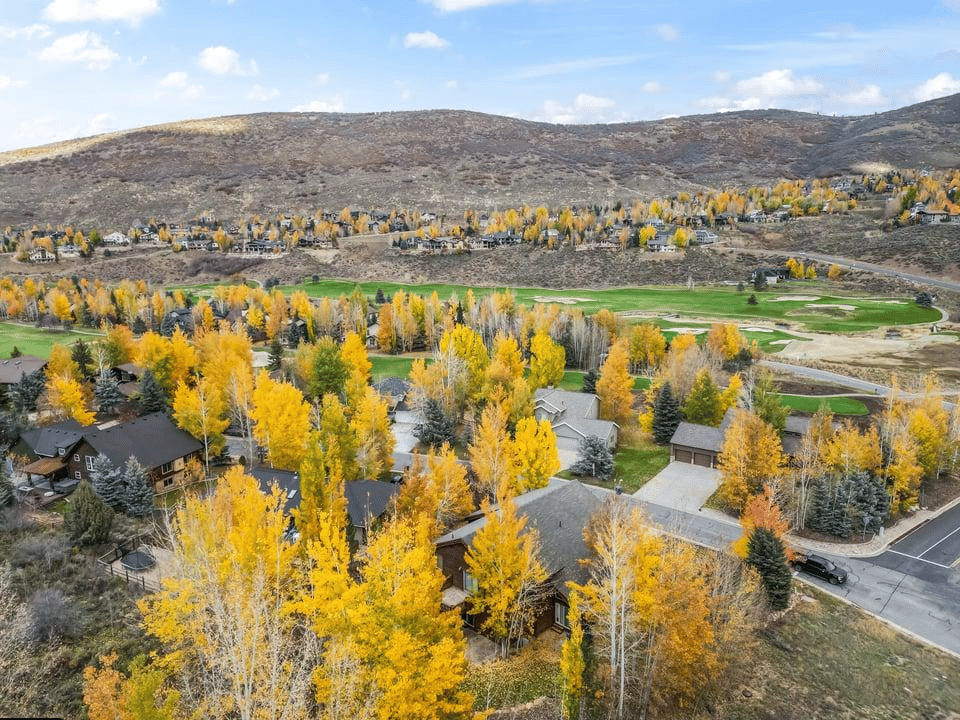
Fall may be Jeremy Ranch's most visually dramatic season.
Mature aspens turn brilliant yellow around the golf course and residential streets while the fairways remain green below.
Native hillsides shift from summer sage to warmer gold and bronze tones.
Cool evenings return.
The contrast between cultivated golf landscape and rugged mountain terrain becomes especially striking.
Because many Jeremy Ranch homes look across rather than directly into neighboring properties, seasonal change often happens on a broad scale.
The landscape itself becomes the view.
Winter changes the neighborhood completely.
Fairways disappear beneath snow.
The surrounding hills become white and sculptural.
Golf gives way to the larger Wasatch winter culture.
Park City Mountain and Deer Valley remain readily accessible, while the neighborhood itself retains its quieter residential rhythm.
Jeremy Ranch Golf & Country Club also maintains a Nordic component to its operations, reinforcing the club's connection to winter recreation rather than functioning exclusively as a summer amenity.
For homeowners, winter living also makes property-specific details important.
Driveway grade, orientation, snow-removal arrangements, roof design, exposure and garage configuration can have substantial practical consequences in any mountain neighborhood and should be evaluated individually.
Jeremy Ranch and Pinebrook sit directly across I-80 from one another, but their environments are distinct.
Summit County planning documents identify Jeremy Ranch on the north side of I-80 and Pinebrook on the south side.
Pinebrook rises more dramatically into heavily wooded mountain terrain.
Jeremy Ranch generally feels more open.
Pinebrook is strongly associated with forested slopes and canyon living.
Jeremy Ranch is more closely identified with golf, East Canyon Creek, broad fairways, sagebrush hillsides and open mountain views.
Both provide excellent western access to the Park City area.
The choice is often less about distance and more about preferred landscape:
wooded mountain enclosure versus open golf-and-canyon country.
Park Meadows and Jeremy Ranch both have strong golf identities, but they represent very different versions of Park City living.
Park Meadows sits close to the center of Park City and surrounds the private Park Meadows Country Club.
Jeremy Ranch lies farther west at the gateway to the Snyderville Basin and surrounds the private Jeremy Ranch Golf & Country Club.
Park Meadows offers greater proximity to Main Street and the resort core.
Jeremy Ranch provides more immediate I-80 access and a stronger visual connection to undeveloped East Canyon.
Park Meadows feels distinctly in town.
Jeremy Ranch feels distinctly at the edge of the mountains.
For a buyer whose lifestyle regularly moves between Park City and Salt Lake, that distinction may be particularly meaningful.
Promontory represents a different scale of private-club community entirely, with extensive gated amenities, multiple golf courses and a highly programmed luxury-club environment.
Jeremy Ranch is older, more organically developed and substantially less resort-like.
The neighborhood's roads and homes developed over decades around one established golf club rather than as part of a contemporary amenity-driven master plan.
For buyers who prefer a neighborhood that feels residential first and club-oriented second, Jeremy Ranch may hold particular appeal.
Its luxury is quieter.
There is less ceremony around arriving.
The mountains, golf course and landscape do most of the talking.
Old Town is about historic architecture, walkability, Main Street, nightlife and immediate resort access.
Jeremy Ranch is almost its counterpoint.
Here the priorities are larger residential settings, garages, outdoor space, mountain views, golf, easier highway access and a quieter relationship with Park City's visitor economy.
A Jeremy Ranch homeowner can still enjoy dinner on Main Street or a day at Deer Valley.
The difference is where that homeowner returns afterward.
Instead of a historic grid beneath the ski mountain, home is a residential canyon landscape surrounded by fairways and Wasatch foothills.
This distinction may be Jeremy Ranch's most important.
Jeremy Ranch was not created as a collection of vacation residences surrounding a hotel.
It became a neighborhood.
Summit County records now describe the larger historic Jeremy Ranch area as containing hundreds of single-family residences and a significant number of attached housing units, illustrating how deeply established the community has become since its development began.
That maturity is visible everywhere.
Trees have had decades to grow.
Homes have been renovated, expanded and replaced.
The golf course has acquired history.
Roads feel settled into the terrain.
And residents live alongside a landscape that still reveals traces of the ranching history that preceded them.
New luxury developments can replicate architecture.
They can build clubhouses.
They can landscape entrances.
What they cannot accelerate is time.
Jeremy Ranch has had more than forty years to become itself.
The broader Jeremy Ranch area contains multiple plats, subdivisions and property types, and buyers should not assume that every property carries identical covenants, HOA obligations or architectural requirements.
Recorded protective covenants exist for portions of Jeremy Ranch, including individual subdivision plats, and Summit County records also identify several separately named developments within the broader Jeremy Ranch area.
Accordingly, any specific purchase should include review of the applicable recorded documents, HOA information, architectural guidelines, zoning, easements, rental rules and ownership obligations.
This is particularly important when comparing a traditional Jeremy Ranch single-family residence with an attached development or a property within one of the area's newer or more estate-oriented subdivisions.
The neighborhood name alone does not tell the entire legal story of the property.
Jeremy Ranch is particularly compelling for buyers who want a genuine Park City-area residence rather than a purely resort-oriented property.
Its advantages are unusually balanced: private golf, substantial residential inventory, mountain scenery, established landscaping, I-80 access, nearby skiing, regional transit, schools, protected open space and immediate proximity to the dramatically quieter East Canyon landscape.
It can work equally well as a primary mountain residence or a second home for someone whose priorities extend beyond skiing alone.
And that is important.
Jeremy Ranch is not dependent upon one season to justify itself.
Winter brings skiing and snow.
Spring reveals East Canyon Creek.
Summer belongs to golf and outdoor recreation.
Autumn turns the entire neighborhood gold.
The landscape keeps changing.
The neighborhood remains.
Park City luxury is often described through exclusivity.
Jeremy Ranch offers another interpretation:
connectivity.
Connection to Park City.
Connection to Salt Lake.
Connection to golf.
Connection to open space.
Connection to East Canyon.
And, increasingly, connection to a permanently protected landscape stretching for thousands of acres beyond the neighborhood.
That connectivity makes Jeremy Ranch unusually practical without making it feel ordinary.
You can leave the neighborhood and be moving west through Parley's Canyon almost immediately.
Or you can head north and watch the pavement give way to one of the most expansive conserved landscapes in the Snyderville Basin.
Few places offer both.
For buyers searching for Jeremy Ranch homes for sale, Park City golf-course homes, luxury real estate near I-80, mountain homes near Park City, or established residential property in the Snyderville Basin, Jeremy Ranch deserves a place near the top of the conversation.
It offers neither the density of Old Town nor the orchestration of a new private-club resort.
Instead, it offers something more grounded:
an established mountain neighborhood built around an historic ranch landscape, an Arnold Palmer golf course, East Canyon Creek and extraordinary access to two sides of the Wasatch.
Jeremy Ranch is close enough to Park City to enjoy everything that has made the destination internationally known—yet removed enough to preserve a sense of space, quiet and everyday mountain life.
Here, Park City does not end at the resort. It opens into the mountains.
20,357 people live in JEREMY RANCH IN PARK CITY, UTAH, where the median age is 42.3 and the average individual income is $90,915. Data provided by the U.S. Census Bureau.
Total Population
Median Age
Population Density Population Density This is the number of people per square mile in a neighborhood.
Average individual Income
There's plenty to do around JEREMY RANCH IN PARK CITY, UTAH, including shopping, dining, nightlife, parks, and more. Data provided by Walk Score and Yelp.
Explore popular things to do in the area, including Park City Cakery, Fresh Coast Seafood, and All Seasons Groceries.
| Name | Category | Distance | Reviews |
Ratings by
Yelp
|
|---|---|---|---|---|
| Dining | 0.36 miles | 4 reviews | 3/5 stars | |
| Dining | 0.67 miles | 0 reviews | 0/5 stars | |
| Dining | 0.67 miles | 5 reviews | 5/5 stars | |
| Dining | 0.67 miles | 1 review | 5/5 stars | |
| Dining | 0.67 miles | 16 reviews | 5/5 stars | |
| Dining | 0.67 miles | 6 reviews | 5/5 stars | |
| Active | 0.4 miles | 4 reviews | 5/5 stars | |
| Active | 0.67 miles | 0 reviews | 0/5 stars | |
| Active | 0.67 miles | 1 review | 5/5 stars | |
| Active | 0.67 miles | 1 review | 5/5 stars | |
| Active | 0.67 miles | 1 review | 5/5 stars | |
| Active | 0.67 miles | 2 reviews | 5/5 stars | |
| Active | 0.67 miles | 0 reviews | 0/5 stars | |
| Active | 0.67 miles | 6 reviews | 5/5 stars | |
| Active | 0.67 miles | 0 reviews | 0/5 stars | |
| Beauty | 0.67 miles | 0 reviews | 0/5 stars | |
| Beauty | 0.67 miles | 0 reviews | 0/5 stars | |
| Beauty | 0.67 miles | 0 reviews | 0/5 stars | |
| Beauty | 0.67 miles | 0 reviews | 0/5 stars | |
| Beauty | 0.67 miles | 0 reviews | 0/5 stars | |
| Beauty | 0.67 miles | 0 reviews | 0/5 stars | |
| Beauty | 0.67 miles | 6 reviews | 5/5 stars | |
| Beauty | 0.67 miles | 28 reviews | 4.9/5 stars | |
|
|
||||
|
|
||||
|
|
||||
|
|
||||
|
|
||||
|
|
JEREMY RANCH IN PARK CITY, UTAH has 7,501 households, with an average household size of 2.7. Data provided by the U.S. Census Bureau. Here’s what the people living in JEREMY RANCH IN PARK CITY, UTAH do for work — and how long it takes them to get there. Data provided by the U.S. Census Bureau. 20,357 people call JEREMY RANCH IN PARK CITY, UTAH home. The population density is 283 and the largest age group is Data provided by the U.S. Census Bureau.
Total Population
Population Density Population Density This is the number of people per square mile in a neighborhood.
Median Age
Men vs Women
Population by Age Group
0-9 Years
10-17 Years
18-24 Years
25-64 Years
65-74 Years
75+ Years
Education Level
Total Households
Average Household Size
Average individual Income
Households with Children
With Children:
Without Children:
Marital Status
Blue vs White Collar Workers
Blue Collar:
White Collar: