WELCOME TO THE AERIE IN PARK CITY, UTAH
Perched high on Masonic Hill above Historic Old Town, Aerie occupies one of the most distinctive residential settings in Park City, Utah. Positioned between Old Town, Lower Deer Valley and Prospector, the neighborhood rises above the activity of central Park City while remaining extraordinarily close to its ski resorts, restaurants, trails, cultural attractions and everyday conveniences.
The name itself feels almost inevitable.
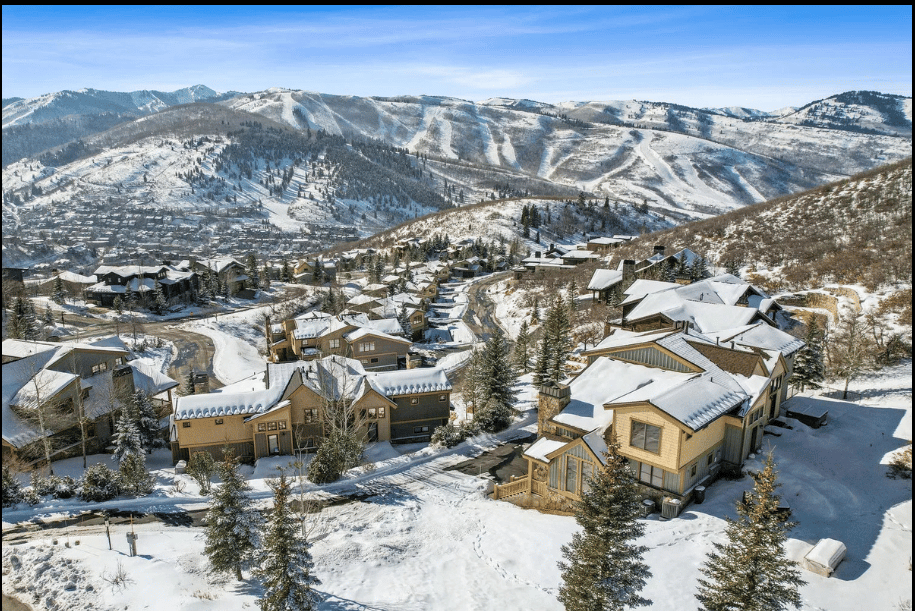
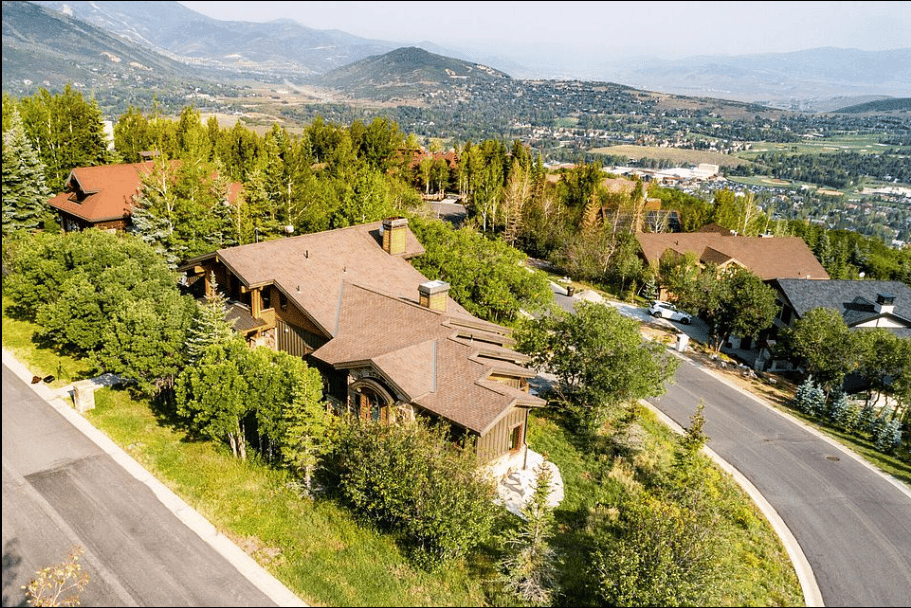
An aerie is an eagle's nest built high above the surrounding landscape, and that elevated perspective is precisely what defines this neighborhood. Homes climb along winding hillside streets and ridgelines where the architecture often seems suspended above Park City itself. Depending upon orientation and elevation, residences can capture sweeping perspectives toward Park City Mountain, Deer Valley, Old Town, Prospector, surrounding ridgelines and the broader Wasatch landscape.
Yet Aerie's distinction is not views alone.
Its real luxury comes from the unusual combination of elevation and centrality.
Many mountain communities achieve privacy by placing residents miles from town. Aerie accomplishes something much rarer: homeowners can retreat high above the city while remaining only minutes from Historic Main Street, Park City Mountain, Deer Valley and the commercial amenities of Prospector.
It is mountain privacy without geographical exile.
And in Park City, that is an increasingly valuable proposition.
Aerie occupies Masonic Hill, the prominent hillside rising between several of Park City's best-known districts.
Below and to one side lies Historic Old Town, with its celebrated Main Street, restaurants, galleries, boutiques and historic mining architecture.
In another direction lies Prospector, one of Park City's long-established residential and commercial districts.
To the southeast is Lower Deer Valley, providing convenient access toward Deer Valley Resort.
And across the valley, Park City Mountain's ski terrain forms a dramatic backdrop to many west-facing properties.
This geography gives Aerie a remarkable visual relationship with the city.
Old Town residents often experience Park City from within it.
Aerie residents frequently experience Park City from above.
Streets rise and curve along the mountain, allowing homes to capitalize on elevation, sunlight and long-distance sightlines. In places, the city feels spread beneath the neighborhood like a mountain panorama rather than surrounding it at street level.
That physical separation creates tranquility without sacrificing access.
Few features are associated with Aerie as strongly as its views.
Because the neighborhood occupies elevated terrain above several lower-lying Park City districts, many properties enjoy broad perspectives that are difficult to reproduce elsewhere in town. Local neighborhood guides consistently identify panoramic mountain and resort views as one of Aerie's principal characteristics.
Depending upon the property's exact location, elevation and orientation, views may encompass:
The experience changes throughout the day.
Morning light can illuminate the surrounding ridges.
Afternoon emphasizes the architecture and terrain of the ski mountains.
Sunset can stretch across the valley.
And after dark, homes positioned above town may look across the lights of Park City while the mountains rise beyond them.
That ability to experience both mountain wilderness and townscape within the same view is one of Aerie's most distinctive aesthetic qualities.
Aerie is predominantly known for substantial single-family residences positioned along its hillside streets and ridgelines. The broader real-estate area also includes limited townhome opportunities, but large custom homes define much of the neighborhood's luxury identity.
The terrain itself influences the architecture.
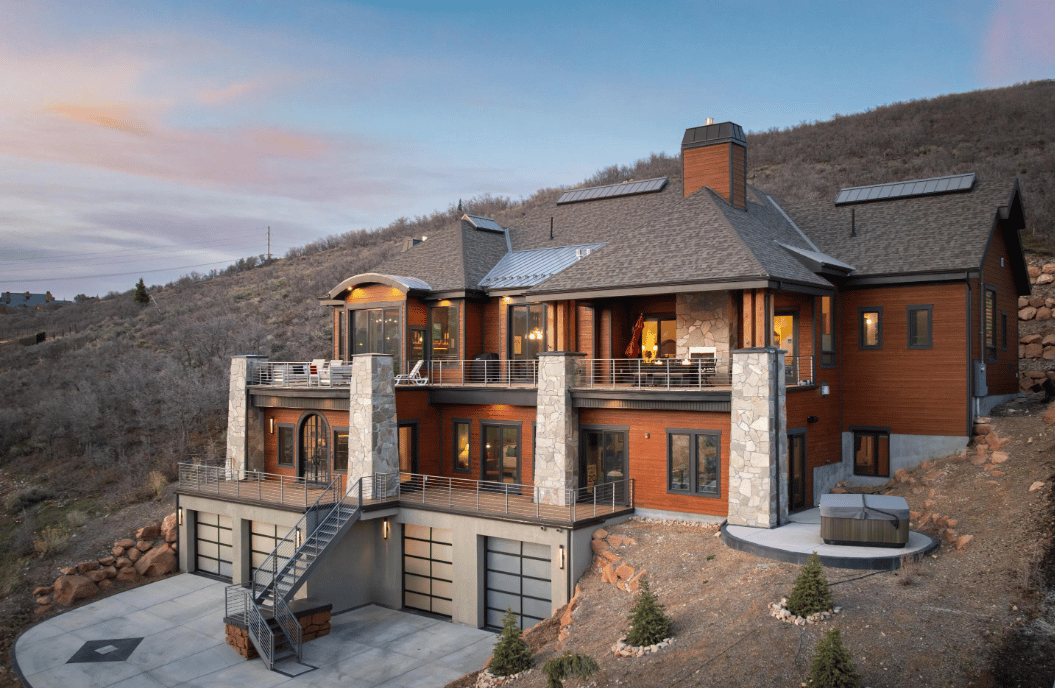
Because many lots are sloped, homes are often designed vertically across several levels rather than spreading across a flat site. This creates opportunities for dramatic architectural solutions: floor-to-ceiling glass, elevated decks, terraces, walkout lower levels and living spaces deliberately positioned toward major mountain views.
At the upper end of the market, Aerie residences can be substantial in scale. Contemporary listings in the neighborhood demonstrate homes ranging from approximately 3,000 square feet to significantly larger estate-scale residences exceeding 8,000 square feet, illustrating the breadth of the neighborhood's luxury housing stock.
The important distinction, however, is not simply size.
It is what the architecture can see.
In Aerie, orientation can matter as much as square footage.
Aerie reflects several generations of Park City luxury architecture.
Earlier residences often express the traditional mountain vocabulary associated with Park City's development as a modern ski community:
As Park City's luxury market has evolved, renovations and newer custom construction have introduced a more contemporary aesthetic.
Modern Aerie residences may feature:
The hillside itself becomes part of the design.
Instead of placing a house upon the landscape, successful Aerie architecture often attempts to work with the mountain, stepping through elevation changes and framing selected views in different directions.
A luxury home here can feel less like a traditional suburban residence and more like an observation point over Park City.
One of Aerie's strongest competitive advantages is residential scale.
Old Town offers extraordinary history and walkability, but many properties there occupy smaller historic lots, narrow streets and tighter building envelopes.
Aerie offers buyers the possibility of substantially larger custom residences while remaining extremely close to Old Town. Local market guides specifically identify Aerie's combination of large-format homes, ridgeline views and Main Street proximity as an important part of the neighborhood's appeal.
That matters for buyers seeking:
Aerie therefore occupies an interesting place within Park City's real-estate hierarchy.
It can provide some of the scale associated with outlying luxury communities while retaining an in-town Park City address.
Aerie's relationship with Historic Main Street is fundamental to its appeal.
The neighborhood rises immediately above Old Town, allowing residents to remain remarkably close to Park City's dining, shopping, galleries, nightlife and cultural events without living directly amid Main Street's pedestrian and vehicular activity. Neighborhood guides consistently characterize Aerie as an in-town location only moments above the historic core.
This creates a compelling lifestyle contrast.
An evening might begin with dinner on Main Street, followed by a short trip home into a setting that feels considerably quieter and more secluded.
That is fundamentally different from living farther into the Snyderville Basin or within one of Park City's remote private-club communities.
Aerie does not ask buyers to choose between privacy and town.
It gives them access to both.
Across the valley, Park City Mountain forms one of Aerie's defining visual landmarks.
The neighborhood itself is not ski-in/ski-out, an important distinction for buyers. Real-estate sources consistently identify Aerie as a residential hillside neighborhood rather than a slopeside ski community.
But skiing remains extremely close.
Aerie's central position allows homeowners to reach Park City Mountain's base-area access without living within the higher-density environment surrounding the resort.
This can be ideal for buyers who want world-class skiing to be an important part of their Park City lifestyle but do not necessarily need a lift outside their door.
Instead, the reward is a quieter home and, from many properties, the ability to look directly toward the ski mountain itself.
There is something distinctly Park City about watching the slopes from home after having spent the day skiing them.
Aerie's eastern and southeastern position also places it conveniently near Lower Deer Valley.
The neighborhood is accessed primarily from Deer Valley Drive, reinforcing the direct geographical relationship between Aerie, Old Town and the Lower Deer Valley corridor.
For owners who ski Deer Valley, this can be particularly attractive.
Rather than living deeper within Deer Valley itself, Aerie residents can remain centrally positioned between multiple parts of Park City while still enjoying convenient access toward the resort.
That versatility distinguishes Aerie from resort-specific communities.
The neighborhood does not belong exclusively to Park City Mountain.
It does not belong exclusively to Deer Valley.
It sits between Park City's major experiences, allowing residents to choose among them.
Directly below the opposite side of Aerie lies Prospector, another of Park City's longstanding residential districts.
Prospector adds a practical dimension to Aerie's location.
Restaurants, cafés, businesses, lodging, recreation and everyday services are located below the hillside, while the nearby Rail Trail and associated trail connections provide an important component of Park City's non-motorized network.
This means an Aerie homeowner does not have to descend exclusively toward Old Town for every need.
The neighborhood sits between several different Park City activity centers, which is one reason its location feels so unusually efficient.
Aerie's hillside setting provides meaningful connections to Park City's trail system.
The Lost Prospector corridor lies near the neighborhood and connects toward Park City's broader trail infrastructure and the Rail Trail below. Local trail-oriented neighborhood guidance specifically identifies Lost Prospector as an important recreational connection for Aerie residents.
Park City's own long-range pedestrian and bicycle planning has historically identified connections between Aerie Drive and Lost Prospector, reinforcing the neighborhood's relationship with the surrounding active-transportation and trail network.
For residents, the significance goes beyond recreation.
It means the mountains are not simply something viewed through a window.
They can be entered.
Hiking, trail running and mountain biking become part of the neighborhood experience, particularly in warmer months.
That combination—viewing the mountains while simultaneously having access into them—is central to Aerie's appeal.
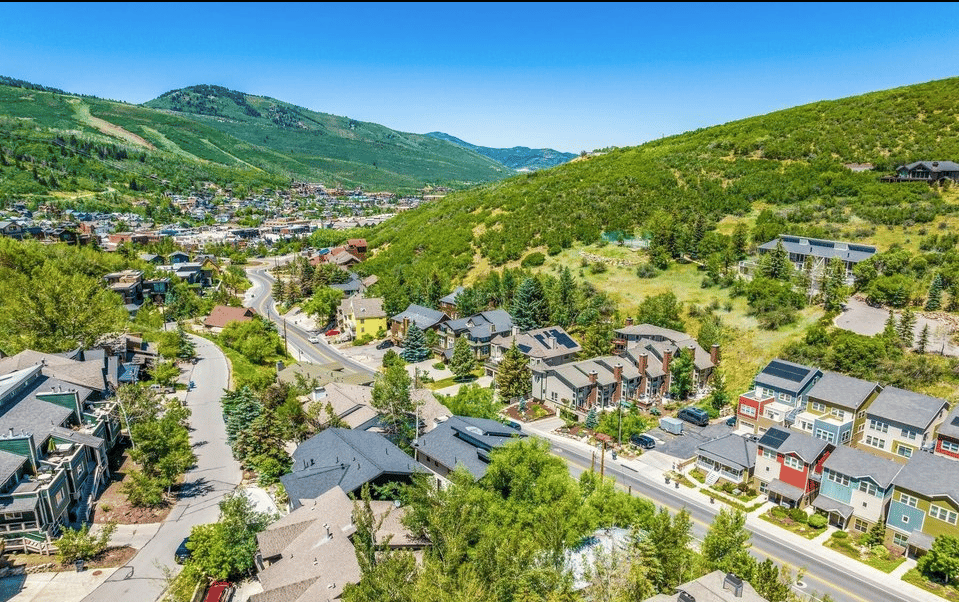
Summer reveals an entirely different side of the neighborhood.
The snow disappears from residential streets.
Native vegetation fills the hillsides.
Aspens and mountain shrubs leaf out.
Terraces and decks become outdoor living rooms.
And Park City's extensive warm-weather recreational culture takes over.
Aerie's elevated homes are particularly well suited to summer entertaining because views are rarely confined to a single season.
Outdoor living spaces may overlook green ski slopes, the rooftops of Old Town, surrounding mountains or expansive western sunsets.
A summer evening in Aerie can feel remarkably removed from town even though restaurants and Main Street activity remain immediately below.
Mountain biking, hiking, golf, concerts, festivals and dining are all easily integrated into daily life.
For second-home owners accustomed to thinking of Park City primarily as a ski destination, Aerie makes a persuasive case for staying after the snow melts.
Autumn brings perhaps the neighborhood's most dramatic transformation.
Mountain vegetation shifts to gold, amber and rust.
Cooler evenings return.
Aspen stands brighten against the surrounding sage and evergreen landscape.
Clear fall skies make the long views across Park City especially striking.
Because Aerie homes often look across the surrounding landscape rather than simply into neighboring trees, autumn can unfold across an enormous visual field.
The entire city seems to change color beneath the mountains.
For homes designed around extensive glazing or large outdoor terraces, the season becomes part of the architecture itself.
Winter is when Aerie's elevation becomes unmistakable.
Snow settles onto roofs and hillsides.
The surrounding ski terrain turns white.
Old Town glows beneath the neighborhood.
And the mountains that dominate the views become the focus of Park City's winter life.
Yet Aerie remains fundamentally residential.
There is no resort plaza outside the front door.
No hotel lobby.
No base-area crowds moving beneath the home.
Instead, residents can leave for skiing, dining or an event and then return to a quieter hillside environment above it all.
That separation is an important component of Aerie's identity.
Close to the energy. Above the commotion.
Many luxury communities establish privacy through gates, guardhouses and long drives from town.
Aerie creates privacy largely through topography.
Elevation separates the neighborhood visually from the districts below.
Winding streets and hillside lots create natural variation between residences.
Homes frequently occupy different elevations from one another, which can reduce the conventional feeling of houses aligned along a flat suburban street.
There is no need for Aerie to manufacture a sense of exclusivity.
The mountain has already done much of the work.
Traditional Aerie is notable for not having one overarching active master homeowners association governing the entire neighborhood. Individual subdivisions or attached-home communities may have their own associations or restrictions, so any particular property must be evaluated individually.
For some luxury buyers, this provides a degree of independence not always available within newer private communities.
However, absence of a master HOA should never be interpreted as absence of regulation.
Park City zoning, building requirements, subdivision restrictions, easements and property-specific covenants may still apply.
For buyers contemplating major renovation, redevelopment or new construction, due diligence regarding the individual parcel remains essential.
Aerie should primarily be approached as a residential ownership neighborhood rather than a nightly-rental investment district.
Current neighborhood real-estate sources report that nightly rentals are generally prohibited throughout most of traditional Aerie. Park City itself requires a Nightly Rental License only where the underlying zoning permits that use.
For marketing purposes, I would treat this carefully.
Specific nightly-rental eligibility should always be independently verified for the individual property with Park City Municipal, the applicable zoning district and any governing HOA or recorded restrictions.
That said, Aerie's predominantly residential character contributes to the quieter atmosphere that differentiates it from many resort-oriented areas.
Aerie's elevation produces extraordinary views, but it also creates practical considerations that sophisticated mountain buyers should understand.
The neighborhood is served by winding and sometimes steep mountain roads.
Driveway grade, snow management, winter exposure, sunlight, drainage and retaining structures can therefore matter significantly from one property to another.
Park City's 2025 General Plan specifically identifies the Aerie Drive–Deer Valley Drive intersection as an area where improvements are needed for pedestrians, bicyclists and vehicles, reflecting the importance of this access point within the city's long-term transportation planning.
For buyers unfamiliar with mountain property, a view lot should never be evaluated solely from the living-room window.
In Aerie, the full evaluation should consider:
These are not disadvantages unique to Aerie.
They are part of the architecture of living beautifully on a mountain.
Because Aerie wraps across sloping terrain rather than facing uniformly in one direction, orientation matters greatly.
A west- or southwest-facing property may emphasize ski-mountain views and sunset.
Another residence may capture morning light over Deer Valley.
A ridge-oriented property may gain wider panoramic exposure.
And a more sheltered site may exchange part of the long-distance view for greater privacy or protection.
This is one of the reasons buyers should resist evaluating Aerie merely by street name.
Individual lots can behave very differently.
In luxury hillside real estate, the parcel is part of the architecture.
Despite being an in-town neighborhood, Aerie retains a strong relationship with the surrounding mountain environment.
Its hillside setting and lower-density residential character create opportunities for wildlife sightings, and neighborhood guides specifically note wildlife as part of the Aerie experience.
This reinforces the paradox that defines the area.
A homeowner may be looking over the lights of Park City one moment and encountering the natural Wasatch landscape the next.
That juxtaposition is difficult to reproduce in a conventional urban or suburban setting.
Aerie and Old Town are geographically close, but the residential experience is markedly different.
For the buyer who loves Main Street but wants more house, more view and greater separation, Aerie can be an exceptional alternative.
Park Meadows and Aerie both offer established in-town luxury living, but their personalities could hardly be more different.
Park Meadows is comparatively open and gently situated around fairways, parks, recreation and broad residential streets.
Aerie is vertical.
Its luxury is created through elevation rather than golf-course frontage.
Park Meadows looks toward the mountains from the valley.
Aerie often looks over the city toward the mountains.
Park Meadows is associated with neighborhood recreation, the MARC and Park Meadows Country Club.
Aerie is associated with ridge views, hillside residences, trails and immediate proximity above Old Town.
A buyer choosing between the two is often choosing between:
open residential landscape and elevated mountain drama.
Deer Valley is fundamentally resort-oriented.
Many Deer Valley neighborhoods are organized around skiing, resort services, luxury hospitality and ski access.
Aerie offers something different.
Residents can reach Deer Valley quickly while retaining a home that is not defined exclusively by one resort.
Aerie also maintains stronger visual and geographic relationships with Old Town, Prospector and Park City Mountain.
For buyers who regularly ski Deer Valley but want to feel more connected to Park City as a town, Aerie can make considerable sense.
Promontory provides an extraordinary private-club lifestyle on a completely different scale: gated amenities, multiple clubhouses, golf, larger parcels and an expansive setting outside Park City proper.
Aerie's proposition is almost the inverse.
It offers no giant private-club infrastructure.
Instead, it provides the scarce commodity of in-town elevation.
A buyer can own a substantial luxury residence with enormous mountain views while remaining directly above Park City's historic and cultural center.
Promontory offers destination-scale privacy.
Aerie offers urban-mountain immediacy.
Both are luxury.
They simply define it differently.
Although Aerie unquestionably appeals to second-home owners, it also works exceptionally well as a primary-residence neighborhood.
Its proximity to Prospector, Old Town, Deer Valley Drive and Park City's central transportation corridors means residents are not isolated from the practical side of town.
Daily life does not require leaving a remote resort enclave simply to reach restaurants, businesses, schools, recreation or community events.
This is an important distinction.
Some mountain neighborhoods are spectacular places to vacation.
Aerie can be a spectacular place to live.
For second-home buyers, the neighborhood offers a compelling combination of qualities:
Aerie works particularly well for owners who want to arrive in Park City and immediately feel connected to town, rather than spending every visit commuting between a distant residential development and the places they actually came to enjoy.
Aerie is a mature, largely established hillside neighborhood rather than an enormous new development with endless phases of future inventory.
That physical constraint is important.
Ridgeline land immediately above central Park City is inherently finite.
The combination of existing development, mountain topography, city planning requirements and limited buildable land means this type of in-town hillside location cannot simply be reproduced elsewhere. Current market commentary likewise identifies constrained supply and the neighborhood's largely built-out nature as meaningful characteristics of Aerie.
Scarcity alone does not make real estate valuable.
But scarcity combined with location, views and residential scale creates a compelling long-term luxury proposition.
Aerie tends to resonate with buyers seeking:
These buyers are often not simply searching for a house in Park City.
They are searching for a very specific relationship with Park City.
They want to be above it, beside it and part of it simultaneously.
Aerie provides exactly that.
A winter morning might begin with coffee while watching fresh snow settle across Park City Mountain.
Minutes later, the homeowner can be heading toward Deer Valley or Park City Mountain for skiing.
Afterward, lunch can happen in Old Town.
The afternoon might return home to a quiet office overlooking the valley.
Dinner may mean descending to Main Street.
And by evening, the same restaurants and streets that provided the night's energy become distant lights beneath the house.
Summer changes the activities but not the rhythm.
A trail replaces the ski slope.
A terrace replaces the fireplace.
Mountain biking replaces powder turns.
A concert or dinner replaces après-ski.
And the view remains.
That consistency across seasons is perhaps Aerie's greatest strength.
The neighborhood is not dependent upon winter to justify itself.
There are many ways to buy luxury in Park City.
You can buy history.
You can buy ski access.
You can buy acreage.
You can buy golf.
You can buy private-club amenities.
You can buy resort services.
Aerie offers something more elemental:
perspective.
Perspective over Old Town.
Perspective toward the ski mountains.
Perspective across a changing mountain landscape.
And perhaps, in the broader sense, perspective on what Park City luxury can actually mean.
It does not always require withdrawing behind a gate.
Sometimes luxury means being close enough to participate in everything and high enough to feel removed from all of it.
For buyers searching for Aerie homes for sale, Park City luxury homes, mountain-view real estate, homes near Historic Main Street, properties near Deer Valley, or luxury residences close to Park City Mountain, Aerie deserves serious consideration.
It is not Park City's largest neighborhood.
It is not its most resort-oriented.
It is not built around a golf course or private club.
Its identity comes directly from the mountain beneath it.
Aerie rises above the heart of Park City, combining dramatic elevation, substantial residences, extraordinary views and remarkable proximity to the experiences that make this town internationally celebrated.
Aerie does not place you outside Park City looking in.
It places Park City beneath you—and virtually everything that matters within reach.
❤️ What to Love About The Aerie
• Unobstructed Views of Old Town, Deer Valley, and PCMR
• Luxury Custom Homes on large, thoughtfully positioned lots
• Direct Access to Park City’s extensive trail system
• Minutes from Main Street dining and events
• Peaceful, low-traffic neighborhood perfect for full-time or second-home living.
🍽️ Dining, Entertainment & Shopping
From your perch in The Aerie, you’re just minutes from the best of Park City:
• Fine Dining: Riverhorse on Main, Grappa, Chimayo
• Entertainment: Egyptian Theatre, Park City Live
• Shopping: Main Street Boutiques & Galleries
8,575 people live in The AERIE in Park City, where the median age is 47.7 and the average individual income is $103,915. Data provided by the U.S. Census Bureau.
Total Population
Median Age
Population Density Population Density This is the number of people per square mile in a neighborhood.
Average individual Income
There's plenty to do around The AERIE in Park City, including shopping, dining, nightlife, parks, and more. Data provided by Walk Score and Yelp.
Explore popular things to do in the area, including Tatou, LAND JUICERY, and Park City Desserts.
| Name | Category | Distance | Reviews |
Ratings by
Yelp
|
|---|---|---|---|---|
| Dining | 0.39 miles | 4 reviews | 2.8/5 stars | |
| Dining | 0.4 miles | 7 reviews | 4/5 stars | |
| Dining | 0.4 miles | 71 reviews | 4.6/5 stars | |
| Dining · $$ | 0.4 miles | 123 reviews | 3.5/5 stars | |
| Dining | 0.4 miles | 4 reviews | 1.8/5 stars | |
| Dining · $$ | 0.41 miles | 700 reviews | 3.5/5 stars | |
| Dining | 0.41 miles | 3 reviews | 1/5 stars | |
| Dining | 0.41 miles | 1 review | 4/5 stars | |
| Shopping | 0.4 miles | 15 reviews | 4.3/5 stars | |
| Shopping | 0.4 miles | 0 reviews | 0/5 stars | |
| Shopping | 0.41 miles | 1 review | 5/5 stars | |
| Shopping | 0.41 miles | 6 reviews | 4.7/5 stars | |
| Shopping | 0.41 miles | 7 reviews | 4.4/5 stars | |
| Shopping | 0.41 miles | 15 reviews | 4.3/5 stars | |
| Active | 0.33 miles | 0 reviews | 0/5 stars | |
| Active | 0.41 miles | 0 reviews | 0/5 stars | |
| Active | 0.41 miles | 48 reviews | 4.9/5 stars | |
| Active | 0.41 miles | 6 reviews | 3.7/5 stars | |
| Active | 0.41 miles | 0 reviews | 0/5 stars | |
| Nightlife | 0.39 miles | 88 reviews | 2.2/5 stars | |
| Beauty | 0.4 miles | 44 reviews | 5/5 stars | |
| Beauty | 0.4 miles | 175 reviews | 4.6/5 stars | |
| Beauty | 0.41 miles | 0 reviews | 0/5 stars | |
| Beauty | 0.41 miles | 1 review | 5/5 stars | |
|
|
||||
|
|
||||
|
|
||||
|
|
||||
|
|
||||
|
|
The AERIE in Park City has 3,426 households, with an average household size of 2.48. Data provided by the U.S. Census Bureau. Here’s what the people living in The AERIE in Park City do for work — and how long it takes them to get there. Data provided by the U.S. Census Bureau. 8,575 people call The AERIE in Park City home. The population density is 196 and the largest age group is Data provided by the U.S. Census Bureau.
Total Population
Population Density Population Density This is the number of people per square mile in a neighborhood.
Median Age
Men vs Women
Population by Age Group
0-9 Years
10-17 Years
18-24 Years
25-64 Years
65-74 Years
75+ Years
Education Level
Total Households
Average Household Size
Average individual Income
Households with Children
With Children:
Without Children:
Marital Status
Blue vs White Collar Workers
Blue Collar:
White Collar: