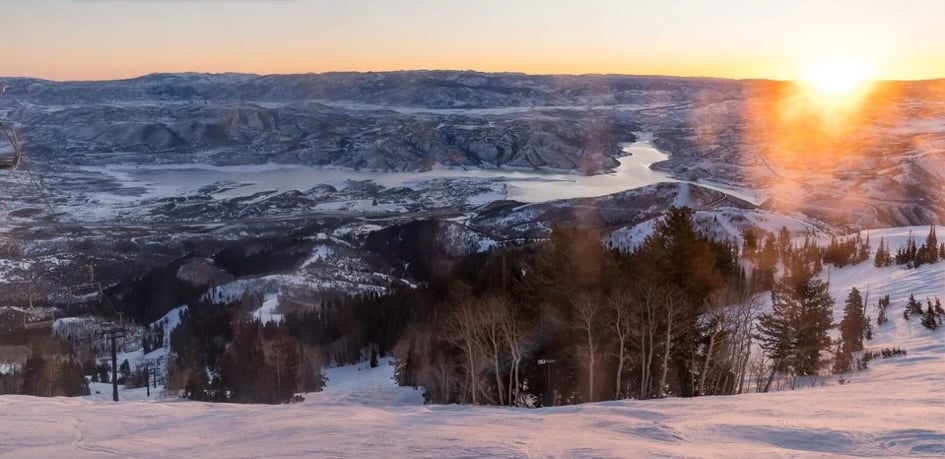
Set along the eastern face of Deer Valley Resort, Deer Crest is one of Park City's most exclusive gated mountain communities—a rare environment where private ski trails, immense custom residences, resort-branded ownership, protected open space and extraordinary views over Jordanelle Reservoir and the Uinta Mountains coexist only minutes from Historic Park City.
Deer Crest's published design guidelines describe a community of approximately 600 acres, with more than 65 percent of the land intended as permanent open space. The original plan incorporated estate homesites, multifamily residences, hotel and commercial uses while deliberately preserving substantial portions of the surrounding mountain landscape.
But acreage alone does not explain Deer Crest.
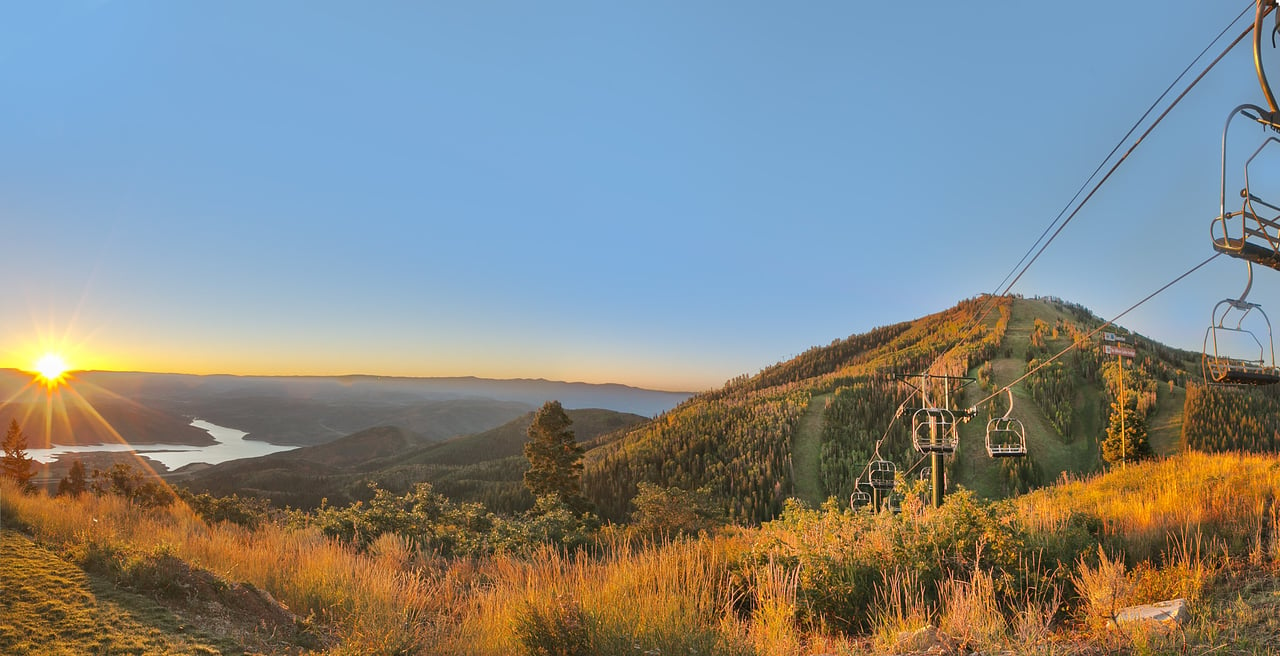
Its defining advantage is the way the community is physically integrated into Deer Valley Resort's ski terrain.
The Deer Crest Master Association currently describes numerous private ski runs within the community and two lifts operated by Deer Valley Resort. The community specifically identifies the Jordanelle Gondola and Mountaineer as important access points connecting Deer Crest with Deer Valley's larger mountain system and Snow Park.
This creates a version of ski-in/ski-out ownership fundamentally different from living at a conventional resort base.
In Deer Crest, the mountain does not merely sit beyond the neighborhood.
The ski terrain moves through it.
Many luxury ski neighborhoods are adjacent to a resort.
Deer Crest is more integrated than that.
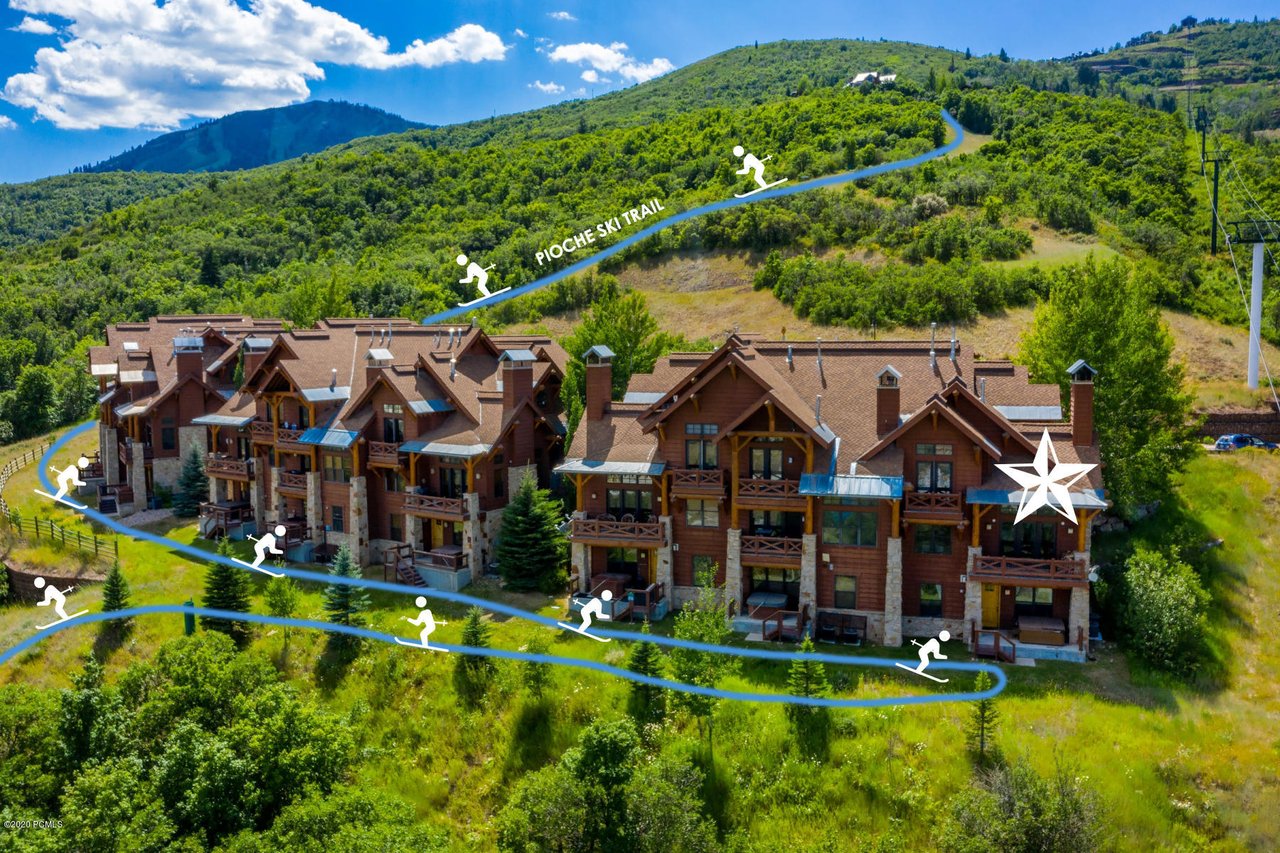
Private residential roads weave through Deer Valley terrain. Ski trails cross the mountain between residences. Lift infrastructure sits within the community. The St. Regis Deer Valley rises from the hillside. Properties occupy both intimate wooded settings and dramatic ridgelines overlooking Jordanelle Reservoir.
The result is an unusual blend of two environments:
private residential estate community and functioning ski mountain.
The Deer Crest Master Association maintains not only roads and common areas but also hiking, biking and ski trails, snowmaking and grooming operations on Deer Crest ski trails and ski patrol services for those community trails.
That operational structure helps explain why Deer Crest feels materially different from simply owning a large house near Deer Valley.
The community itself participates in the mountain experience.
One of Deer Crest's most important design principles was restraint.
The community's design guidelines describe approximately 600 acres, with more than 65 percent preserved as permanent open space. They also reference approximately 50 skiable acres of community trails integrated with Deer Valley's system and roughly five miles of bike trails within the original community plan.
That preserved terrain matters enormously.
It creates visual separation between homes.
It maintains natural slopes.
It protects parts of the aspen and evergreen landscape.
It allows ski and recreation corridors to pass through undeveloped mountain terrain.
And it prevents Deer Crest from reading as a conventional subdivision draped across a ski hill.
Luxury residences may be enormous.
But the mountain still feels larger.
That is precisely how it should be.
Deer Crest occupies a particularly unusual orientation within the larger Deer Valley landscape.
Much of traditional Deer Valley looks toward Park City, the Wasatch Mountains and surrounding resort terrain.
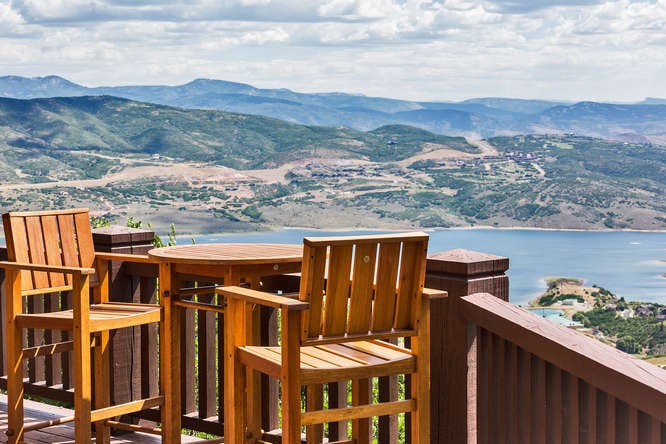
Deer Crest opens dramatically toward the east and southeast, placing Jordanelle Reservoir, the Heber Valley side of the Wasatch Back and the distant Uinta Mountains into the visual field.
The Deer Crest Master Association specifically identifies views toward the Wasatch Range, Jordanelle Reservoir and the Uintas as defining elements of the community.
That gives Deer Crest a very different emotional character from Empire Pass or Upper Deer Valley.
The view can feel enormous.
Instead of facing another developed mountain, selected properties look out across water, valley and multiple mountain ranges.
The horizon recedes.
Few Park City luxury neighborhoods have a relationship with water as dramatic as Deer Crest.
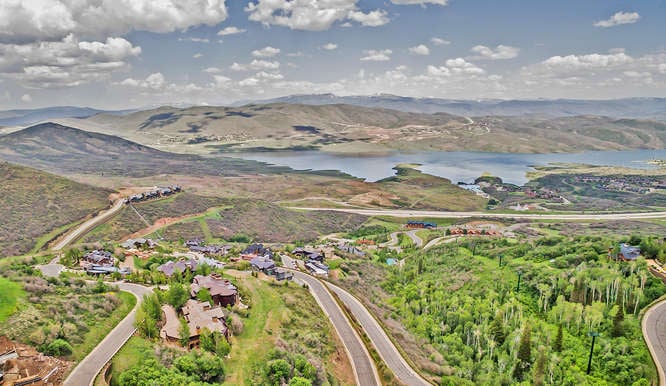
Jordanelle Reservoir lies below the eastern slopes of the community and becomes a major visual feature from many properties.
In summer, the reservoir turns deep blue beneath the surrounding mountain landscape.
In autumn, gold and rust move through the hills between the homes and the shoreline.
Winter transforms the entire basin into a stark composition of snow, water, mountains and sky.
And because Deer Crest is elevated substantially above the reservoir, selected homes experience Jordanelle less as a nearby body of water than as part of a panoramic landscape.
The community itself promotes Jordanelle water recreation as part of its summer lifestyle and highlights nearby boating opportunities alongside mountain recreation.
That gives Deer Crest something most ski-in/ski-out neighborhoods simply do not have:
ski mountain above, water below.
Beyond Jordanelle rise the Uinta Mountains, creating another layer in Deer Crest's celebrated eastern panorama.
This orientation can be especially dramatic in the morning.
Eastern light reaches the distant mountains first before moving across the reservoir and climbing toward Deer Crest.
At sunset, the experience reverses: the Wasatch terrain behind the homes darkens while the enormous eastern landscape remains visible below.
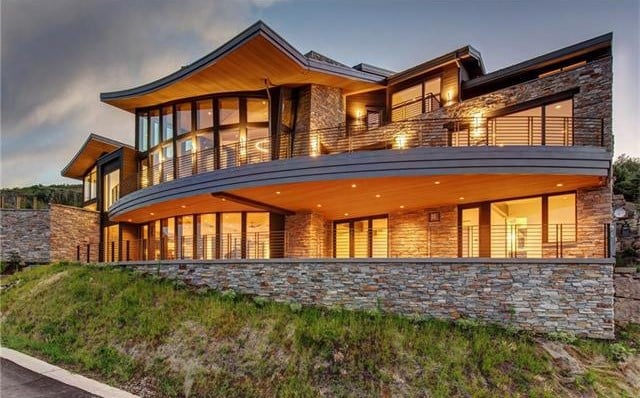
Architecture in Deer Crest frequently responds directly to these sightlines with monumental glazing, terraces and primary living spaces oriented toward water and distant mountains.
The view is not decorative.
For the best homes, the view is the organizing principle of the architecture.
Deer Crest has another unusual strategic advantage: controlled access from both sides of the mountain.
The Queen Esther Gate House provides the western entrance from the Deer Valley and Park City side of the community.
The Jordanelle Gate House provides the eastern entrance from the Highway 40 side near Jordanelle Reservoir.
That dual-access configuration materially changes how Deer Crest functions.
Head west and the community connects toward Deer Valley and downtown Park City.
Head east and residents can reach Highway 40 and the Jordanelle side of the Wasatch Back without first descending through central Park City.
The Master Association does not allow the roads to function as a general public vehicular throughway, preserving their private residential character.
This is more than a security feature.
It is a geographical advantage.
Privacy often has a price: distance.
Deer Crest largely avoids that compromise.
The Deer Crest Master Association currently describes its Queen Esther access as placing homeowners less than ten minutes from downtown Park City.
That is remarkable when one considers the residential environment on the other side of the gate.
A Deer Crest property can feel profoundly removed—mountain terrain, private roads, large homesites, ski trails and enormous views—while Historic Main Street remains nearby.
Dinner.
Galleries.
Shopping.
Events.
Nightlife.
All of it can be part of the same evening.
The community offers seclusion without exile.
Skiing is not merely an amenity in Deer Crest.
It is the community's central organizing idea.
The Deer Crest Master Association states that the property contains multiple private ski runs and two Deer Valley-operated lifts. Its home page further identifies the Jordanelle Gondola and Mountaineer as providing access between community terrain, Deer Valley and Snow Park.
That matters because “ski-in/ski-out” can mean wildly different things in mountain real estate.
At one property, it may mean walking through a lobby and crossing a plaza.
At another, it may require a short path.
At the finest Deer Crest estates, the relationship can be dramatically more immediate—private ski trails may run beside or below the homes themselves.
Property-specific access still matters tremendously.
Slope orientation, trail connection, grade, snowmaking and exact route should always be evaluated for the individual residence.
But at the neighborhood level, Deer Crest was deliberately conceived around skiing.
The Mountaineer side of Deer Valley illustrates one of Deer Crest's greatest advantages.
Unlike Snow Park, it is not organized around major public parking.
Founders Place, which sits at the base of Mountaineer Express within Deer Crest, specifically emphasizes that absence of large public parking as part of the lift's quieter morning experience.
That is the deeper point.
Deer Crest does not simply give owners access to Deer Valley.
It can give them a different way of entering Deer Valley.
Rather than beginning every ski day in the principal public arrival sequence, owners can move into the resort from within the residential mountain itself.
For a serious skier, that distinction is substantial.
Deer Crest is integrated into Deer Valley Resort, one of Park City's defining luxury ski destinations.
Deer Valley remains a ski-only resort, and its current operating model continues to limit daily skier numbers and encourage advance ticket purchasing during high-demand periods.
For Deer Crest owners, the significance goes beyond resort reputation.
The community's private ski corridors ultimately feed into Deer Valley's larger lift and trail system.
Home therefore becomes the beginning and end of the ski day rather than simply a place near the ski day.
That is the essence of true ski-oriented real estate.
One of Deer Crest's defining landmarks is The St. Regis Deer Valley, located directly within the community.
The Deer Crest Master Association identifies The St. Regis as part of the community, while Marriott describes the property as a ski-in/ski-out mountainside resort with direct slope access, dining, spa, swimming and year-round recreational amenities.
Its presence gives Deer Crest an unusual layer of resort infrastructure.
Fine dining.
Spa services.
Après-ski.
Hotel accommodations for guests.
Social spaces.
Private events.
Luxury hospitality.
These exist within the same larger mountain environment as privately owned estates and residences.
For homeowners who value resort-level services but do not necessarily want to live within a hotel residence, The St. Regis can function almost as a sophisticated neighborhood anchor.
One of Deer Valley's most distinctive pieces of transportation infrastructure is the St. Regis funicular.
The funicular connects the lower Snow Park side of the property with the upper mountainside resort, traversing the steep terrain that separates the two. Marriott continues to feature the funicular as an integral part of the St. Regis Deer Valley experience.
It gives Deer Crest yet another unusual relationship with elevation.
Guests and residents can move between the lower Deer Valley environment and the St. Regis mountainside setting without approaching the property like a conventional hotel.
The ascent itself becomes part of the arrival.
The Deer Crest Club adds a private social and sporting dimension to the community.
Marriott currently describes the club as providing members with a private slopeside lounge, direct ski-in/ski-out access, ski or wine lockers, seasonal food service, family programming and preferred pricing on certain St. Regis services.
Importantly, Deer Crest ownership should not be represented as automatically conveying club membership.
The Deer Crest Master Association currently states that owners receive priority status on the Deer Crest Club membership waiting list, while the club itself offers a limited number of memberships.
That distinction is important in luxury real-estate marketing.
The club is a significant nearby amenity.
It is not an automatic appurtenance to every Deer Crest residence.
The St. Regis adds a polished hospitality component to Deer Crest's otherwise private residential experience.
Current on-property dining includes venues such as RIME, Brasserie 7452 and The St. Regis Bar, along with additional dining concepts and private wine experiences. Marriott also operates The St. Regis Spa and outdoor pool facilities at the resort.
The value to Deer Crest is not that every homeowner will use those facilities every day.
It is that they are there when desired.
An estate owner can live in a profoundly private residence and still have sophisticated dining and resort hospitality within the broader community.
That is an unusual balance.
Founders Place represents one of Deer Crest's most important recent additions.
Located along Deer Hollow Road at the base of Mountaineer Express, Founders Place is a multi-building luxury condominium community integrated directly into the Deer Crest ski landscape. Park City approval documents locate it inside Deer Crest between Deer Valley Resort and Highway 40, accessed through either the Queen Esther or Jordanelle gates.
The development places contemporary attached luxury ownership in an environment historically dominated by large custom estates and limited multifamily projects.
Its location is particularly compelling.
Founders Place sits steps from Mountaineer Express, and its own current development materials emphasize year-round use, immediate ski access and connections to hiking, mountain biking and other warm-weather recreation.
This gives buyers another path into Deer Crest.
Not everyone needs a 10,000-square-foot estate.
Some want a sophisticated lock-and-leave residence at the mountain.
Founders Place answers that buyer.
At the other end of the spectrum are the custom residences and estate homesites that define Deer Crest Estates.
These properties embody the community's most dramatic expression of private mountain living.
Large homes.
Substantial garages.
Expansive terraces.
Spa environments.
Ski rooms.
Guest suites.
Wine rooms.
Fitness areas.
Indoor-outdoor entertainment.
And, in selected properties, extraordinary direct relationships with the ski trails themselves.
Deer Crest's design guidelines were created to allow substantial architectural expression while maintaining harmony among individual properties, the larger community and the natural mountain terrain. Site planning, grading, landscaping, lighting and architecture are subject to design review.
That review process is important.
The homes may be individual.
The mountain is the common architectural context.
Deer Crest contains some of the most ambitious residential architecture in the Park City market.
Traditional residences often express a sophisticated alpine vocabulary:
Newer architecture increasingly pushes toward a refined mountain-contemporary aesthetic:
The best Deer Crest architecture avoids becoming a trophy placed on a mountainside.
Instead, it uses the slope, view and ski access as part of the building itself.
In a community where a single poorly considered structure could dramatically affect the surrounding landscape, design control matters.
The Deer Crest design guidelines establish review requirements for architecture, siting, grading, landscaping, lighting, driveways and other visible improvements. Their stated intent is to preserve aesthetic quality while permitting creative architectural expression and maintaining harmony with the natural landscape.
For buyers contemplating renovation or redevelopment, this is crucial due diligence.
Owning an extraordinary site does not mean unrestricted construction.
Building envelopes.
Height.
Grading.
Landscape treatment.
Lighting.
Material choices.
And other design requirements may materially affect what can be built.
In Deer Crest, the land is valuable enough that the community takes seriously how architecture occupies it.
Deer Crest's Master Association is responsible for an unusually extensive range of infrastructure.
Current HOA responsibilities include road inspection and maintenance, snow-removal oversight, retaining walls, bridges and tunnels, gate operations, common landscaping, construction coordination and mountain-trail maintenance.
That matters because Deer Crest is not conventional suburban terrain.
Steep mountain roads.
Heavy snow.
Retaining structures.
Bridges.
Private ski corridors.
Complex grading.
These are real components of owning and maintaining a community at this elevation.
The HOA's role extends far beyond mowing an entrance median.
It helps operate a mountain.
Privacy is one of Deer Crest's defining characteristics.
Controlled vehicular access occurs through the Queen Esther and Jordanelle gatehouses, and the Master Association states that public road traffic is not permitted to use Deer Crest as a through-route between Park City and the Jordanelle side.
The distinction is important.
Deer Crest is not simply a neighborhood with decorative gates.
The road system is genuinely private in character.
That allows the community to occupy an extraordinarily strategic location without functioning as a public shortcut across the mountain.
For luxury homeowners, privacy here comes from controlled access, topography and land, rather than from being inconveniently far away.
Winter may have shaped Deer Crest's master plan, but summer reveals how complete the community actually is.
The Master Association maintains hiking and mountain-biking trails that connect with Deer Valley's larger trail system. Its current lifestyle materials specifically identify both hiking and biking as core warm-weather activities.
Aspens fill in around the homes.
The ski terrain turns green.
Jordanelle becomes an active recreation landscape below.
Terraces reopen.
Mountain bikes replace skis.
And the same private terrain that directs winter movement toward the lifts becomes part of an expansive summer trail environment.
A four-season Deer Crest home therefore does not lose its reason for existing when the snow disappears.
The relationship with the mountain simply changes.
Deer Crest's own trails connect into Deer Valley's much larger summer network.
The Master Association currently promotes community trail routes and identifies direct connections toward Deer Valley hiking and biking.
For serious riders and hikers, this is enormously valuable.
The trailhead is not necessarily somewhere across town.
It may be within the community.
This creates a summer counterpart to Deer Crest's winter ski access:
leave the residence and enter the mountain directly.
Jordanelle Reservoir adds another dimension to summer life.
The Deer Crest Master Association specifically highlights boating and reservoir recreation as part of the community's warm-weather lifestyle.
That gives Deer Crest residents access to two completely different recreational environments within the same day.
Morning on the mountain.
Afternoon on the water.
Dinner in Park City.
Home before sunset.
That combination helps explain why Deer Crest can function as much more than a winter retreat.
The eastern gate also places Deer Crest in a useful relationship with the broader Heber Valley and Jordanelle corridor.
The Master Association promotes nearby Middle Provo River fishing alongside reservoir recreation.
This is another consequence of Deer Crest's dual-sided geography.
Park City lies one direction.
Heber Valley recreation lies the other.
Residents do not need to treat the Wasatch Back as two disconnected worlds.
Deer Crest sits at the hinge between them.
Autumn may be Deer Crest's most visually extravagant season.
The aspen stands surrounding the homes move from green to brilliant gold.
Jordanelle remains blue below.
The Uinta Mountains sharpen in the distance.
Early snow begins appearing on higher Deer Valley terrain.
And the architecture—stone, glass, wood and steel—takes on an entirely different relationship with the landscape.
Because so much of Deer Crest remains open land, autumn does not occur in isolated patches of landscaping.
Entire mountainsides change color.
Then everything simplifies.
White mountain.
Dark evergreens.
Aspens stripped to pale trunks.
Blue reservoir.
Enormous sky.
The private ski trails become active.
Snowmaking and grooming return.
Deer Valley's lifts move across the mountain.
Ski rooms become the functional entrances to homes.
Driveways become engineered winter infrastructure.
And the reason Deer Crest was created becomes immediately apparent.
This is a community designed around the idea that skiing should begin at home.
Spring exposes the complexity of mountain ownership.
Snow retreats differently according to aspect and elevation.
Drainage begins moving.
Trails close and reopen according to conditions.
Landscaping awakens unevenly.
Wildlife movement changes.
The reservoir below shifts with seasonal water conditions.
For homeowners, it is also a season when grading, drainage, exterior maintenance and landscape conditions become particularly visible.
At Deer Crest scale, land stewardship is part of luxury ownership.
Deer Crest and Empire Pass both represent the highest end of Deer Valley real estate, but they express luxury differently.
Empire Pass occupies the western and upper Deer Valley side of the mountain, emphasizing slopeside lodges, condominium communities, private-club culture and proximity to the Empire and Flagstaff terrain.
Deer Crest occupies the eastern side and is more strongly associated with large private estates, controlled gates, private ski trails and panoramic views across Jordanelle Reservoir and the Uintas.
Empire Pass feels deeply embedded in Deer Valley's alpine interior.
Deer Crest feels perched on Deer Valley's edge overlooking the entire Wasatch Back.
The difference is not merely price.
It is perspective.
Upper Deer Valley is one of Park City's most established resort neighborhoods, surrounding Silver Lake Village and long-standing condominium and single-family communities.
Its great strength is traditional Deer Valley convenience and the established village environment.
Deer Crest is more private.
More controlled.
More estate-oriented.
And considerably more dramatic in its eastern views.
Upper Deer Valley offers village access.
Deer Crest offers private mountain access.
Lower Deer Valley provides proximity to Snow Park and relatively quick access to Historic Main Street.
It is easier to enter and more integrated with conventional Park City streets.
Deer Crest adds another layer of separation through its gates, private roads and mountain terrain.
Lower Deer Valley is connected directly to town.
Deer Crest is connected to town through privacy.
That distinction sounds subtle.
In practice, it defines the ownership experience.
The comparison with Deer Valley East Village is especially interesting because both occupy the Jordanelle side of Deer Valley.
But they belong to different generations of resort development.
East Village represents Deer Valley's major expansion and a new concentration of hotels, residences, ski infrastructure and contemporary communities.
Deer Crest is established, gated and comparatively limited in scale.
East Village is becoming a major new resort gateway.
Deer Crest is a private residential mountain embedded within the established Deer Valley system.
A buyer deciding between them is often deciding between new-development energy and mature exclusivity.
Tuhaye lies across the Jordanelle landscape and can appear surprisingly close from Deer Crest homes.
But the ownership proposition is completely different.
Tuhaye emphasizes acreage, golf and private-club living within the Talisker Club environment.
Deer Crest emphasizes skiing, gates, Deer Valley integration and proximity to Park City.
Tuhaye looks toward Deer Valley.
Deer Crest lives on Deer Valley.
For buyers who prioritize golf and club amenities, Tuhaye has compelling advantages.
For someone whose lifestyle begins with skiing out the door, Deer Crest occupies another category.
Promontory is one of Park City's largest private-club communities, with extensive golf and family amenity infrastructure spread across an enormous landscape.
Deer Crest is substantially more concentrated and more directly connected to skiing.
Promontory offers a programmed club lifestyle.
Deer Crest offers a private ski-mountain lifestyle.
Both are exclusive.
They simply organize exclusivity around different passions.
Deer Crest tends to appeal to buyers with unusually specific priorities.
They want privacy but do not want distance.
They want a significant residence but also want the land around it protected.
They want skiing to begin at home.
They may want resort dining and spa access nearby without living in a conventional hotel environment.
They value enormous eastern views.
They want controlled entrances.
They appreciate architecture at a serious scale.
And they are often looking for a property that feels unmistakably rare even within an already rarefied market.
That buyer is not simply purchasing a Park City house.
They are purchasing a position on Deer Valley itself.
For a primary resident, Deer Crest offers a highly unusual combination.
Private mountain environment.
Fast Park City access.
Winter recreation.
Summer trails.
Jordanelle.
Heber Valley access.
Luxury hospitality nearby.
And substantial homes designed to accommodate work, family, guests and recreation at scale.
The logistical considerations are real—mountain roads, snow, HOA requirements and sophisticated property systems require management.
But for buyers comfortable with that level of ownership, Deer Crest can function beautifully throughout the year.
Deer Crest may be even more intuitive as a second-home market.
Arrive.
Enter through the gate.
Park in a heated garage.
Put skis in the ski room.
Wake up.
Ski from the neighborhood.
Return home.
Meet friends at The St. Regis.
Spend another night on Main Street.
During summer, replace skis with mountain bikes and Jordanelle.
The home becomes not simply accommodation but the center of the entire Park City experience.
Deer Crest is sophisticated real estate, and purchases should be evaluated accordingly.
The Master Association maintains CC&Rs, rules, architectural review standards and community operating requirements.
Individual properties may also lie within specific condominium or sub-association structures.
A buyer should review, among other things:
In Deer Crest, assumptions are expensive.
Due diligence should be as sophisticated as the property.
Deer Crest contains multiple property types, including private homes, condominium communities, St. Regis residences and newer attached developments such as Founders Place.
Rental rights and restrictions therefore should never be generalized across the entire community.
The Deer Crest Master Association maintains rental-related documents, while individual projects may have separate HOA and operating requirements.
Any buyer evaluating a residence for short-term or long-term rental should verify current entitlements, governing documents, licensing requirements and management restrictions for that exact property.
This is especially important at this level of the market, where two nearby residences can have materially different operating models.
There are many expensive houses in Park City.
Deer Crest's real luxury is more elusive.
Access.
Access through controlled gates.
Access to private ski trails.
Access directly into Deer Valley.
Access east toward Jordanelle.
Access west toward Park City.
Access to trails.
Access to resort hospitality.
Access to enormous open views.
And, perhaps most importantly, access without surrendering privacy.
That is what separates Deer Crest from simply buying a beautiful house in the mountains.
The second great asset is impossible to manufacture.
The eastern view.
Jordanelle below.
The Uintas beyond.
The Wasatch around you.
Few Park City neighborhoods have a water-and-mountain panorama of this scale while simultaneously offering direct Deer Valley ski access.
A spectacular kitchen can be renovated.
A ski room can be enlarged.
Technology can be replaced.
Architecture can even be reinvented.
The horizon cannot.
Deer Crest occupies the eastern edge of Deer Valley, and that edge is precisely where its magic lies.
Behind you:
one of America's great ski resorts.
Below you:
Jordanelle Reservoir.
Beyond it:
the vast Wasatch Back and Uinta Mountains.
Through one gate:
Park City.
Through the other:
Highway 40 and the Heber Valley side.
Few communities allow an owner to stand quite so literally between resort and wilderness, town and water, privacy and access.
That is Deer Crest's real geography.
And geography is the one luxury feature no remodel can add later.
For buyers searching for Deer Crest homes for sale, Deer Valley ski-in/ski-out real estate, Deer Crest Estates, St. Regis Deer Valley residences, Founders Place, luxury homes overlooking Jordanelle Reservoir or private gated ski homes in Park City, Deer Crest belongs among the most important communities in the Deer Valley market.
Its master plan encompasses approximately 600 acres, with the published design guidelines allocating more than 65 percent to permanent open space.
The community maintains private ski trails and currently has two Deer Valley-operated lifts on the property.
Its own trails connect into Deer Valley's hiking and mountain-biking network.
The Queen Esther entrance places owners less than ten minutes from downtown Park City.
The eastern entrance connects toward Highway 40 and Jordanelle Reservoir.
The St. Regis Deer Valley brings ski-in/ski-out hospitality, dining, spa and private-club opportunities into the community itself.
And beneath all of that is something much harder to quantify:
a rare position on the mountain where the private world of a Deer Valley estate opens outward toward one of the largest landscapes in the Park City market.
Deer Crest is not simply a place to own at Deer Valley.
It is a private way of living on Deer Valley itself.
47 people live in Deer Crest in Park City, Utah, where the median age is 48 and the average individual income is $103,619. Data provided by the U.S. Census Bureau.
Total Population
Median Age
Population Density Population Density This is the number of people per square mile in a neighborhood.
Average individual Income
There's plenty to do around Deer Crest in Park City, Utah, including shopping, dining, nightlife, parks, and more. Data provided by Walk Score and Yelp.
Explore popular things to do in the area, including RIME Raw Bar, Brasserie 7452, and RIME Raw Bar.
| Name | Category | Distance | Reviews |
Ratings by
Yelp
|
|---|---|---|---|---|
| Dining | 0.55 miles | 13 reviews | 3.1/5 stars | |
| Dining | 0.64 miles | 6 reviews | 4.7/5 stars | |
|
|
||||
|
|
||||
|
|
||||
|
|
||||
|
|
||||
|
|
Deer Crest in Park City, Utah has 30 households, with an average household size of 3. Data provided by the U.S. Census Bureau. Here’s what the people living in Deer Crest in Park City, Utah do for work — and how long it takes them to get there. Data provided by the U.S. Census Bureau.
Total Population
Population Density Population Density This is the number of people per square mile in a neighborhood.
Median Age
Men vs Women
Population by Age Group
0-9 Years
10-17 Years
18-24 Years
25-64 Years
65-74 Years
75+ Years
Education Level
Total Households
Average Household Size
Average individual Income
Households with Children
With Children:
Without Children:
Marital Status
Blue vs White Collar Workers
Blue Collar:
White Collar: