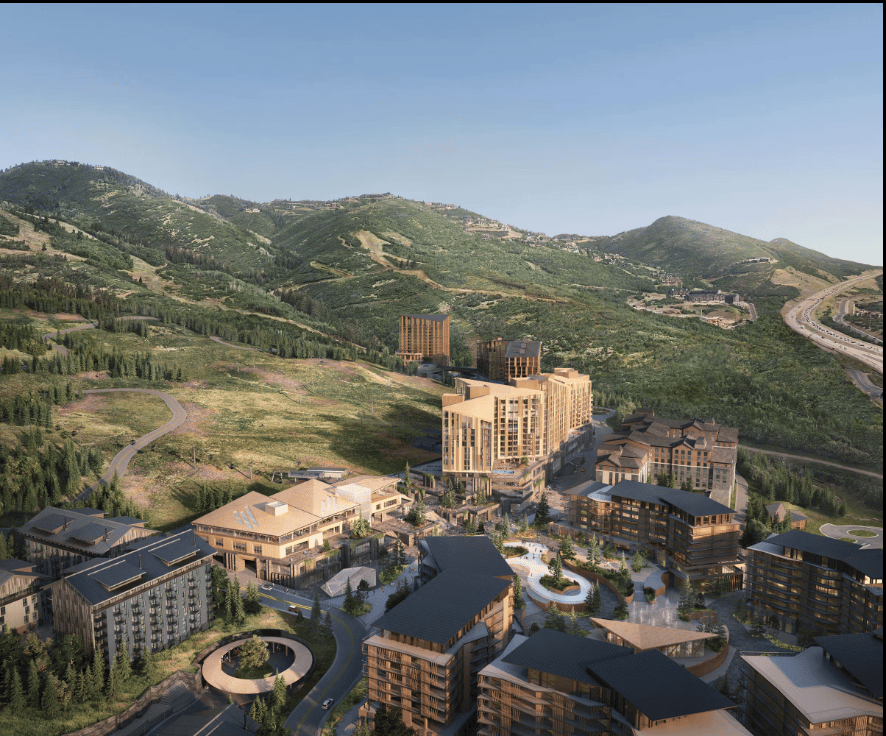
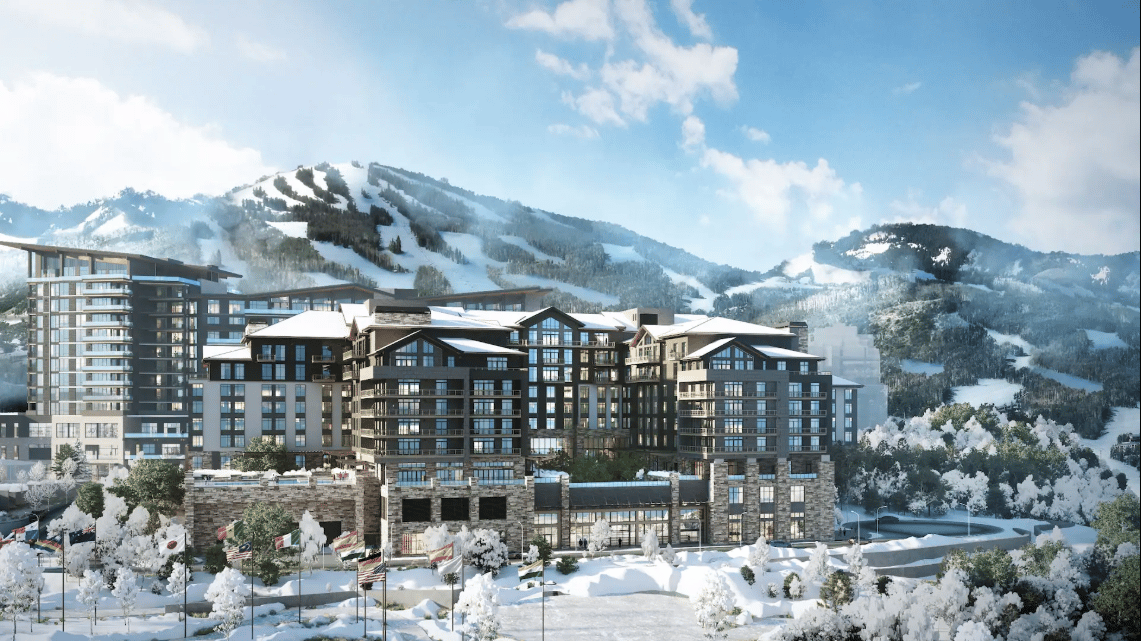
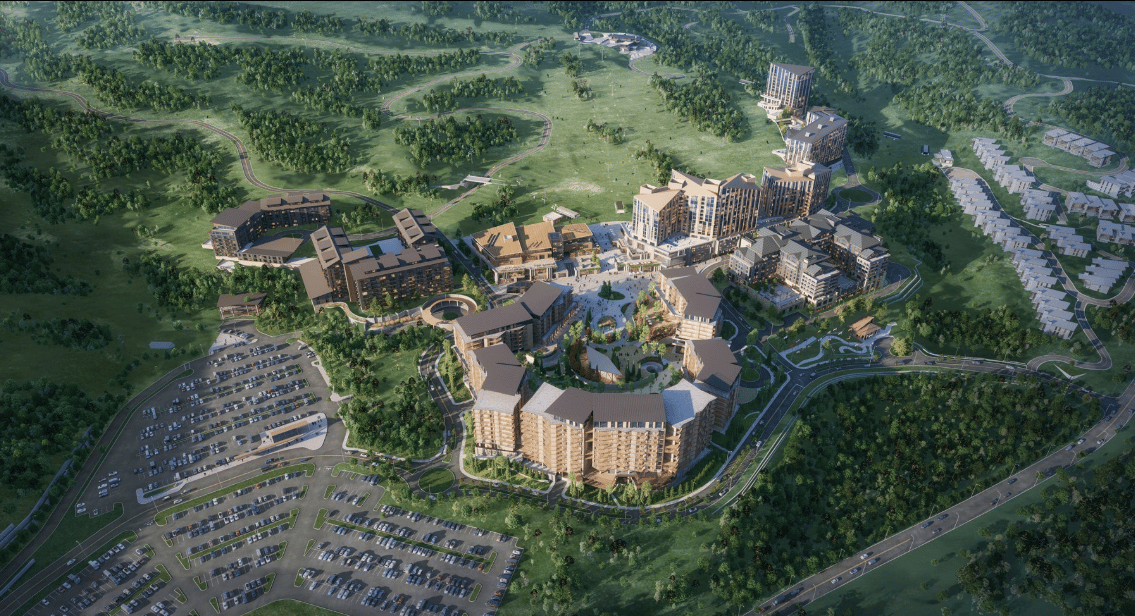
Rising above Jordanelle Reservoir on the eastern side of Deer Valley Resort, Deer Valley East Village represents one of the most consequential transformations in the modern history of Park City and the Wasatch Back.
This is not simply another residential development added beside an existing ski resort.
It is the creation of an entirely new Deer Valley gateway, alpine village and mountain district, integrated directly into thousands of acres of newly developed Deer Valley terrain and designed from the outset around skiing, luxury hospitality, branded residences, private residential communities, restaurants, retail, wellness, recreation and four-season mountain living.
What was previously associated with the Mayflower Mountain Resort project has become an integral part of Deer Valley Resort through the resort's multi-year Expanded Excellence initiative. The expansion stretches across South Peak, Park Peak, Big Dutch, Pioche and Hail Mountain, east of Deer Valley's historic Bald Mountain terrain.
The physical scale is extraordinary.
For the 2026/27 winter season, Deer Valley expects to offer approximately 4,500 skiable acres, 209 runs and 32 aerial lifts, following the addition of 11 new lifts since December 2024. Deer Valley's longer-term Expanded Excellence master plan envisions approximately 5,726 skiable acres, 238 runs and 37 chairlifts when the full expansion is completed.
Yet the significance of East Village extends well beyond skiing.
At full buildout, Deer Valley projects that the village will contain nearly 1,700 residential units, approximately 800 hotel rooms, 250,000 square feet of retail and commercial space and 68,000 square feet dedicated to recreation, along with restaurants, ski school and children's programs, an ice-skating component and what Deer Valley describes as the largest ski beach in North America.
The result will be something Park City has not previously had:
a newly created, fully integrated luxury alpine village built at the scale of a major resort expansion rather than inserted into an already established neighborhood.
Understanding East Village requires understanding what the land was intended to become before Deer Valley incorporated it into its future.
For years, the eastern mountain terrain was associated with the proposed Mayflower Mountain Resort. Deer Valley's current expansion materials expressly identify the new terrain as the area formerly known by that project name.
In August 2023, Deer Valley announced its Expanded Excellence initiative, integrating approximately 3,700 acres of planned additional terrain with the existing resort and establishing a new eastern resort portal along U.S. Route 40. In January 2024, Deer Valley and Extell Development formally unveiled the village name:
Deer Valley East Village.
That change was more than branding.
It made clear that the eastern terrain would not function as an unrelated neighboring ski area.
It would become Deer Valley.
The same skier-only operating philosophy.
The same emphasis on grooming.
The same mountain operations.
The same ski school.
The same service expectations.
But on an entirely different physical scale.
Historically, most visitors approaching Deer Valley moved through Park City itself toward Snow Park, continuing farther up the mountain toward Silver Lake, Empire Pass and other established Deer Valley neighborhoods.
East Village changes that geography.
The new village is accessed directly from U.S. Route 40, allowing skiers and residents to enter Deer Valley from the Jordanelle side of the mountain without first traveling through central Park City. Deer Valley currently provides approximately 1,200 complimentary day-skier parking spaces at the East Village portal.
Deer Valley states that the East Village route from Salt Lake City International Airport is approximately 40 minutes and currently involves no traffic signals along the route.
That access is strategically significant.
East Village does not replace Snow Park.
It gives Deer Valley a second major front door.
For owners who frequently travel between Park City and Salt Lake City, East Village's relationship with U.S. 40 and Interstate 80 creates a fundamentally different arrival experience from traditional Deer Valley ownership.
Traditional Deer Valley is geographically oriented primarily toward Park City.
East Village turns the resort toward Jordanelle Reservoir, the Heber Valley side of the Wasatch Back and the eastern mountain landscape.
This changes the visual experience dramatically.
Many residences and hotel rooms within the new village are positioned to capture views toward:
Grand Hyatt specifically markets rooms and residences with Jordanelle Reservoir views, while Four Seasons' planned residences emphasize expansive mountain outlooks from the village core.
The landscape therefore becomes part of East Village's identity.
Traditional Deer Valley often feels enclosed within the alpine environment.
East Village frequently feels more panoramic.
Mountain in one direction.
Water and distant peaks in another.
The village itself has been conceived as more than a collection of hotel buildings around a lift terminal.
Deer Valley's plans call for restaurants, retail, recreation, ski services, residential buildings, hotels, plazas and gathering spaces integrated into a walkable resort environment. At full buildout, the projected program includes nearly 1,700 residences, 800 hotel rooms, 250,000 square feet of commercial and retail uses and 68,000 square feet of recreation.
The architectural master planning is being shaped substantially by ODA, which is designing signature buildings, interiors, landscape, the skier-services structure and important portions of the public realm.
The design intentionally reinterprets rather than copies traditional alpine architecture.
ODA describes buildings rising from stone podiums, with wood-and-glass façades broken into smaller visual components to suggest a collection of individual village structures rather than monumental blocks. Terraces, varied roof forms and contemporary butterfly roofs are used to respond to the mountain setting and capture views.
It is essentially a contemporary reimagining of the alpine village, rather than a nostalgic imitation of one.
One of East Village's most distinctive planned public spaces is its enormous ski beach.
ODA's master plan places this elevated plaza at the interface between the mountain and village, connecting the lifts, skier services and surrounding buildings. Landscape design becomes progressively more refined as one moves away from the mountain toward the architecture, while transitions between upper and lower plazas are designed to echo the natural slope of the terrain.
Deer Valley describes the completed East Village ski beach as planned to be the largest in North America.
That space is intended to become the village's winter living room.
Skiers arriving.
Families gathering.
Après-ski.
Restaurants spilling toward the plaza.
Residents moving between homes and lifts.
Children heading to ski school.
The mountain and village physically meeting in one place.
That relationship will give East Village a very different energy from Deer Valley's more traditional lodge-centered base areas.
The public realm is also being designed around multiple levels rather than one enormous flat base plaza.
ODA's master plan uses an upper ski-beach level, a middle plaza and a lower plaza associated with the planned ice-skating experience. The middle level is intended to maintain a visual and pedestrian connection between the ski mountain and lower village rather than creating isolated zones.
This layered organization matters.
East Village is steep terrain.
Rather than fighting that topography, the master plan attempts to turn elevation change into part of the village experience.
Mountain above.
Retail and gathering spaces between.
Village activity below.
The landscape becomes circulation.
The scale of Deer Valley's eastern terrain expansion is difficult to overstate.
During the 2024/25 season, East Village debuted with its first 20 new ski runs and three new lifts, including Keetley Express, Deer Valley's first six-person bubble chair.
For 2025/26, Deer Valley added nearly 80 additional runs and seven additional lifts, including the East Village Express, a 10-passenger gondola connecting East Village with Park Peak.
For 2026/27, Hail Peak Express adds another 200 skiable acres and seven runs, bringing the resort to approximately 4,500 skiable acres.
The long-term plan remains larger still.
Deer Valley's original Expanded Excellence blueprint calls for approximately 5,726 skiable acres, 238 runs and 37 lifts once the full mountain vision is completed.
East Village therefore should not be understood as a small resort annex.
It is anchoring the largest geographic expansion in Deer Valley's history.
The East Village Express is central to the new village's identity.
The 10-passenger gondola opened during the 2025/26 season and connects East Village directly toward Park Peak, dramatically improving vertical connectivity from the new village into Deer Valley's expanded mountain.
This is more consequential than adding another lift.
A major gondola creates a genuine village portal.
It gives the base a visual landmark.
It creates efficient movement for families.
It anchors surrounding real estate.
And it provides the infrastructure around which restaurants, residences and skier services can organize.
East Village is therefore no longer simply a peripheral point from which one accesses a chairlift.
It is becoming one of Deer Valley's principal mountain arrival experiences.
Keetley Express was one of the first major visible symbols of Deer Valley's expansion.
The heated six-passenger bubble chair began serving the new East Village terrain during the 2024/25 season and helped establish the first operational ski connection between the new eastern portal and the expanded mountain.
Its importance is partially practical and partially symbolic.
The lift demonstrated that East Village was no longer merely a real-estate development scheduled for the future.
The mountain had begun operating.
The transformation continues into the upcoming 2026/27 ski season.
Deer Valley plans to open Hail Peak Express, providing access to approximately 200 new skiable acres and seven new runs on the resort's easternmost terrain. The new lift is designed to carry approximately 2,400 skiers per hour and gain roughly 1,130 vertical feet.
The opening brings Deer Valley to:
This is current for the 2026/27 season—not the ultimate buildout.
East Village is still evolving.
Park Peak functions as one of the key high points within the expansion.
The East Village Express gondola connects the village toward Park Peak, while the area is becoming an important on-mountain junction in Deer Valley's expanded system.
Deer Valley is also developing Park Peak Lodge. As of June 2026, Deer Valley expected the core and shell to be completed by fall 2026, with interior dining, restaurant and bar buildout continuing toward a planned 2027/28 opening.
This reinforces an important point about East Village:
the transformation is occurring both at the village and on the mountain.
Massive ski expansion requires equally substantial mountain infrastructure.
Deer Valley's 2026 plans include a new 10-million-gallon reservoir near Park Peak to support expanded snowmaking. The east-side system is being designed to distribute water across the new terrain at extremely high capacity.
For real-estate buyers, snowmaking infrastructure may sound like an operational detail.
It is not.
Reliable early-season coverage, grooming and snowmaking directly affect the usefulness of ski-in/ski-out property.
East Village is being built alongside new mountain infrastructure rather than relying entirely on legacy systems created decades ago.
Expansion at this scale naturally raises an important question:
Does Deer Valley become something fundamentally different?
Operationally, the resort continues to emphasize the principles upon which its reputation was built.
Deer Valley remains skier-only and continues to limit daily lift-ticket sales. The resort's current Expanded Excellence messaging emphasizes maintaining Deer Valley's established standards of service and grooming while increasing terrain and guest access.
That continuity is critical to East Village's value proposition.
Buyers are not purchasing beside an unrelated new ski resort.
They are purchasing into an expansion carrying the Deer Valley name and operating model.
One run provides a particularly good sense of the expansion's scale.
The Green Monster stretches approximately 4.8 miles, providing a remarkably long route through the expanded resort system. Deer Valley identifies it as the resort's longest run.
Long-distance routes like this demonstrate how East Village connects into the larger mountain rather than functioning as a geographically isolated pod of terrain.
A skier can begin high on Deer Valley and descend toward a completely different side of the Wasatch.
That creates an entirely new sense of scale within a resort historically associated with a much more compact geography.
The Grand Hyatt Deer Valley became East Village's first major luxury hospitality anchor when it opened in late 2024.
Deer Valley's original announcement identified the property as containing hotel rooms and suites along with 55 private residences, while Hyatt now operates the hotel as the flagship hospitality property of Deer Valley East Village.
The hotel brings:
Its architecture immediately gave East Village something crucial:
a physical center of gravity.
Before the village was complete, Grand Hyatt made the destination tangible.
The private residences at Grand Hyatt provide one of East Village's most established forms of branded residential ownership.
Hyatt describes the residences as modern mountain homes with features including floor-to-ceiling windows, fully equipped kitchens, fireplaces, spa-inspired bathrooms and private terraces in many residences, along with access to Grand Hyatt amenities and services.
Many residences are oriented toward Jordanelle Reservoir or the surrounding mountains.
This makes Grand Hyatt particularly appealing to buyers seeking:
service-rich, lock-and-leave mountain ownership without the scale and maintenance demands of a detached ski estate.
If Grand Hyatt established East Village's first major luxury-hospitality presence, the planned Four Seasons Resort and Private Residences Deer Valley pushes branded residential luxury considerably farther.
Four Seasons and Extell announced the project with 134 hotel rooms and suites and 123 private residences ranging from one to six bedrooms. Fifty-five residences are planned above the resort, with another 68 in an adjacent owner-exclusive residential building.
Four Seasons currently lists the project among its future openings and markets it around:
The property is designed by ODA Architecture, strengthening the visual relationship between the Four Seasons buildings and the larger East Village master plan.
Four Seasons currently lists the Deer Valley property among its 2028 openings.
East Village is also adding a more lifestyle-oriented hospitality component through Canopy by Hilton at Deer Valley.
Hilton identifies the property as a 180-room hotel within Deer Valley East Village, with planned amenities including a rooftop lounge, ski access, ski storage, fitness facilities, steam room, sauna and golf simulator.
As of August 14, 2026, Hilton is accepting reservations beginning August 16, 2026, placing the hotel on the verge of welcoming its first guests.
Its arrival broadens the village considerably.
East Village is not being designed around one single hospitality tier or brand.
It is becoming a layered resort district.
Another significant future hospitality and residential anchor is the announced Waldorf Astoria Deer Valley Resort and Residences.
Current plans call for 132 hotel accommodations and 105 private residences, with 56 residences located above the hotel and 49 in a separate residential tower. The project is currently targeted for 2028.
Planned amenities include a substantial spa and wellness program, indoor lap pool, fitness facilities, restaurants and bars, golf simulator and ski-valet services.
The project is planned alongside the Green Monster, strengthening its relationship with Deer Valley's expanded ski terrain.
Again, the larger pattern is important:
East Village is becoming a major branded-residential market, not simply a new collection of vacation condominiums.
Marcella Landing occupies another tier of the East Village residential market entirely.
The gated development comprises 50 private luxury residences positioned on a prominent ridge overlooking Deer Valley East Village and designed by internationally recognized architecture firm Olson Kundig.
Initial floor plans are approximately 5,000 square feet, with features including large great rooms, multiple family spaces, private fitness and spa areas, dry saunas, cold plunges, heated driveways and substantial garages.
The community is designed around direct mountain access through The Landing, an Olson Kundig-designed alpine clubhouse with ski valet, equipment storage, lounge spaces, lockers, work areas and summer mountain-bike amenities.
Each Marcella Landing residence includes a Marcella Ski Membership, although golf privileges are structured separately. Marcella currently identifies Landing as the Marcella residential offering in which nightly rentals are permitted.
This is not branded-hotel ownership.
It is a private-club interpretation of East Village luxury.
Velvære introduces yet another interpretation of East Village ownership.
The private, gated ski-in/ski-out community currently plans 115 total residences and two private clubhouses.
Its residential collection includes:
The community is intentionally centered on wellness and human performance.
Velvære's residences incorporate features such as advanced air and water filtration and circadian lighting, while the community's private-club structure includes The Base and The Well, creating a wellness-forward alternative to conventional golf- or ski-club living.
The community also describes its ski access as operating through a dedicated private chairlift integrated into Deer Valley terrain.
Velvære is especially interesting because it demonstrates how diverse East Village real estate is becoming.
Hotel residence.
Townhome.
Custom estate.
Private ski club.
Wellness community.
All within the same broader Deer Valley expansion.
Cormont provides another important component of East Village's residential core.
Current East Village materials identify Cormont as a Reef Capital development consisting of five luxury ski-in/ski-out condominium towers and a plaza.
Its location and format add greater condominium density to the village itself and reinforce the broader plan for an active, mixed-use base rather than an exclusively low-density estate environment.
This is important from a market perspective.
East Village is not being built for one kind of luxury buyer.
Taken together, Deer Valley East Village offers an unusually broad spectrum of luxury ownership.
A buyer may choose:
Branded hotel residences
Grand Hyatt, Four Seasons and future Waldorf Astoria offerings emphasize service, amenities and relatively effortless ownership.
Luxury ski condominiums
Projects such as Cormont provide direct mountain access in a more traditional condominium format.
Architectural townhomes
Marcella Landing combines Olson Kundig architecture with private-club access.
Wellness-focused residences
Velvære offers paired residences, cabins and estate sites wrapped around a private wellness and club experience.
Custom homesites
Selected East Village-area developments allow buyers to create estate-scale residences rather than purchase finished attached homes.
This diversity will make East Village fundamentally different from established Deer Valley neighborhoods that developed around a more limited range of housing types.
This point is crucial for buyers.
The words “Deer Valley East Village” do not define one HOA, one rental policy, one membership structure or one ownership model.
A Four Seasons residence operates very differently from a Velvære estate homesite.
A Grand Hyatt residence differs from Marcella Landing.
Cormont differs from both.
Some properties may include private club memberships.
Others may provide hotel services.
Some may allow nightly rental use.
Others may impose minimum rental periods.
Some may carry multiple association layers.
Some may include ski-valet operations or property-management programs.
Accordingly, buyers should evaluate each East Village property individually for:
At this level of development, the legal and operating structure may matter nearly as much as the residence itself.
East Village's relationship with Jordanelle Reservoir fundamentally separates it from traditional Deer Valley.
Jordanelle lies immediately below the eastern mountain terrain and provides an enormous visual foreground to many East Village and surrounding residential properties.
For summer residents, the reservoir also broadens the recreational environment beyond the mountain itself.
Boating.
Paddleboarding.
Fishing.
Water recreation.
Mountain biking and hiking above.
The combination creates a genuinely four-season recreational geography.
Grand Hyatt actively markets its location around both Deer Valley skiing and access toward Jordanelle's summer activities.
This gives East Village a particularly unusual luxury proposition:
ski slopes above, water below.
East Village is being conceived as a four-season village rather than a winter-only ski base.
The master plan includes recreational space, gathering areas, restaurants and public spaces capable of functioning beyond ski season. Four Seasons, Velvære and Marcella all explicitly frame their East Village projects around year-round mountain use, while ODA's master planning addresses pedestrian spaces and landscape as permanent village infrastructure rather than temporary ski-season facilities.
The larger Deer Valley trail system already supports hiking and lift-served mountain biking elsewhere in the resort during summer.
As East Village matures, its four-season identity will increasingly be defined by the relationship between the village, new mountain terrain and Jordanelle.
East Village's architecture deserves special attention because it represents a significant departure from older Park City resort development.
ODA's master plan deliberately references alpine architecture without reproducing old European chalets literally.
Buildings sit on stone podiums.
Wood and glass dominate upper façades.
Structures are visually divided into smaller masses to avoid the appearance of massive hotel blocks.
Terraces step through the terrain.
Rooflines change height and form.
Public plazas respond to mountain contours rather than imposing a rigid urban grid.
The best description may be:
modern alpine architecture informed by the mountain rather than disguised as history.
That distinction will matter increasingly as East Village establishes its own architectural identity.
The comparison with Deer Crest is particularly important because the two occupy the eastern side of Deer Valley and both overlook Jordanelle.
Yet their characters are almost opposites.
Deer Crest is established, gated and low-density.
Its identity revolves around:
East Village is a new resort village.
Its identity revolves around:
Deer Crest is private mountain retreat.
East Village is new alpine energy.
Empire Pass represents one of established Deer Valley's finest expressions of slopeside luxury.
It is positioned high within the resort and includes properties associated with the Talisker Club, ski-in/ski-out lodges and proximity to Empire Canyon and Flagstaff terrain.
East Village occupies an entirely different physical and developmental environment.
Empire Pass feels embedded in the mature Deer Valley mountain.
East Village feels like the creation of a new mountain district.
Empire Pass offers established scarcity.
East Village offers new construction and scale.
Empire Pass has history.
East Village is making it.
Upper Deer Valley is centered around the long-established Silver Lake Village.
Its architecture, lodges, restaurants and residential communities developed gradually around Deer Valley's original mid-mountain experience.
East Village will be substantially larger and more contemporary.
Silver Lake is intimate and mature.
East Village is ambitious and evolving.
Silver Lake represents classic Deer Valley.
East Village represents the next Deer Valley.
Neither replaces the other.
They offer different interpretations of the same resort.
Snow Park has historically functioned as Deer Valley's principal public arrival point.
It remains deeply connected to Park City and will itself undergo significant long-term transformation as part of Deer Valley's Expanded Excellence initiative.
East Village introduces a very different arrival pattern.
Snow Park faces toward Park City.
East Village faces toward Jordanelle and U.S. 40.
Snow Park is established.
East Village is newly constructed.
Snow Park is close to Main Street.
East Village offers faster regional access toward Salt Lake and the broader Wasatch Back.
The future Deer Valley experience will increasingly be dual-gateway rather than single-gateway.
There is an interesting comparison with Canyons Village at Park City Mountain.
Both function as major ski gateways.
Both contain residences, hotels, restaurants and resort services.
But East Village is being created at a different point in time and around a much newer mountain infrastructure system.
Canyons Village evolved through multiple generations of ownership and development.
East Village has the unusual opportunity to create a modern village, ski beach, gondola system, branded residences and public realm in a far more coordinated way.
It is a twenty-first-century resort master plan rather than a village assembled over several decades.
East Village also changes the context for surrounding communities such as SkyRidge, Mayflower Lakeside, Hideout, Tuhaye and other Jordanelle-area developments.
Historically, many of those communities were marketed around proximity to Deer Valley.
East Village brings Deer Valley physically closer to the eastern side of Jordanelle.
That distinction matters.
A home that once looked toward Deer Valley may now be positioned near one of Deer Valley's principal gateways.
East Village therefore has implications not only for its own real estate, but for the entire eastern Wasatch Back luxury market.
One unusual component of the larger East Village story is its partnership with Utah's Military Installation Development Authority.
East Village's development framework includes a military recreation mission, and the Grand Hyatt project contains a block of rooms intended to be available to military service members at preferred rates.
This is not the defining feature of East Village's luxury market, but it is part of the project's history and its broader public-private development structure.
This is perhaps the most important consideration for today's buyer.
Deer Valley East Village is not finished.
It is operating.
The skiing is real.
Grand Hyatt is open.
The gondola is operating.
Thousands of acres of new terrain are skiable.
Additional hotels and residences are arriving.
But the complete village envisioned in renderings is still being built.
That creates both opportunity and tradeoffs.
Early buyers gain access to new inventory within one of the largest transformations in Deer Valley history.
They also purchase during a period when:
For sophisticated buyers, the correct question is not simply:
“What is here today?”
It is:
“What will exist around this property when the East Village master plan matures?”
That distinction is essential.
Because East Village is being developed in phases, buyers should pay very close attention to future development parcels.
A spectacular current view may eventually face another building.
A quiet road may become a significant village connection.
An empty parcel may contain a planned hotel, condominium tower, plaza or commercial building.
Conversely, a residence that currently feels peripheral may ultimately occupy an extraordinarily strategic position once surrounding phases are completed.
In new-development real estate, buyers are purchasing both a residence and a master plan.
Understanding that master plan is fundamental.
East Village will contain a substantial vacation-oriented ownership component, but rental policy should never be generalized.
Branded hotel residences may operate under particular management and rental programs.
Private communities may impose minimum rental periods.
Marcella Landing currently specifically identifies itself as the Marcella offering permitting nightly rentals.
Velvære's current rules vary by property type: its estate homesites, cabins and paired residences carry different stated minimum rental periods.
That variation illustrates why investors must evaluate the particular residence rather than merely the East Village location.
East Village is particularly compelling for buyers who want to participate in the next generation of Deer Valley.
They may value:
These buyers are often comfortable purchasing into a neighborhood that is still becoming itself.
For them, that is part of the attraction.
East Village is particularly well suited to sophisticated second-home ownership.
Imagine the sequence:
Arrive from Salt Lake City.
Enter Deer Valley from U.S. 40.
Valet the car.
Skis are already stored.
The gondola is outside.
Dinner is downstairs or across the village.
The residence is professionally maintained.
The mountain is accessible without navigating central Park City.
Then leave several days later knowing the home can be cared for until the next visit.
That level of frictionless ownership is exactly what branded and managed East Village residences are being designed to provide.
Primary ownership is a somewhat different proposition.
Full-time East Village residents gain extraordinary recreational access and contemporary architecture but should also consider the evolving nature of the village.
Daily life will increasingly include restaurants, recreation and services as the development matures.
U.S. 40 provides convenient regional access.
The Jordanelle and Heber Valley side is readily available.
Park City remains accessible across the mountain and by road.
For a buyer comfortable living within an active resort environment, East Village may eventually provide one of the most amenity-rich full-time residential settings in the Wasatch Back.
One of East Village's less obvious advantages is the age of its infrastructure.
Most great American ski destinations were built around roads, lifts and village systems established decades ago and subsequently adapted to modern demand.
East Village is being built now.
New lifts.
New gondola.
New snowmaking.
New roads.
New lodging.
New skier services.
New residential buildings.
New public spaces.
New recreation infrastructure.
This gives planners an opportunity that mature resort areas simply do not have:
to design around contemporary expectations from the beginning.
Deer Valley East Village may ultimately offer more diversity of luxury ownership than any single established Deer Valley neighborhood.
A buyer can pursue:
Four Seasons service.
Grand Hyatt residence ownership.
Waldorf Astoria hospitality.
Marcella's club experience.
Velvære's wellness model.
Cormont condominium living.
Custom estate development.
Different architecture.
Different rental rules.
Different club structures.
Different degrees of privacy.
All while accessing the same broader Deer Valley mountain.
That creates something exceptionally rare:
choice without leaving the resort ecosystem.
There is another quality unique to East Village.
The opportunity to participate in the creation of a major ski destination does not occur often.
Most buyers in Aspen, Vail, Deer Valley, Jackson Hole or established Park City neighborhoods are purchasing into communities whose basic geographic identity was settled decades ago.
East Village is different.
The lifts are new.
The village is emerging.
Hotels are opening.
Restaurants and boutiques are still arriving.
Entire residential communities are being created.
The final skyline does not yet exist.
That uncertainty requires careful due diligence.
But it also creates a quality established markets cannot offer:
the ability to own during the formation of the place itself.
East Village is ultimately part of something larger than East Village.
Deer Valley is simultaneously expanding its mountain, creating a new eastern portal, investing in snowmaking and on-mountain infrastructure and planning a major reinvention of Snow Park.
The resort that emerges from this process will be physically different from the Deer Valley generations have known.
Larger.
More geographically diverse.
Accessible from multiple directions.
Anchored by more than one major village.
Yet still operating under the Deer Valley identity.
East Village is the clearest physical manifestation of that transformation.
For buyers searching for Deer Valley East Village real estate, ski-in/ski-out homes at Deer Valley, Four Seasons Private Residences Deer Valley, Grand Hyatt Deer Valley residences, Marcella Landing, Velvære, Cormont, branded residences in Park City or luxury homes overlooking Jordanelle Reservoir, East Village represents one of the most consequential new real-estate markets in the American mountain West.
For the 2026/27 winter season, Deer Valley expects 4,500 skiable acres, 209 runs and 32 aerial lifts, including the East Village Express gondola and newly opening Hail Peak terrain.
The long-term Deer Valley expansion is planned to reach approximately 5,726 skiable acres and 238 runs.
The completed village is projected to contain nearly 1,700 residences, 800 hotel rooms, 250,000 square feet of commercial and retail space and 68,000 square feet of recreation, together with restaurants, children's ski programs, an ice-skating component and North America's largest planned ski beach.
Grand Hyatt has already opened.
Four Seasons is underway.
Canopy by Hilton is arriving.
Waldorf Astoria has been announced.
Marcella Landing is bringing Olson Kundig architecture to the ridge.
Velvære is building an entirely new wellness-oriented private ski community.
And the ski terrain above all of it continues expanding.
East Village is therefore not simply the newest place to buy at Deer Valley.
It is the place where Deer Valley is building its future.
And perhaps the clearest way to understand it is this:
Old Deer Valley grew around a mountain. Deer Valley East Village is being designed as the mountain, the village and the residences simultaneously.
There's plenty to do around DEER VALLEY EAST VILLAGE | THE NEXT GENERATION OF DEER VALLEY, including shopping, dining, nightlife, parks, and more. Data provided by Walk Score and Yelp.
Explore popular things to do in the area, including Double Blacks Cafe, Sunspell Pool + Provisions, and Agaci.
| Name | Category | Distance | Reviews |
Ratings by
Yelp
|
|---|---|---|---|---|
| Dining | 0.63 miles | 3 reviews | 4/5 stars | |
| Active | 0.63 miles | 0 reviews | 0/5 stars | |
| Beauty | 0.63 miles | 2 reviews | 3.5/5 stars | |
|
|
||||
|
|
||||
|
|
||||
|
|
||||
|
|
||||
|
|