WELCOME to RANCH PLACE
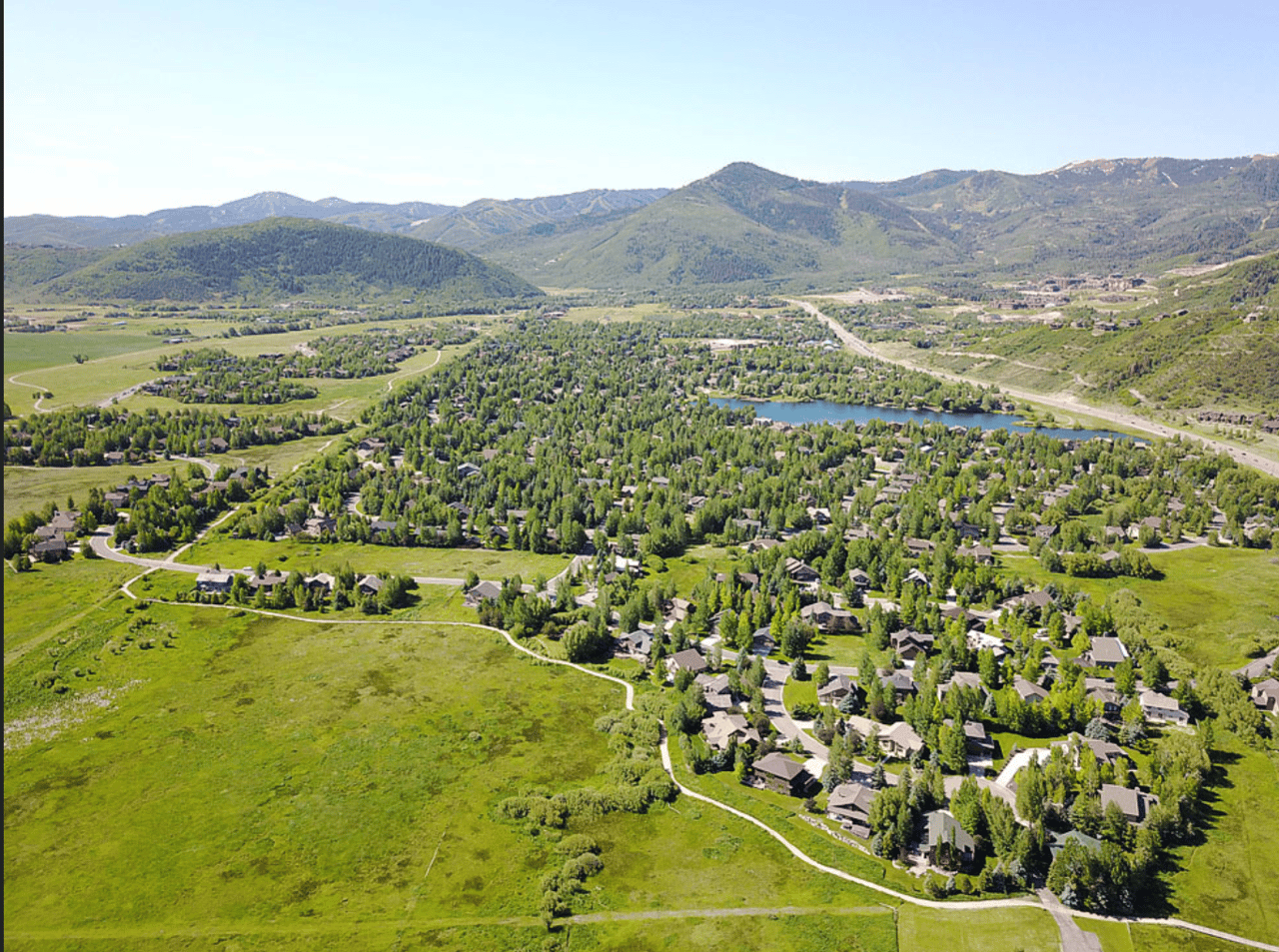
Set just east of State Route 224 between Kimball Junction and central Park City, Ranch Place is one of the Snyderville Basin's most desirable established residential neighborhoods—a community defined not by gates or resort infrastructure, but by protected open space, broad mountain views, an extensive trail network and an unusually convenient relationship with nearly every component of the Park City lifestyle.
Ranch Place occupies relatively gentle terrain along Park City's primary entrance corridor, adjoining the vast wetlands and meadows of the Swaner Preserve. The Ranch Place Homeowners Association describes the neighborhood as containing 228 homesites, two neighborhood parks, approximately 115 acres of dedicated open space and several miles of maintained trails. The neighborhood directly adjoins Swaner's approximately 1,200-acre nature preserve, creating a remarkable amount of undeveloped landscape beside an established residential community.
That relationship with open space is fundamental to Ranch Place.
In many luxury mountain communities, open views are created by elevation: homes climb higher onto ridgelines so they can look over development below.
Ranch Place achieves openness in almost the opposite manner.
The neighborhood sits largely on flat or gently rolling terrain, while protected wetlands, meadows, neighborhood common land and trail corridors extend around and through it. Historic community records describe Ranch Place lots as generally flat and note that many homes enjoy mountain, preserve or ski-area views because of the open land surrounding the subdivision.
The resulting atmosphere is unusually spacious for a community so close to Park City's commercial and resort centers.
Ranch Place feels residential.
It feels green.
It feels connected.
And perhaps most importantly, it feels like a neighborhood designed for living in Park City year-round, rather than simply visiting it.
Ranch Place was platted in the mid-1990s, making it newer than much of neighboring Silver Springs while still old enough for its trees, landscaping and streetscape to have matured substantially.
Historical community records place the neighborhood on land once associated with the Fletcher Ranch and Wallin Dairy Farm, portions of which ultimately became part of today's Swaner Nature Preserve.
That agricultural history remains surprisingly legible in the landscape.
Ranch Place is not built into steep mountain terrain.
Instead, its streets follow the broad floor of the Snyderville Basin, where wetlands, meadowland and mountain views create a softer landscape than one encounters in neighborhoods such as Aerie, Thaynes Canyon or Pinebrook.
The mountains remain present, but they are experienced at a distance.
The sky feels larger.
Views extend farther.
And the preserved land surrounding portions of the community allows individual homes to feel connected with a landscape much larger than their own lot boundaries.
This creates one of Ranch Place's greatest real-estate advantages:
you do not necessarily need acreage to experience open space.
Perhaps no natural feature defines Ranch Place more strongly than the Swaner Preserve.
Utah State University operates the Swaner Preserve & EcoCenter as a 1,200-acre nature preserve and educational center at the entryway to Park City. The preserve protects an extensive wetland ecosystem within an area that otherwise experienced enormous growth during Park City's transformation into an international mountain destination.
Ranch Place lies immediately beside this protected landscape.
That proximity matters both environmentally and aesthetically.
Wetlands and meadowland create substantial visual separation from surrounding development. Depending upon a home's location, views can extend across open preserve land toward the surrounding Wasatch and Uinta landscape rather than terminating at another row of houses.
Wildlife also remains a conspicuous part of this environment. The Swaner Preserve protects important wetland habitat within the Snyderville Basin, and the neighborhood's relationship with that landscape gives Ranch Place a much stronger connection with the natural environment than its proximity to Kimball Junction might initially suggest.
This is one of the neighborhood's great paradoxes.
Restaurants, groceries, businesses, recreation facilities and major transportation corridors are close by.
Yet from portions of Ranch Place, the dominant visual experience may still be grassland, water, wildlife and mountains.
The neighborhood itself adds another substantial layer of protected landscape.
The HOA reports approximately 115 acres of neighborhood open space, in addition to the adjacent Swaner Preserve.
That open space is not merely ornamental.
It contributes to the organization of the community, creates buffers between portions of the neighborhood and provides space for its internal trail network.
A conventional subdivision might maximize the number of buildable lots.
Ranch Place retains substantial areas where the land remains undeveloped.
The effect is subtle but consequential.
Roads do not always feel enclosed by uninterrupted housing.
Views open unexpectedly.
Trails move away from streets.
Homes adjoining common land can enjoy a dramatically different relationship with their surroundings from properties in more densely developed communities.
This is why Ranch Place can feel considerably more spacious than lot sizes alone might suggest.
The true experience of a property may include not only the privately owned parcel but also the visual and recreational landscape surrounding it.
Trails are not an afterthought in Ranch Place.
They are one of the neighborhood's defining features.
The HOA maintains several miles of trails within the community, while the larger Snyderville Basin trail system connects Ranch Place with Silver Springs, Kimball Junction and the broader Park City area.
Basin Recreation currently manages approximately 185 miles of trail throughout the Snyderville Basin, including about 45 miles of commuter pathways designed to connect neighborhoods, parks and community destinations. These paved and compacted-gravel connections support walking, running, biking and other forms of non-motorized transportation.
That distinction is important.
In some Park City neighborhoods, trail access means driving to a mountain-biking trailhead.
In Ranch Place, trails also function as everyday infrastructure.
They can be used for a morning walk.
A run.
A bike ride.
A trip toward neighboring recreation facilities.
A connection toward Kimball Junction.
Or simply a way to move through the neighborhood without following the roadway.
For residents who value Park City's outdoor culture, that makes daily recreation unusually accessible.
The trail is not merely somewhere one goes.
It is part of how the neighborhood works.
One of Ranch Place's less glamorous but enormously important advantages is its terrain.
Many of Park City's most dramatic homes occupy steep mountainsides. The reward can be tremendous views, but hillside living also introduces steep driveways, retaining walls, winter access concerns, limited yards and significant elevation changes around the property.
Ranch Place offers another form of mountain living.
Historical neighborhood information specifically describes its lots as flat, a characteristic that distinguishes Ranch Place from much of Park City's hillside housing stock.
That can make a meaningful difference in everyday life.
Outdoor spaces can be genuinely usable.
Driveways tend to be more conventional.
Children can move around the neighborhood more easily.
Walking and cycling are more approachable.
Patios and yards can connect naturally with interior living spaces.
And winter snow management may be considerably less complicated than on steep mountainside parcels.
For buyers arriving from outside Utah, this may seem like a minor distinction.
After one winter in Park City, it usually does not.
Flat land in a ski town is its own kind of luxury.
Ranch Place consists predominantly of single-family homes, with development beginning in the 1990s and continuing as individual properties were built and later renovated.
Because the community was not constructed as a single builder-controlled project, its homes possess more architectural variety than one finds in many newer developments.
Local neighborhood sources note a comparatively strong presence of custom-designed homes and three-car garages relative to some neighboring Silver Springs communities.
The architecture reflects several decades of Park City residential design.
Earlier homes often feature the mountain-residential vocabulary popular during the 1990s and early 2000s: pitched roofs, stucco, natural stone, timber accents, large fireplaces, covered entries and generously proportioned attached garages.
Many have since been remodeled.
More recent renovations often introduce lighter interiors, larger kitchens, contemporary fireplaces, wider-plank flooring, updated windows and more seamless relationships between indoor and outdoor spaces.
Some properties have undergone considerably more extensive transformations, producing contemporary mountain homes that retain the neighborhood's mature setting while offering the finishes and functionality expected by today's luxury buyer.
Unlike newer communities where every house reflects the same design era, Ranch Place has architectural depth.
The neighborhood has evolved.
Ranch Place's lot configuration contributes enormously to its lifestyle.
Although the neighborhood does not generally offer estate-scale acreage, the combination of conventional residential lots, relatively flat land and surrounding common open space allows many homes to provide functional outdoor environments.
A backyard here can actually function as a backyard.
That distinction matters.
In steep hillside neighborhoods, even a large parcel may contain relatively little flat usable land.
In Ranch Place, homeowners can more readily create patios, lawns, gardens, outdoor kitchens, play areas and gathering spaces that connect naturally with the home.
Properties adjoining HOA open space, wetlands or preserve land may gain an additional sense of openness beyond their formal property boundaries.
These homes can feel substantially larger than the parcel statistics imply because the eye continues outward into undeveloped land.
For the right property, the backyard does not visually end at the fence.
It continues into Park City.
Ranch Place includes two neighborhood parks, reinforcing its identity as a residential community rather than a resort subdivision.
The parks and common areas support the kind of informal daily life that distinguishes a genuine neighborhood from a collection of vacation homes.
Residents walk.
Children play.
Dogs become neighborhood celebrities with better social lives than most adults.
Neighbors actually encounter one another.
This might sound ordinary until one considers how unusual genuine neighborhood fabric can become in a destination real-estate market dominated by second homes, resort lodging and gated communities.
Ranch Place's luxury is not isolation.
It is community without sacrificing scenery.
Immediately south and east of the broader Ranch Place/Silver Springs area lies one of Snyderville Basin's most comprehensive outdoor recreational facilities: Willow Creek Park.
Basin Recreation operates the 17.5-acre park, which includes an all-abilities playground, playing fields, a dog park, tennis courts, eight pickleball courts, sand volleyball, basketball, pavilions and multi-use trails.
Adjacent to the park is another 66 acres of protected open space, with soft-surface trails connecting into the broader Snyderville Basin network. Depending upon winter conditions, these trails also support Nordic skiing.
The park's pond adds another unusually Park City detail.
In summer it serves recreational purposes, including seasonal dog access; when winter conditions permit, Basin Recreation converts the pond into a natural outdoor ice-skating surface.
This proximity gives Ranch Place residents access to an extraordinary quantity of public recreation without requiring a private-club membership.
Near Kimball Junction is the Basin Recreation Fieldhouse, another major component of the Ranch Place lifestyle.
As of 2026, Basin Recreation describes the Fieldhouse as an approximately 87,000-square-foot indoor recreation facility and reports that the district manages nearly 2,500 acres of open space and 185 miles of trails throughout the Snyderville Basin.
The Fieldhouse provides year-round indoor fitness and recreational opportunities, complementing the outdoor parks and trails surrounding Ranch Place.
This is particularly valuable in a four-season mountain environment.
Summer may belong to trails and outdoor fields.
Winter may belong to skiing.
Mud season may have other opinions.
The Fieldhouse keeps recreation available throughout the year.
Ranch Place occupies an exceptionally strategic location near Kimball Junction, the primary commercial center at Park City's northern gateway.
Neighborhood sources place Ranch Place approximately one mile from the Kimball Junction area and emphasize its convenient relationship with Redstone's retail, restaurants, services and entertainment.
For everyday life, that proximity matters tremendously.
A homeowner does not need to travel into Historic Main Street for groceries, routine shopping, fitness or day-to-day services.
This gives Ranch Place an advantage that can be overlooked when buyers initially focus only on ski proximity.
Park City is a resort town.
Ranch Place is positioned to make it function like a hometown.
Ranch Place is not a ski-in/ski-out community, nor should it be marketed as one.
Its appeal lies in being a residential neighborhood remarkably close to skiing without being consumed by the resort environment.
Canyons Village is the closest major base-area gateway to Park City Mountain, while the broader Highway 224 corridor provides access toward Park City Mountain, Historic Main Street and Deer Valley.
This distinction is useful for buyers who ski frequently but do not want to live directly in a resort village.
Skiing remains nearby.
The gondola remains nearby.
Après-ski remains nearby.
But home remains home.
Ranch Place is particularly strong as a four-season community because its identity is not dependent upon snow.
In winter, residents have access to skiing, Nordic recreation, neighborhood walking routes, recreation facilities and nearby resort activity.
Spring transforms the wetlands and open spaces as snowmelt returns water and wildlife to the basin.
Summer may be the neighborhood's most beautiful season. Lawns and mature landscaping turn green, the preserve becomes vivid, bikes replace skis and patios return to daily life.
Autumn brings gold into the aspens and cottonwoods while surrounding hillsides shift toward amber and rust.
The homes remain the same.
The entire landscape changes around them.
That is mountain living in its most complete form.
Summer reveals why Ranch Place's open-space orientation matters.
The wetlands turn green.
Long evenings illuminate the surrounding mountains.
Trails fill with walkers, runners and cyclists.
Willow Creek Park becomes an outdoor extension of the neighborhood.
Children move between houses and parks.
Outdoor entertaining becomes part of daily life.
And because so much of the community lies on relatively level terrain, recreation does not always need to be strenuous.
One does not need to climb 1,500 vertical feet before breakfast simply to establish mountain credibility.
A walk through preserved meadowland can be enough.
Winter creates an entirely different landscape.
Snow covers the meadows.
The nearby ski mountains become visible across the basin.
Trails change character.
Resort activity intensifies along Highway 224.
Yet Ranch Place itself remains primarily residential.
This is a significant distinction for buyers evaluating primary versus vacation-home neighborhoods.
A resort community often becomes busier precisely when owners want to use it most.
Ranch Place benefits from proximity to that energy without placing residents directly inside it.
You can ski the mountain.
Then leave the mountain behind.
Living beside a nature preserve creates benefits, but it also comes with responsibilities.
The Swaner Preserve exists to protect a functioning wetland ecosystem, not simply to provide attractive scenery for adjacent homes. USU operates the preserve as an environmental and educational resource, while conservation protections preserve substantial portions of the surrounding landscape.
For homeowners, that means wildlife encounters and seasonal changes are part of the experience.
It also means buyers evaluating a property along preserve or wetland edges should carefully review property boundaries, drainage, conservation easements, flood-related considerations where applicable, landscaping restrictions and HOA requirements.
The beauty of living beside protected land comes partly from the fact that the land is not yours to reshape.
For many Ranch Place buyers, that is precisely its value.
Ranch Place lies within the Park City School District.
The district's current boundary information places Ranch Place within the Parley's Park Elementary School attendance area. The district currently operates four elementary schools serving preschool through fifth grade, Ecker Hill Middle School for grades six through eight, and Park City High School for grades nine through twelve.
Because attendance boundaries and enrollment policies can change, school assignments should always be independently verified with Park City School District for a specific property.
Still, Ranch Place's location within the district reinforces its longstanding appeal as a primary-residence neighborhood rather than a community built principally around transient resort occupancy.
Ranch Place is governed by an active homeowners association.
The HOA maintains community documents, architectural-review procedures, policies, common areas and neighborhood standards. Its current website directs owners to architectural review for exterior modifications such as landscaping, painting, additions and fencing.
This contributes to the neighborhood's cohesive appearance without requiring every residence to share identical architecture.
For buyers contemplating remodeling or expansion, the architectural-review process should be investigated before purchase—particularly when plans involve significant exterior changes, additions, accessory structures, fencing or major landscape alterations.
The correct approach in Ranch Place is not to assume.
It is to verify.
Ranch Place is fundamentally residential in character.
The HOA's published guidance states that rentals of less than 30 days are prohibited, citing the community's CC&Rs restricting transient lodging uses. The HOA's current website continues to publish its amended and restated CC&Rs among the community's governing documents.
For any purchase involving rental income, however, current eligibility should be independently verified against the specific property's recorded documents, HOA rules and applicable Summit County regulations before relying on rental assumptions.
This limitation is important strategically.
Ranch Place should not be positioned primarily as a nightly-rental investment community.
It should be positioned as something increasingly scarce in Park City:
an established residential neighborhood where people actually live.
Ranch Place sits just east of Highway 224, the primary route connecting Kimball Junction with central Park City.
That location provides relatively straightforward access north toward Interstate 80 and south toward Canyons Village, Park City Mountain, Historic Main Street and Deer Valley.
The significance becomes clearer when compared with more remote communities.
Ranch Place homeowners do not have to descend from a remote mountain subdivision merely to reach groceries or begin the drive toward Salt Lake City.
Nor do they have to live amid Main Street density in order to remain connected to Park City.
The neighborhood occupies the middle ground.
And geographically, middle ground can be extremely valuable.
High Valley Transit currently operates a free regional transportation network throughout the Wasatch Back, including fixed-route and on-demand microtransit service in and around the Kimball Junction area. The system also provides commuter connections between Summit County and Salt Lake City.
Combined with Ranch Place's bicycle and pedestrian trail connections, this creates transportation options beyond the private automobile.
That is particularly meaningful in Park City, where trail systems increasingly function not only as recreation but as genuine connective infrastructure between neighborhoods and commercial districts.
Ranch Place is often grouped with the larger Silver Springs area, and geographically that makes sense.
But the neighborhoods should not be treated as interchangeable.
Silver Springs contains some older homes and is particularly associated with its established residential streets and private lakes.
Ranch Place developed later and has a stronger direct relationship with Swaner Preserve, broader HOA open space and the preserved wetlands surrounding its northern edge. Historical community information specifically notes Ranch Place's later development and its location beside Swaner.
The two communities share the advantages of relatively flat terrain, trail access and a central Snyderville Basin location.
Ranch Place's personality, however, is particularly tied to meadow, preserve and open-space living.
Park Meadows and Ranch Place both function exceptionally well as primary-residence neighborhoods, but they provide very different versions of Park City living.
Park Meadows is closer to Historic Main Street and organized visually around the private Park Meadows Country Club and surrounding hills.
Ranch Place sits farther north in the Snyderville Basin, offering easier access to Kimball Junction and I-80 while emphasizing protected wetlands, neighborhood trails and open meadows.
Park Meadows feels distinctly in town.
Ranch Place feels more open and pastoral.
Both provide convenience.
They simply place different landscapes outside the window.
Despite the shared word ranch, Ranch Place and Jeremy Ranch are fundamentally different.
Jeremy Ranch sits near I-80 at the western edge of the Snyderville Basin and derives much of its identity from the Arnold Palmer-designed Jeremy Ranch Golf & Country Club and East Canyon.
Ranch Place lies closer to Highway 224 and Kimball Junction, with its identity rooted in Swaner Preserve, trails, wetlands and neighborhood open space.
Jeremy Ranch is golf-and-canyon country.
Ranch Place is preserve-and-meadow country.
That distinction is meaningful for buyers deciding where they want their everyday Park City life to unfold.
Trailside is strongly associated with access to extensive trail networks, Trailside Park and mountain-bike-oriented recreation.
Ranch Place offers excellent trail access as well, but its terrain and character are different.
Ranch Place is generally flatter.
Swaner Preserve creates a strong wetland and meadow component.
Kimball Junction is especially close.
And the neighborhood itself contains significant HOA-owned open space.
For buyers who want trails but prefer a gentler, greener residential environment over a more elevated high-desert landscape, Ranch Place can be particularly compelling.
Old Town represents the opposite end of the Park City residential spectrum.
Old Town offers historic mining architecture, walkability to Main Street and immediate resort energy.
Ranch Place offers more conventional residential lots, larger yards, easier garages and parking, open-space adjacency, quieter streets and proximity to everyday commercial services.
An Old Town homeowner can walk to dinner.
A Ranch Place homeowner may be able to bike through miles of connected open-space trails.
Both are quintessentially Park City.
They simply answer entirely different lifestyle priorities.
Perhaps the most important thing to understand about Ranch Place is that it works exceptionally well as a home.
Not merely a ski property.
Not merely an investment property.
Not merely a vacation retreat.
A home.
That distinction explains many of its characteristics.
Garages matter.
Yards matter.
Trails matter.
Schools matter.
Nearby groceries matter.
Neighborhood parks matter.
Getting to work matters.
Reaching I-80 matters.
Having somewhere for the dog to run matters.
Being able to take a walk without driving to a trailhead matters.
Ranch Place is not designed around the fantasy of spending seven perfect powder days in Park City.
It is designed around the far more complex—and arguably more rewarding—experience of living here every day.
Park City contains extraordinary expressions of luxury.
Ski-in/ski-out estates.
Private golf clubs.
Gated compounds.
Historic Main Street homes.
Architectural showpieces.
Ranch Place offers something quieter.
Its luxury lies in space that has deliberately been left alone.
A wetland that will not become another row of houses.
A meadow beyond the backyard.
A trail crossing open land.
A mountain visible because nothing has been built in front of it.
A child riding a bike through the neighborhood.
A morning walk that starts at the front door.
A home close enough to the resort that skiing is easy and far enough away that ordinary life still feels ordinary.
That kind of luxury does not photograph as dramatically as a ski lift outside the window.
But for someone who intends to live here, it can be infinitely more consequential.
For buyers searching for Ranch Place homes for sale, Park City primary residences, homes near Swaner Preserve, Silver Springs-area real estate, family-oriented Park City neighborhoods, or properties with direct trail and open-space access, Ranch Place deserves serious consideration.
It combines approximately 115 acres of neighborhood open space with immediate adjacency to the 1,200-acre Swaner Preserve, two neighborhood parks, miles of trails, relatively level residential terrain and exceptional proximity to Kimball Junction and the broader Park City corridor.
Ranch Place is neither a resort village nor a private-club enclave.
That is precisely its strength.
It is a mature residential neighborhood surrounded by the very things that brought people to Park City in the first place:
mountains, open land, trails, wildlife and room to breathe.
And despite everything around Park City that has changed, Ranch Place retains the rarest amenity of all—
space that still feels like space.
20,311 people live in RANCH PLACE IN PARK CITY, UTAH, where the median age is 41.9 and the average individual income is $85,653. Data provided by the U.S. Census Bureau.
Total Population
Median Age
Population Density Population Density This is the number of people per square mile in a neighborhood.
Average individual Income
There's plenty to do around RANCH PLACE IN PARK CITY, UTAH, including shopping, dining, nightlife, parks, and more. Data provided by Walk Score and Yelp.
Explore popular things to do in the area, including Park City Cakery, Ramblin' Rose Cafe, and Lady Sugar Sparkles.
| Name | Category | Distance | Reviews |
Ratings by
Yelp
|
|---|---|---|---|---|
| Dining | 0.36 miles | 4 reviews | 3/5 stars | |
| Dining | 0.67 miles | 6 reviews | 5/5 stars | |
| Dining | 0.67 miles | 0 reviews | 0/5 stars | |
| Dining | 0.67 miles | 0 reviews | 0/5 stars | |
| Dining | 0.67 miles | 1 review | 5/5 stars | |
| Dining | 0.67 miles | 5 reviews | 5/5 stars | |
| Active | 0.4 miles | 4 reviews | 5/5 stars | |
| Active | 0.67 miles | 0 reviews | 0/5 stars | |
| Active | 0.67 miles | 0 reviews | 0/5 stars | |
| Active | 0.67 miles | 6 reviews | 5/5 stars | |
| Active | 0.67 miles | 3 reviews | 5/5 stars | |
| Active | 0.67 miles | 1 review | 5/5 stars | |
| Active | 0.67 miles | 0 reviews | 0/5 stars | |
| Active | 0.67 miles | 2 reviews | 5/5 stars | |
| Active | 0.67 miles | 1 review | 5/5 stars | |
| Active | 0.67 miles | 1 review | 5/5 stars | |
| Beauty | 0.67 miles | 0 reviews | 0/5 stars | |
| Beauty | 0.67 miles | 0 reviews | 0/5 stars | |
| Beauty | 0.67 miles | 0 reviews | 0/5 stars | |
| Beauty | 0.67 miles | 0 reviews | 0/5 stars | |
| Beauty | 0.67 miles | 0 reviews | 0/5 stars | |
| Beauty | 0.67 miles | 0 reviews | 0/5 stars | |
| Beauty | 0.67 miles | 28 reviews | 4.9/5 stars | |
|
|
||||
|
|
||||
|
|
||||
|
|
||||
|
|
||||
|
|
RANCH PLACE IN PARK CITY, UTAH has 6,926 households, with an average household size of 2.92. Data provided by the U.S. Census Bureau. Here’s what the people living in RANCH PLACE IN PARK CITY, UTAH do for work — and how long it takes them to get there. Data provided by the U.S. Census Bureau. 20,311 people call RANCH PLACE IN PARK CITY, UTAH home. The population density is 283 and the largest age group is Data provided by the U.S. Census Bureau.
Total Population
Population Density Population Density This is the number of people per square mile in a neighborhood.
Median Age
Men vs Women
Population by Age Group
0-9 Years
10-17 Years
18-24 Years
25-64 Years
65-74 Years
75+ Years
Education Level
Total Households
Average Household Size
Average individual Income
Households with Children
With Children:
Without Children:
Marital Status
Blue vs White Collar Workers
Blue Collar:
White Collar: