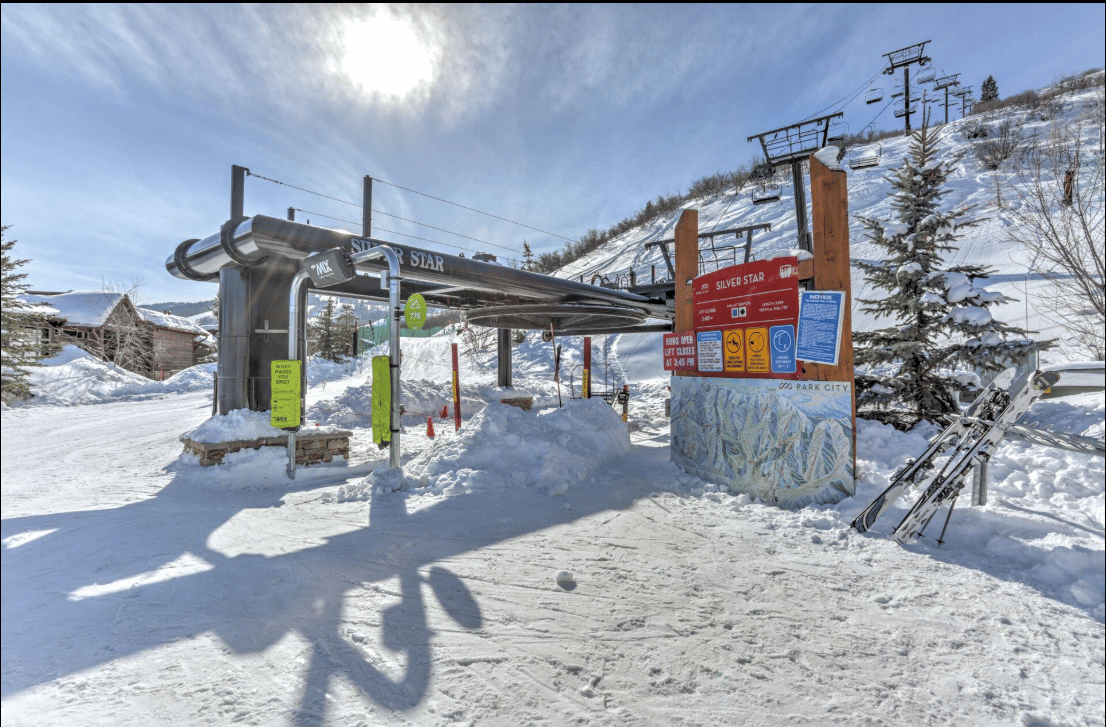
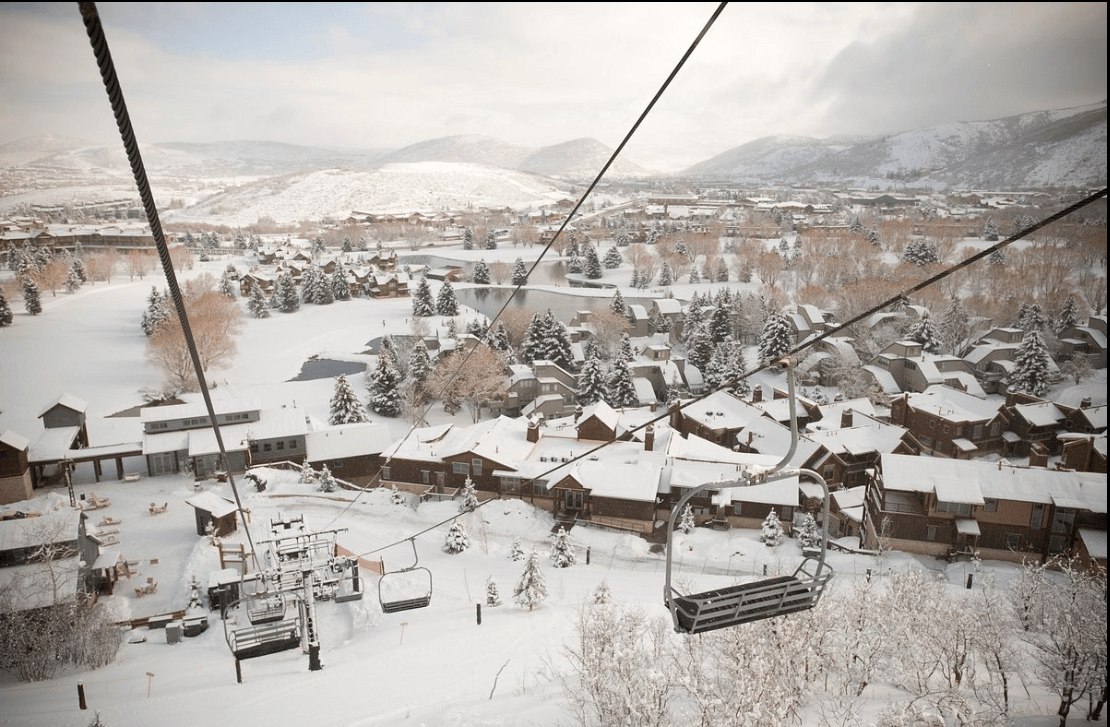
Set slopeside on Park City Mountain, overlooking the Park City Golf Course and only minutes from Historic Main Street, Silver Star occupies one of the most unusual and compelling positions in Park City real estate.
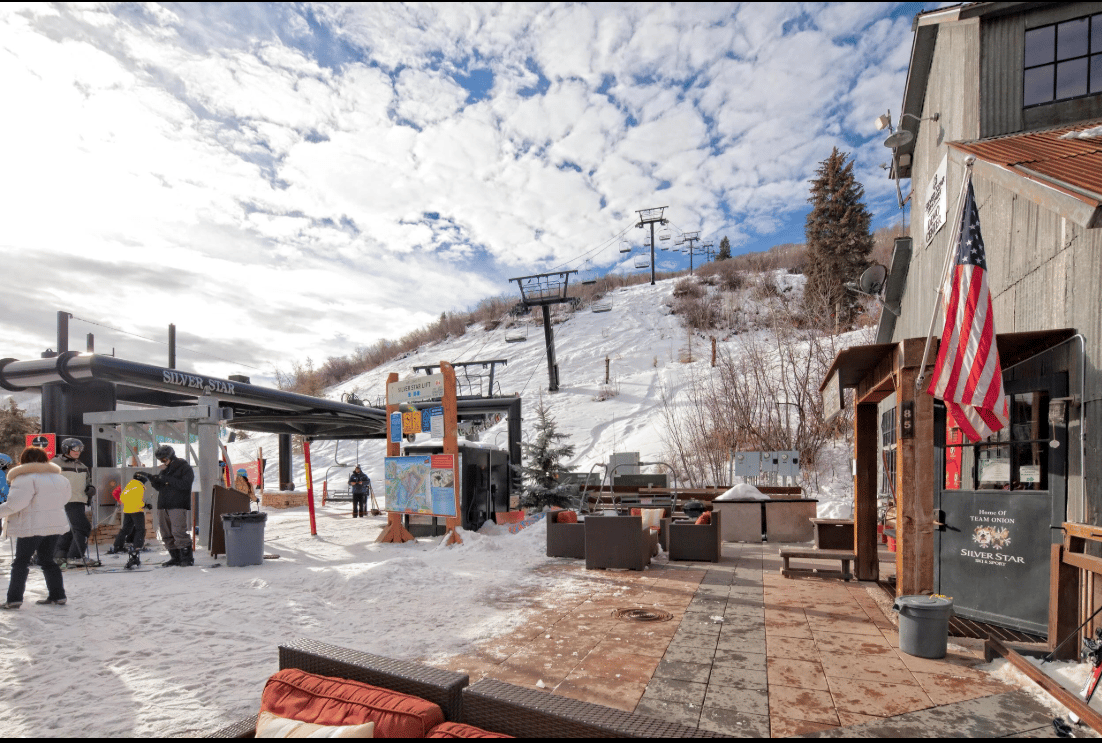
At first glance, Silver Star is an intimate luxury ski village: mountain residences clustered around a small plaza, ski and bike services steps from the homes, direct access to the Silver Star chairlift during winter operations, restaurants and gathering spaces, and trails leaving virtually from the village itself. Park City Mountain describes Silver Star as a luxury ski-in/ski-out property located slopeside at the resort and immediately adjacent to the Park City Golf Course.
But Silver Star has considerably more depth than its ski access suggests.
The village sits on land connected directly to Park City's mining history. The Spiro Tunnel, one of the most fascinating artifacts from the city's transition from mining town to ski destination, begins at what is now Silver Star Plaza. In the 1960s, the old mine workings were transformed into an extraordinary underground transportation system: skiers were carried nearly three miles through the mountain in subway-style mine cars, then hoisted approximately 1,800 vertical feet to the surface to reach the original Thaynes chairlift. Park City Mountain calls the short-lived system a unique chapter in the resort's history.
Today, that same mountainside has become one of Park City's most refined residential environments.
The result is something rare even by Park City standards:
a contemporary luxury ski community built directly into the physical history of the mountain itself.
Silver Star's first great advantage is scale.
It does not operate like Mountain Village.
It does not resemble Canyons Village.
And it does not have the density or visitor intensity of a major resort base.
Instead, Silver Star is deliberately intimate.
Its commercial village is centered around a relatively small plaza at the base of the Silver Star lift. Silver Star Ski & Sport describes the development as a collection of ski-in/ski-out townhouses, condominiums and cottages arranged around historic mining structures and a small commercial village.
That creates an entirely different atmosphere.
There are residences above and around the plaza.
The lift rises directly from the neighborhood.
The ski shop is steps away.
The trailhead begins nearby.
The café provides a natural gathering place.
Owners and guests encounter one another because the development is compact enough to create genuine common space without feeling like a large resort complex.
It is a ski village on a human scale.
Perhaps nothing distinguishes Silver Star more profoundly than the Spiro Tunnel.
Park City's rise as an internationally recognized mountain destination grew directly from its mining past, and the Silver Star location provides one of the clearest physical connections between those eras.
After the first season of the original Treasure Mountains ski area, United Mines installed an early version of the Thaynes chairlift. Instead of constructing a conventional surface route to the lift, the resort used the old Spiro Tunnel. Skiers boarded subway-style cars near the location of today's Silver Star Plaza and traveled almost three miles underground through old mine workings. At the far end, a hoist lifted them about 1,800 feet vertically to the surface near today's Thaynes lift. The underground skier system operated only until 1969.
That history matters enormously to Silver Star's sense of place.
The development is not styled to look like it belongs to Park City's mining past.
It physically occupies part of that past.
City planning records for Silver Star even identify the historic mine tunnel entrance shed as part of the development and list the structure as a significant historic site.
There is a profound difference between architectural nostalgia and genuine historical continuity.
Silver Star has the latter.
Modern Silver Star emerged through the Spiro Tunnel Master Planned Development, approved by the Park City Planning Commission in 2004.
City records describe the original project as a mixed-use development containing 74 condominium units, 22 cottage units and one single-family residence with a guest component, along with commercial uses, artist studio and gallery space, meeting areas and affordable housing.
That mixed-use concept explains why Silver Star feels more complete than a conventional slopeside condominium complex.
The objective was not simply to construct lodging.
The plan created a small village.
Residential buildings coexist with commercial and historic spaces.
Ski services coexist with restaurants.
New construction sits beside mining remnants.
Public-facing activity concentrates around the plaza while residences climb away into quieter portions of the development.
The architecture and site planning were therefore required to negotiate three very different identities:
historic Park City, modern luxury residence and functioning ski village.
That tension is one of Silver Star's strongest design characteristics.
Silver Star offers several different residential formats rather than one standardized condominium product.
The community includes condominiums, townhomes and detached or cottage-style residences, allowing buyers to select very different ownership experiences while remaining within the same village environment.
Some properties are positioned directly around or above the plaza.
Others climb farther along the mountainside.
Some emphasize immediate lift convenience.
Others emphasize greater residential separation, outdoor space or broader views.
This variation makes micro-location particularly important.
Two Silver Star properties may share the same community amenities yet feel quite different depending upon their relationship to the lift, plaza, ski trail, parking, golf course and surrounding hillside.
As with almost all Park City resort property, the address tells only part of the story; orientation tells the rest.
Silver Star's architectural vocabulary deliberately draws from Park City's industrial and mining history rather than relying exclusively on conventional rustic-lodge imagery.
The community itself describes historic mining buildings as part of its setting, while current lodging and real-estate sources emphasize a combination of contemporary mountain design and industrial references to Park City's past.
Stone provides mass and permanence.
Timber adds mountain warmth.
Metal roofs and industrial detailing reference utilitarian mining structures.
Large windows open interiors toward the mountain and golf course.
Covered terraces, balconies and outdoor hot tubs turn the surrounding landscape into part of the residence.
The result feels recognizably Western without becoming theatrical.
Silver Star does not resemble a transplanted European ski village.
Nor does it attempt to reproduce Victorian Main Street.
Its architectural identity is closer to refined mountain-industrial Park City.
That is a much more authentic expression of this particular site.
Silver Star is genuinely slopeside at Park City Mountain, and Park City Mountain itself identifies the property as ski-in/ski-out.
The Silver Star chairlift rises directly from the village plaza and provides mountain access during scheduled winter operations. Park City Mountain has historically identified Silver Star as one of its less congested alternative starting points, and the resort notes that the area is served by public transportation.
This is important because Silver Star's ski access feels fundamentally different from a large base-area experience.
An owner does not necessarily need to enter Mountain Village, navigate a large plaza and join the principal morning flow of resort guests.
Instead, the ski day can begin from the comparatively intimate Silver Star base.
Lift and terrain operations are always subject to weather, snow conditions and resort scheduling, so buyers should understand ski-in/ski-out as access associated with the operating resort rather than an unconditional year-round property right. Park City Mountain maintains current lift and terrain status separately.
That caveat notwithstanding, the ability to begin a Park City Mountain ski day from one's own small neighborhood plaza is one of Silver Star's defining ownership privileges.
Silver Star connects directly into an enormous recreational environment.
Park City Mountain currently reports approximately 7,300 acres of skiable terrain, 41 lifts and more than 330 trails, stretching between the Park City and Canyons sides of the resort.
That scale gives Silver Star owners access to a resort system vastly larger than the intimate village outside their residence might suggest.
This is one of Silver Star's appealing contrasts.
At home, the environment is compact.
Once on the mountain, it is immense.
Silver Star demonstrates why not all ski-in/ski-out real estate is equivalent.
There is ski access at a large hotel.
There is ski access from a massive condominium complex.
There is ski access within a purpose-built resort village.
And then there is Silver Star.
Here, lift access exists within a small residential enclave deeply connected to the historic Park City side of the mountain.
Historic Main Street remains nearby.
The municipal golf course lies directly below.
Thaynes Canyon and established Park City residential neighborhoods surround the area.
Trails emerge from the plaza.
The resort is therefore integrated into Park City as a town, rather than separated from it as a self-contained destination.
That distinction is crucial.
Silver Star Plaza acts as the community's living room.
The commercial village is arranged around the ski lift and includes services designed for mountain recreation and après-ski. Silver Star Ski & Sport operates directly at the plaza and provides ski, snowboard and bicycle services, while the community description notes that the plaza has also hosted occasional live music and neighborhood gathering activity.
This gives the development a social center without forcing residents into a large commercial district.
The plaza is intimate enough that owners can walk through it routinely without feeling as if they are traversing a resort concourse.
That matters.
Good mountain communities need places where people naturally cross paths.
Silver Star has one.
The Silver Star Café is another important part of the neighborhood's identity.
It is located directly within the Silver Star community and functions as both a restaurant and an après-ski gathering place. Silver Star Ski & Sport identifies it as an established component of the plaza and notes its history of live music and its unusual ability to be reached by ski or bicycle from the surrounding mountain network.
This adds considerable lifestyle value.
Many ski-in/ski-out communities provide access to a mountain but require owners to drive elsewhere for virtually every social interaction.
Silver Star has at least part of that experience directly at home.
Silver Star Ski & Sport opened in 2008 specifically to support the newly developed Silver Star community before growing into a broader local ski and bicycle operation.
Its presence gives owners and guests immediate access to equipment rental, tuning and mountain-oriented services without requiring a trip to the primary resort base.
In winter, that means skis and snowboards.
In summer, bicycles take over.
The shop's evolution mirrors Silver Star itself:
what began as an amenity for a new development became part of Park City's wider recreational culture.
Silver Star may actually become even more distinctive after the snow melts.
The plaza sits directly beside trail access for Spiro, Armstrong and Dawn's, and the community specifically promotes those trails as part of its summer experience.
Park City Mountain likewise identifies Spiro, Armstrong and Dawn's among its notable hiking routes and points visitors toward access from the Silver Star side of the mountain.
This means Silver Star does not simply transition from ski property to ordinary condominium complex when winter ends.
It transitions from ski village to trail village.
That is an enormous distinction for four-season ownership.
The Armstrong Trail is one of the most important recreational assets associated with Silver Star.
Mountain Trails describes Armstrong as a purpose-built directional uphill bicycle trail created to provide a better climbing route into Park City Mountain and reduce conflicts on Spiro.
Its lower access is associated directly with Silver Star, making the community a natural starting point for mountain-bike rides into the resort's trail system. Park City Mountain also identifies the Armstrong trailhead near Silver Star Plaza.
From there, riders can continue toward higher mountain terrain and eventually connect into broader trail systems such as Mid Mountain.
For a serious mountain biker, this is not merely “close to trails.”
This is living at the trailhead.
Spiro occupies an almost legendary position in Park City's mountain-bike history.
Mountain Trails explains that the route was cut in the mid-1990s and for years served as one of the primary singletrack connections into the upper reaches of Park City Mountain. As Armstrong later became the preferred climbing route for cyclists, Spiro increasingly evolved into an important downhill connection.
The proximity of Spiro gives Silver Star residents another direct line into the mountains.
An owner can leave home and transition from architecture to forested singletrack in minutes.
That immediacy is one of the defining qualities of the development.
Dawn's Trail provides yet another hiking and biking connection through the mountain terrain surrounding Silver Star.
Together, Dawn's, Armstrong and Spiro create a dense cluster of recreational options immediately above the village.
Rather than relying upon one trail, owners gain access to a network.
That network ultimately becomes part of Park City's much larger interconnected system.
The significance of Silver Star's trail location becomes clearer when those local routes are viewed in relation to Mid Mountain Trail.
Mountain Trails describes Mid Mountain as approximately 26 miles long, traversing the mountains between Park City's resort terrain and connecting with trail systems including Spiro and Armstrong.
That creates an extraordinary recreational progression:
Silver Star Plaza.
Armstrong.
Spiro.
Dawn's.
Mid Mountain.
And from there, much of Park City's broader trail system.
For an owner who mountain bikes, hikes or trail runs regularly, the practical value is difficult to overstate.
Silver Star sits immediately beside the Park City Golf Course, another feature that distinguishes it from most ski-in/ski-out communities. Park City Mountain specifically identifies Silver Star as adjacent to the golf course.
This creates a spectacular visual and seasonal relationship.
In winter, the course becomes a broad snow-covered landscape beneath the homes.
In summer, it turns intensely green.
The fairways provide visual separation and long sightlines toward the surrounding Park City neighborhoods and mountains.
For golf-oriented owners, the location provides obvious recreational appeal.
But even for someone who never swings a club, the course is valuable as open foreground.
It gives the neighborhood room to breathe.
Silver Star's views are unusually varied because of its position between ski terrain and the golf-course valley below.
Depending upon the residence and orientation, views may focus toward the mountain, across the golf course, toward Park Meadows and the surrounding residential landscape, or over broader portions of Park City.
A slopeside condominium may emphasize immediate mountain drama.
A cottage positioned toward the lower side may open more strongly toward the golf course and town.
Some residences benefit from multiple exposures.
This makes orientation extremely important when evaluating Silver Star real estate.
A floor plan may be replicated.
A view cannot.
In addition to ski and trail access, current lodging operators at Silver Star identify community amenities including a heated swimming pool, hot tub, fitness center, fire pits, ski storage and private or dedicated parking, although exact amenity rights and access should always be confirmed for the particular residence and HOA.
These amenities reinforce Silver Star's position between conventional neighborhood living and resort ownership.
Owners gain significantly more common infrastructure than one would typically expect in an ordinary residential subdivision.
But the overall environment remains considerably more intimate than a full-service resort hotel.
One of Silver Star's most important advantages is that ski access does not come at the cost of being removed from town.
The community itself describes Silver Star as only a couple of miles from Historic Main Street and roughly a mile from Park City Mountain's principal base area.
This gives owners exceptional choice.
They can remain within the Silver Star plaza.
They can access the mountain directly.
They can head to Mountain Village.
Or they can reach Main Street for dining, galleries, shopping and nightlife.
Silver Star therefore avoids one of the compromises common to destination resort ownership.
It provides slopeside living without requiring owners to live apart from Park City.
Silver Star is also served by Park City's transit network.
Park City's published route information includes Silver Star as a stop on the Blue Thaynes Canyon/Park Meadows route, connecting the area with Park City Mountain, the PC MARC and Old Town Transit Center.
Park City Mountain has also specifically highlighted public transportation as one of the advantages of beginning a ski day from Silver Star.
That is particularly valuable because parking around Silver Star is intentionally limited and trail-oriented visitors are routinely encouraged to use transit rather than drive to the plaza.
For residents, this means the car can become optional for a meaningful portion of the Park City experience.
Winter is the season in which Silver Star's design becomes most immediately legible.
Snow settles onto the plaza and historic mining structures.
The Silver Star chairlift rises directly above the residences.
Skiers move quietly through the village rather than through a massive base terminal.
The mountain becomes transportation as much as scenery.
An owner can prepare equipment at home, walk toward the lift, ski Park City Mountain and return to the same intimate neighborhood at the end of the day.
Après-ski can occur steps from the residence.
Dinner on Main Street remains close.
And the golf course below transforms into open winter landscape.
It is an unusually complete Park City winter experience.
Summer changes almost every activity while preserving the same fundamental convenience.
Skis disappear.
Bicycles emerge.
The plaza becomes a trailhead.
Armstrong, Spiro and Dawn's reconnect owners directly with Park City Mountain's warm-weather landscape.
The golf course turns green.
Aspens fill out.
Outdoor terraces become part of everyday living.
Silver Star Café becomes accessible to hikers and cyclists rather than only skiers.
Park City Mountain itself operates year-round, with hiking, mountain biking and other summer activities forming part of its broader seasonal offering.
Silver Star therefore loses very little relevance when ski season ends.
For some owners, it may become even better.
Autumn is a particularly beautiful season in this part of Park City because Silver Star sits directly against the mountain's wooded lower slopes.
Aspens move through gold.
The golf course remains green below.
The higher resort terrain shifts toward rust and amber.
Morning temperatures sharpen.
Trail traffic becomes quieter.
The architectural materials—stone, timber and metal—feel especially at home against the changing mountain colors.
Unlike a high-elevation resort enclave that may already feel winterbound, Silver Star remains closely connected to town and lower-elevation recreation.
The result is a remarkably balanced shoulder season.
Spring reveals the practical advantage of Silver Star's relatively low position on Park City Mountain.
Snow gradually retreats from the golf course and lower trails while the upper mountain may remain white.
Cycling and walking begin returning to town.
The ski community transitions almost seamlessly into its summer identity.
This is one of the pleasures of owning in a genuine four-season mountain town rather than a winter-only resort destination.
The landscape changes use before it ever becomes irrelevant.
Silver Star is one of the Park City communities where rental rights require careful, property-specific due diligence.
Park City planning records state that the Spiro Tunnel Master Planned Development was approved as a mixed-use project and was considered a nightly-rental condominium project as part of its original approvals.
That does not mean every property should automatically be represented as eligible for identical rental use.
Individual condominium plats, HOA documents, property type, current Park City licensing requirements and any subsequent amendments should all be reviewed before a buyer relies upon nightly-rental income.
This is particularly important because Silver Star includes different housing formats and ownership structures.
The correct marketing language is therefore not:
“All Silver Star properties allow nightly rentals.”
It is:
“Silver Star was developed with significant nightly-rental use, but current rental eligibility should be verified for the individual residence.”
That is both more accurate and more useful.
Silver Star's mix of condominiums, cottages, commercial spaces and common amenities creates a more complex ownership environment than a conventional single-family subdivision.
City records refer specifically to the Silver Star Plaza Condominiums Owners Association and assign responsibility for areas such as parking management to the applicable association structure.
For buyers, due diligence should therefore address the specific HOA governing the residence, current assessments, reserve funding, common-area responsibility, insurance, parking, ski storage, amenity rights, rental restrictions and maintenance obligations.
A cottage may not have the same ownership responsibilities as a condominium.
A plaza residence may not function identically to a townhome farther from the commercial core.
Silver Star should be analyzed at the unit and association level, not merely by neighborhood name.
Silver Star and Park City Mountain's principal Mountain Village base provide access to the same enormous resort, yet the ownership experience is substantially different.
Mountain Village is a major resort base.
It contains larger lodging properties, expansive skier services, major parking areas, ticketing, lessons and heavier visitor circulation.
Silver Star is intimate.
Its lift is integrated into a small residential-commercial plaza.
The housing is lower scale.
The mountain interface feels almost private by comparison.
A buyer who wants maximum proximity to the full resort base infrastructure may prefer Mountain Village.
A buyer who wants ski access without living inside the principal resort hub may find Silver Star far more compelling.
Old Town offers something Silver Star cannot replicate:
historic Main Street walkability and the texture of Park City's original mining-era street grid.
Silver Star offers something much of Old Town cannot replicate:
planned luxury residences with direct lift access, contemporary amenities, easier parking arrangements, mountain-bike trail access and the open landscape of the golf course immediately below.
Both have authentic relationships with Park City's mining history.
But they express that history differently.
Old Town preserves the town created by mining.
Silver Star preserves the mountain infrastructure created by mining.
That is a fascinating distinction.
Silver Star and Thaynes Canyon sit beside one another geographically but provide fundamentally different lifestyles.
Thaynes Canyon is primarily an established single-family residential neighborhood.
Mature trees.
Private yards.
Larger detached homes.
Quiet streets.
Golf-course proximity.
Silver Star is a mixed-use slopeside village.
Condos.
Townhomes.
Cottages.
Common amenities.
Commercial space.
Direct lift and trail access.
Thaynes Canyon feels like a Park City home beside the mountain.
Silver Star feels like living where the mountain begins.
Park Meadows emphasizes spacious in-town residential living, Park Meadows Country Club, larger single-family homes and broad neighborhood streets.
Silver Star is considerably more compact and resort-oriented.
Park Meadows offers the country-club interpretation of central Park City.
Silver Star offers the ski-and-trail-village interpretation.
Both remain exceptionally close to town.
The decision comes down less to location than to lifestyle.
Deer Valley's ski-in/ski-out properties often emphasize luxury resort services, polished hospitality, private clubs and a highly curated ownership experience.
Silver Star's atmosphere is more casual and more deeply connected to Park City's historic, local and recreational culture.
The architecture is refined, but the trailhead sits beside the plaza.
The bike shop matters as much as the ski concierge.
The mining tunnel matters.
The café matters.
The municipal golf course is below rather than a private club behind a gate.
Silver Star feels luxurious without becoming insulated from Park City.
Canyons Village operates on a much larger scale.
It is a major destination resort village with hotels, branded residences, extensive skier services, restaurants, events and multiple lift systems.
Silver Star is almost the opposite.
Its small size is the luxury.
Canyons Village offers variety and scale.
Silver Star offers intimacy and proximity to central Park City.
Both access Park City Mountain.
They simply represent completely different relationships with it.
Silver Star is exceptionally well suited to buyers who want a second home that works across all four seasons.
Winter provides direct resort access.
Summer delivers immediate trail access.
Golf is adjacent.
Historic Main Street remains nearby.
Community amenities reduce the need to leave the development.
Attached-property formats can simplify maintenance compared with large detached mountain estates.
And the original planning of the development accommodated significant vacation-oriented use.
For a buyer who actually intends to use Park City rather than merely admire it through a window, that combination is powerful.
Silver Star can also work beautifully as a primary residence—but for a different buyer than Park Meadows or Thaynes Canyon.
The ideal full-time Silver Star owner often values recreation and location more than acreage.
They may prefer walking to a lift over maintaining a large yard.
They may value ski storage over a detached workshop.
They may spend more time on mountain-bike trails than landscaping.
They may want Main Street nearby without living in Old Town.
And they may appreciate the social energy of the plaza without wanting the scale of a resort village.
Silver Star is therefore a particularly good fit for buyers whose definition of luxury includes time outside.
Silver Star is particularly compelling for buyers seeking:
What these buyers tend to share is not simply a desire to own in Park City.
They want to participate in the mountain immediately.
Many Park City owners wake up and drive to recreation.
Silver Star changes that equation.
In winter, the chairlift is outside.
In summer, the trailhead is outside.
Golf begins below the community.
A café is in the plaza.
A ski and bike shop is steps away.
Transit runs through the area.
Main Street remains close.
This is why Silver Star's luxury cannot be measured exclusively in square footage, finishes or views.
Its most valuable amenity may be time.
Time not spent driving to the mountain.
Time not spent finding parking.
Time not spent loading bicycles.
Time not spent transporting equipment.
The day begins sooner because the experience begins at home.
Silver Star also possesses something no new resort development can purchase.
History beneath the building.
Not decorative history.
Not a collection of mining photographs hung in a lobby.
Actual mining infrastructure.
The Spiro Tunnel.
Historic structures.
A site from which skiers once traveled nearly three miles underground through old mine workings before being hoisted 1,800 feet toward the ski slopes.
That story is almost fantastical.
And yet it happened exactly where Silver Star stands today.
It gives the neighborhood a narrative depth that architecture alone could never create.
Perhaps Silver Star's greatest distinction is that it is simultaneously resort property and neighborhood property.
The lift makes it resort real estate.
The trails make it recreational real estate.
The golf course gives it open space.
The historic mining site gives it authenticity.
Three Kings and Thaynes Canyon connect it to established Park City neighborhoods.
Main Street keeps it connected to town.
Silver Star never feels like an isolated vacation compound.
It remains unmistakably part of Park City.
That is difficult to duplicate.
For buyers searching for Silver Star Park City real estate, Silver Star condos for sale, ski-in/ski-out homes at Park City Mountain, Silver Star townhomes, luxury Park City cottages, homes near Armstrong and Spiro trails or lock-and-leave Park City properties, Silver Star belongs among the city's most distinctive ownership opportunities.
Park City Mountain identifies it as a slopeside ski-in/ski-out property beside the Park City Golf Course.
The Silver Star community combines condominiums, townhomes and cottages with an intimate commercial plaza, mountain services and winter lift access.
Its trailhead connects directly toward Spiro, Armstrong and Dawn's during the warmer months.
Park City Transit serves the neighborhood.
Historic Main Street remains only minutes away.
And beneath it all lies the Spiro Tunnel—a physical reminder that the same mountain which once produced Park City's silver eventually became the mountain that reinvented the town.
Silver Star therefore offers something considerably more interesting than ski-in/ski-out convenience.
It is where Park City's mining history, ski culture and four-season mountain lifestyle occupy the same piece of ground.
And there may be no more authentically Park City place to begin a day on the mountain.