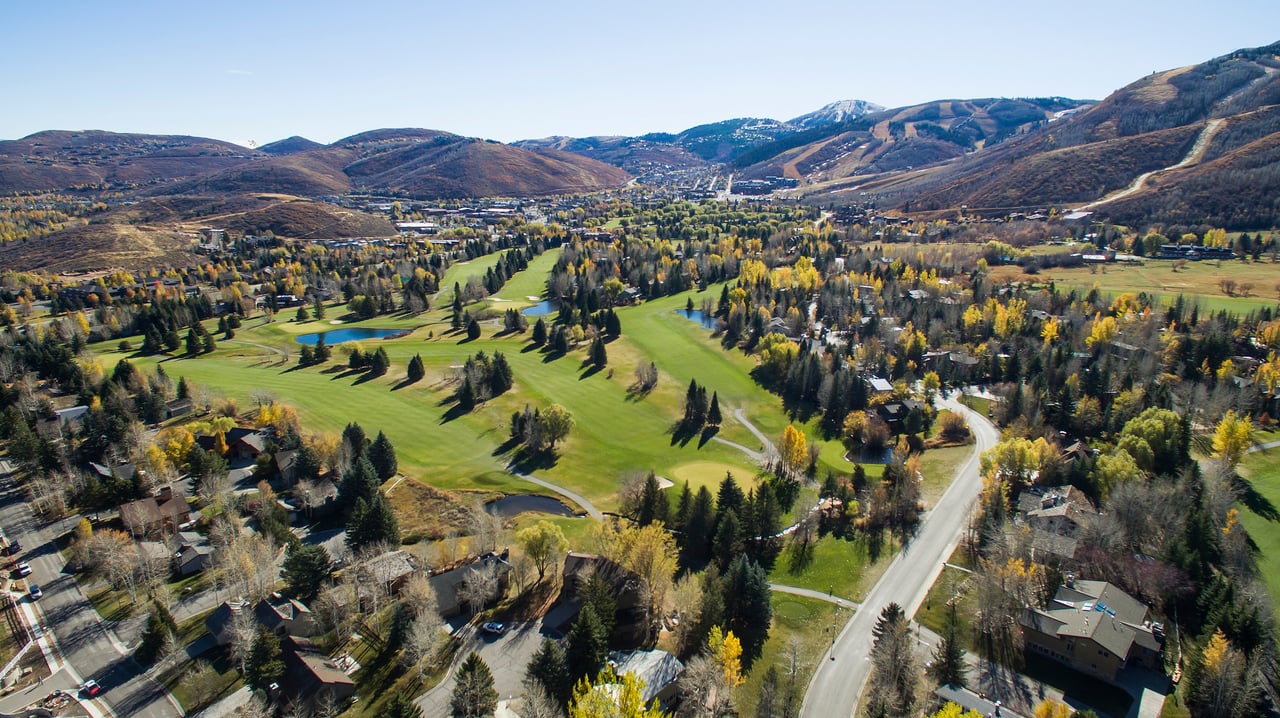
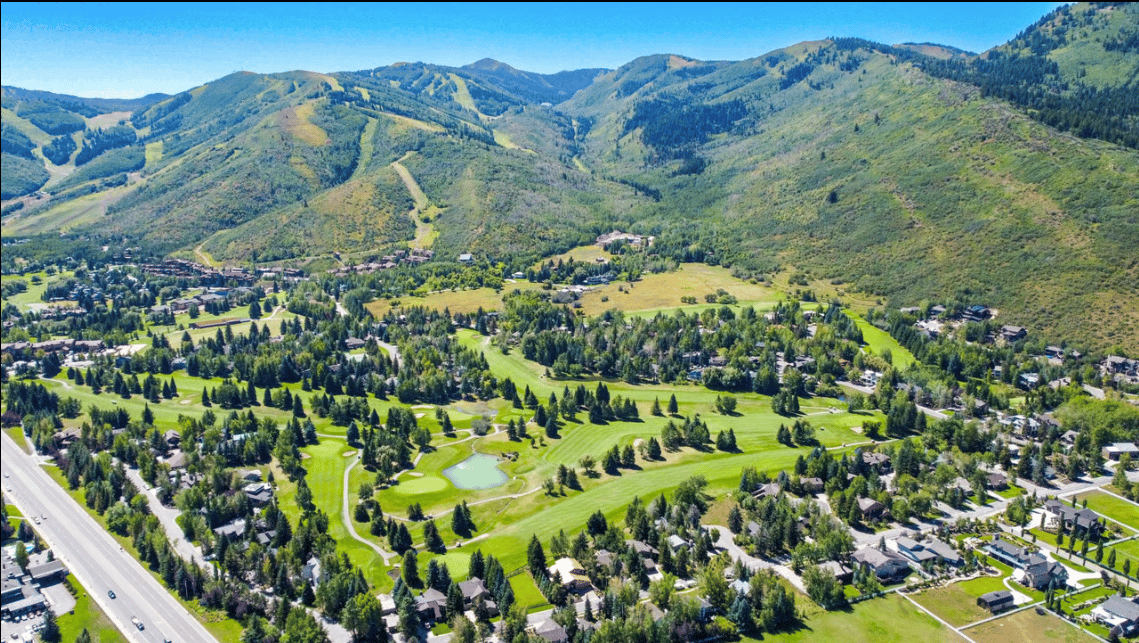
Tucked between the slopes of Park City Mountain, Iron Mountain and the Park City Golf Club, Thaynes Canyon is one of Park City's most established and quietly compelling residential areas—a neighborhood where towering aspens, mature evergreens, winding streets, golf-course greens, mountain trails and substantial private residences create an atmosphere distinctly different from Park City's resort villages and newer master-planned communities.
Thaynes Canyon lies within Park City proper, close to the entrance into town along the Highway 224 and Park Avenue corridor. The neighborhood stretches through the wooded terrain surrounding Thaynes Canyon Drive and Payday Drive, with the municipal golf course along its eastern side and the terrain climbing toward Iron Mountain and the broader Aspen Springs and Iron Canyon areas to the south and west. Local real-estate usage of the broader “Thaynes Canyon” MLS area may also encompass communities such as Silver Star, Three Kings, Payday, Snow Flower, Aspen Springs Ranch and Iron Canyon, so the character of individual properties can vary considerably within the larger market area.
What ties the area together is location.
Thaynes Canyon occupies one of those increasingly rare positions in Park City where a homeowner can live among mature trees and mountain terrain while remaining only minutes from Park City Mountain, Historic Main Street, Deer Valley, golf, recreation, restaurants and everyday services.
Yet the neighborhood rarely feels like the center of a resort town.
Instead, its winding roads, established landscaping and wooded lots can create an unexpected sense of refuge.
It is this tension—privacy in the middle of Park City—that defines Thaynes Canyon.
Thaynes Canyon does not announce itself with a monumental gate, a branded clubhouse or a single architectural vocabulary.
Its character developed organically.
The core neighborhood was largely established during the 1970s and 1980s, allowing decades for aspens, evergreens and residential landscaping to mature. Original mountain homes remain beside renovated properties and contemporary replacements, producing a layered architectural landscape rather than the visual uniformity of a master-planned development.
That history gives Thaynes Canyon something increasingly valuable in luxury mountain real estate:
a sense that the neighborhood was grown rather than designed.
Homes appear between trees.
Roads curve with the terrain.
Some properties overlook the golf course.
Others climb toward wooded hillsides.
Still others enjoy perspectives toward Park City Mountain, the surrounding ridgelines or the iconic open landscapes near McPolin Farm.
For buyers who appreciate polished new construction but do not necessarily want to live inside a polished new development, Thaynes Canyon offers a compelling alternative.
Its luxury is less ceremonial.
More private.
More individual.
And distinctly Park City.
Understanding Thaynes Canyon begins with understanding its terrain.
Unlike neighborhoods that occupy a relatively uniform bench or hillside, Thaynes Canyon transitions through several environments.
Closer to the Park City Golf Club, the terrain is generally more open and gently sloping, with mature landscaping and broad views created by the golf course itself.
Moving farther into the neighborhood, roads begin climbing toward the wooded slopes associated with Iron Mountain, producing properties with greater elevation, thicker vegetation and potentially broader mountain and valley perspectives.
The larger Thaynes Canyon MLS area can include everything from established single-family homes to golf-oriented residences, condominiums, townhomes, ski-access properties at Silver Star and larger estate properties toward Aspen Springs and Iron Canyon.
That geographic diversity makes Thaynes Canyon unusually nuanced from a real-estate perspective.
Two homes separated by only several blocks may offer very different experiences.
One might front the golf course.
Another may disappear into an aspen grove.
A third may occupy an elevated hillside.
Another may sit close to a trail connection.
Still another may be part of a condominium or ski-oriented development near Silver Star.
For sophisticated buyers, micro-location matters enormously here.
Orientation, elevation, tree coverage, winter sun, golf exposure, ski-mountain views, road access and proximity to trails can materially change how a particular Thaynes Canyon property lives.
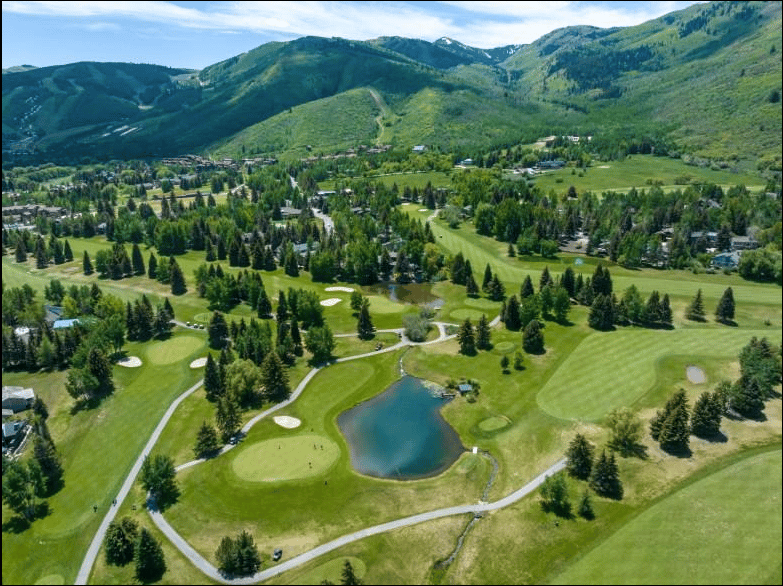
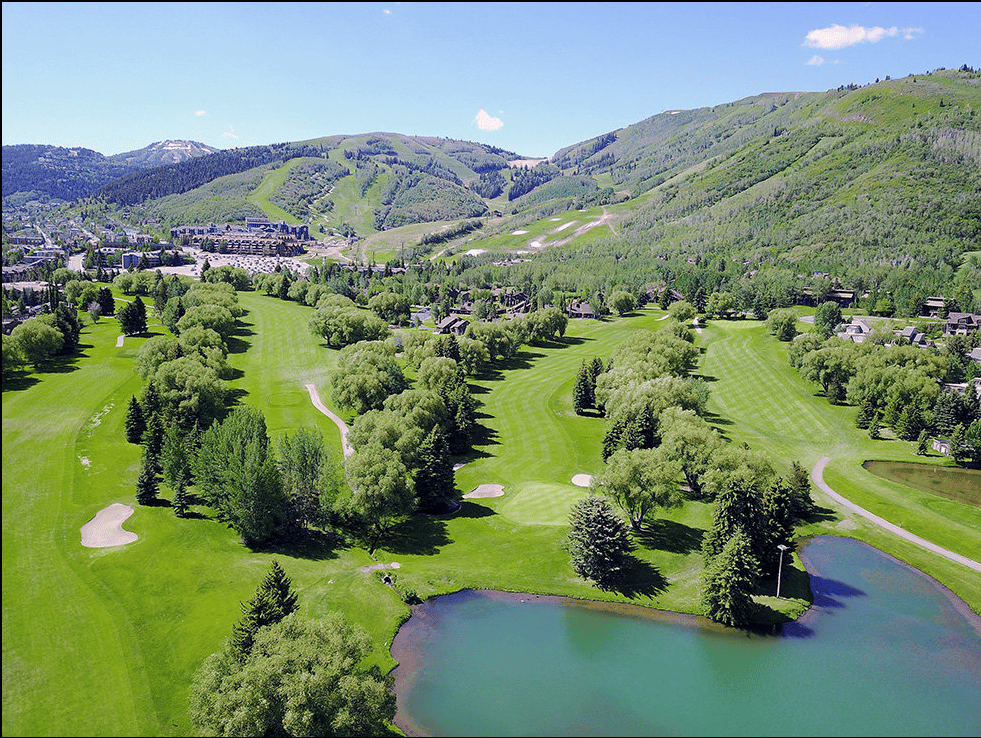
One of the defining geographic features of Thaynes Canyon is the Park City Golf Club, located at 1541 Thaynes Canyon Drive.
Unlike Park Meadows Country Club, which is private, Park City Golf Club is a municipally operated public golf course. Park City's current golf program provides both 18-hole and 9-hole play, leagues, lessons and resident rates.
The course occupies a spectacular position beneath the surrounding mountains.
Green fairways run through the center of town beneath Park City Mountain's ski terrain, creating one of the neighborhood's most memorable visual juxtapositions: golf in the foreground and ski runs climbing dramatically behind it.
For Thaynes Canyon homeowners, the golf course contributes far more than recreation.
It creates open sightlines.
It introduces broad green corridors into an otherwise heavily wooded residential landscape.
It provides seasonal contrast.
And it reinforces one of the defining qualities of this portion of Park City—the ability to live in a residential mountain environment without relinquishing proximity to town.
During summer, those fairways become one of the neighborhood's dominant visual elements.
When winter arrives, Park City's Trails & Open Space program also manages a winter Nordic concession associated with the golf course, transforming part of the summer landscape into seasonal snow recreation.
Few neighborhoods can place skiing, Nordic recreation, golf and residential living within such a compact geography.
At the northern edge of the broader Thaynes Canyon area sits Silver Star, one of Park City's distinctive slopeside developments.
Silver Star at Park City is positioned adjacent to the Park City Golf Course and provides direct access to Park City Mountain through the Silver Star chairlift when that terrain and lift are operating. Park City Mountain itself describes Silver Star as a slopeside ski-in/ski-out property, while Park City Mountain's guidance identifies the Silver Star lift as an access point into the resort.
This creates an interesting distinction within Thaynes Canyon.
The majority of the traditional single-family neighborhood is not ski-in/ski-out.
Instead, owners enjoy exceptionally close proximity to skiing without living inside a resort village.
Silver Star provides the area's more immediate lift-access component, while homes deeper into Thaynes Canyon retain a quieter, more conventional residential character.
That balance appeals to buyers who want skiing to be central to their Park City lifestyle without requiring their home to function as resort lodging.
Park City Mountain currently encompasses approximately 7,300 acres of skiable terrain, making proximity to the mountain a significant four-season asset for this side of town.
One of Thaynes Canyon's greatest strengths becomes particularly evident after the snow melts.
The area sits alongside some of Park City's most celebrated mountain biking and hiking terrain.
The broader Park City trail network contains hundreds of miles of interconnected non-motorized recreational trails, and Mountain Trails Foundation identifies Park City as an International Mountain Bicycling Association Gold-Level Ride Center.
Near Silver Star and Park City Mountain, riders and hikers can connect toward well-known trails including Spiro, Armstrong and Mid Mountain.
Mountain Trails Foundation describes Mid Mountain as a roughly 26-mile trail traversing Park City's mountain terrain at approximately 8,000 feet, with connections around Spiro, Armstrong, Iron Mountain and beyond.
Armstrong was developed as a directional uphill bicycle trail, while Spiro has long played an important role in Park City's riding network. Mountain Trails Foundation's trail history documents the evolution of both trails as recreational use increased.
For Thaynes Canyon residents, that network fundamentally changes the meaning of “trail access.”
The trails are not merely a recreational destination somewhere across town.
They form part of the immediate landscape.
A summer morning can begin with a ride or hike into the mountains and end with coffee, golf or work without requiring a lengthy trip to a trailhead.
For many Park City residents, that is the essence of luxury:
time returned to the day because recreation begins close to home.
Hidden behind the golf course off Payday Drive is one of Thaynes Canyon's loveliest small amenities: Rotary Park.
Park City describes Rotary Park as a quiet mountain setting surrounded by aspen trees and a flowing stream. The park contains picnic facilities and a pavilion while retaining a surprisingly secluded atmosphere given its central location.
Rotary Park encapsulates the personality of Thaynes Canyon remarkably well.
It is understated.
Wooded.
Peaceful.
And almost unexpectedly close to the center of Park City.
The stream, mature aspens and shaded setting contribute to the neighborhood's softer, greener character during summer. In fall, those same trees become one of the area's most dramatic visual features as the canyon shifts into brilliant gold.
This mature vegetation is one of the characteristics that newer developments simply cannot reproduce quickly.
Trees require time.
Thaynes Canyon has had it.
Approaching Park City along Highway 224, few landmarks are more recognizable than McPolin Farm and its famous white barn.
The historic agricultural landscape creates a dramatic visual threshold between the Snyderville Basin and Park City proper, and portions of the broader Thaynes Canyon and Aspen Springs area occupy the terrain behind and around this treasured open landscape. Park City maintains McPolin Farm as a civic and historic resource, while the city's broader open-space program preserves substantial land throughout the community.
The White Barn has become more than a historic structure.
It functions almost as a visual symbol of arriving in Park City.
For nearby residential areas, those open agricultural views create a very different experience from dense resort development.
Pasture, mountains, historic architecture and luxury residences can coexist within the same panorama.
That juxtaposition helps explain why the southern and western reaches of the broader Thaynes Canyon area can feel remarkably pastoral despite their proximity to Park City's commercial and resort center.
The housing stock within Thaynes Canyon reflects decades of Park City architectural history.
The neighborhood contains original homes from earlier phases of Park City's modern resort era, extensively remodeled residences, custom mountain homes and contemporary replacements. The broader MLS area also contains condominiums and townhomes associated with communities such as Silver Star, Three Kings, Snow Flower and Payday.
This creates tremendous variety.
Traditional mountain architecture may feature:
Renovated residences often reinterpret those elements with cleaner interiors, larger openings and more contemporary finishes.
Newer custom homes increasingly introduce:
Because Thaynes Canyon is not governed by a single development-era architectural concept, the result is a neighborhood with genuine architectural individuality.
For some buyers, this diversity is an advantage.
They are not purchasing a prescribed aesthetic.
They are purchasing a location and a landscape, then selecting the home that best suits them within it.
The age of Thaynes Canyon provides another important advantage: landscape maturity.
Properties developed decades ago can contain large established aspens, spruce and other mountain vegetation that soften architecture and create privacy between homes.
That is materially different from purchasing a luxury residence in a newly constructed neighborhood where landscaping may require years to mature.
The visual experience changes seasonally.
In spring, the understory begins to green.
Summer produces dense foliage and shade.
Autumn turns the aspens gold.
Winter strips the landscape back to trunks, evergreens and snow, often revealing mountain views that become partially concealed during summer.
It gives Thaynes Canyon residences an unusually strong relationship with the seasons.
And because terrain varies throughout the neighborhood, some properties derive their privacy from mature vegetation, others from elevation, acreage, open-space adjacency or golf-course orientation.
There is no single Thaynes Canyon formula.
That is part of its attraction.
As the broader Thaynes Canyon area climbs toward Iron Mountain, the atmosphere changes again.
Terrain becomes more elevated and wooded, with sections of the Mid Mountain trail system crossing the face of Iron Mountain. Mountain Trails Foundation describes this portion of Mid Mountain as moving through mountain terrain and aspen groves before continuing toward Canyons Village.
Properties in and around the upper canyon, Aspen Springs and Iron Canyon can offer a different scale of mountain living from homes nearer the golf course.
Here the focus may shift toward:
Yet residents remain remarkably close to Park City's urban core.
That is the contradiction Thaynes Canyon repeatedly manages to achieve:
the farther into it one travels, the more removed it can feel—without actually being far away.
Summer transforms Thaynes Canyon.
The golf course becomes vivid green.
Aspens and mature landscaping fill in.
The trail network opens across Park City Mountain and Iron Mountain.
Cyclists move through the surrounding paths.
Rotary Park becomes shaded and green.
Patios, terraces and outdoor dining spaces become extensions of the home.
A resident can play golf, ride mountain bikes, hike, attend events on Main Street or simply remain at home beneath the trees.
Park City's trail network and municipal golf facilities give the neighborhood an unusual combination of active recreation and residential calm.
And unlike neighborhoods whose strongest identity arrives only with snow, Thaynes Canyon may be equally compelling—or even more compelling—to some residents during summer.
It becomes intensely green, quiet and intimate.
Autumn deserves its own chapter here.
Mature aspens are one of Thaynes Canyon's defining visual elements, and as temperatures cool, the neighborhood becomes layered with gold.
Aspen trunks brighten against darker evergreen trees.
The golf course remains green below.
The surrounding mountains turn amber and rust.
Morning temperatures sharpen.
The first snow may dust the upper ridgelines while fall remains visible beneath.
For residents of heavily wooded properties, autumn can feel almost cinematic.
It is a brief season, but perhaps the one that best reveals why established vegetation matters so profoundly in mountain real estate.
Architecture alone does not create a mountain home.
Landscape does.
And Thaynes Canyon has landscape in abundance.
Winter returns the neighborhood to its most iconic Park City setting.
Snow settles across the golf course and into the trees.
Park City Mountain rises immediately beyond the neighborhood.
Silver Star provides nearby mountain access, while the primary Park City Mountain base is only minutes from much of Thaynes Canyon. Deer Valley is also readily accessible from this central location.
Nordic recreation returns to the municipal golf-course landscape, and the extensive Park City winter recreation network comes alive. Park City's Trails & Open Space team reports management of winter trails as part of its citywide open-space program.
Yet unlike a ski village, Thaynes Canyon remains principally residential.
That distinction matters.
The neighborhood can participate in resort life without being consumed by it.
A homeowner may spend the day skiing and still return to a quiet street, a private driveway and an established mountain home surrounded by trees.
Thaynes Canyon's proximity to Historic Main Street is one of its most powerful advantages.
The neighborhood is located within Park City rather than in an outlying portion of the Wasatch Back, placing Main Street's restaurants, galleries, boutiques, cultural attractions and nightlife only a short drive away from most properties. Local neighborhood sources typically characterize the drive as approximately five minutes, although actual travel time depends upon the exact property, weather, traffic and season.
That centrality becomes particularly valuable when viewed against Park City's geography.
Many luxury developments deliver privacy and mountain views by moving farther away from town.
Thaynes Canyon achieves something different.
It provides privacy through terrain, mature landscaping and residential character rather than sheer distance.
That is a more difficult combination to replicate.
Park City operates a robust public transportation system, and the broader Thaynes Canyon area is served by transit connections near Thaynes Canyon Drive, Three Kings, Payday, Park Avenue and the Highway 224 corridor, although routes and schedules can change seasonally and should always be confirmed for a specific property.
Highway 224 also provides immediate access north toward the Snyderville Basin and Interstate 80.
For second-home owners or residents who travel frequently, that orientation can be particularly advantageous because leaving Park City does not necessarily require navigating the narrow streets of Old Town first.
Again, the key word is access.
Thaynes Canyon enjoys it in virtually every direction.
Another important distinction for prospective buyers is that traditional Thaynes Canyon is not one uniform master-planned development.
There is no single area-wide HOA controlling the entire neighborhood. Individual subdivisions, condominium communities or planned developments within the larger Thaynes Canyon MLS area may have their own associations, governing documents, architectural requirements and fees.
That matters considerably when comparing properties.
A single-family home in the traditional Thaynes Canyon neighborhood may operate under a very different ownership structure from a residence at Silver Star or a condominium within another nearby development.
Buyers should therefore evaluate each property's:
individually rather than assuming that the neighborhood name establishes a uniform set of rules.
This is particularly important for buyers considering nightly rental income. Eligibility varies by parcel, zoning and development, and should be independently verified with Park City Municipal and the applicable HOA rather than inferred from the broader Thaynes Canyon designation.
Thaynes Canyon and Park Meadows are geographically close, but their personalities are meaningfully different.
Park Meadows is organized visually around broader residential streets, the private Park Meadows Country Club and extensive fairway landscapes.
Thaynes Canyon feels more enclosed, wooded and topographically varied, with a public municipal golf course on one edge and slopes rising toward Iron Mountain on another.
Park Meadows often presents a more open, polished and country-club-oriented experience.
Thaynes Canyon often feels more organic and private.
Park Meadows offers the private Jack Nicklaus golf-club lifestyle.
Thaynes Canyon provides direct proximity to Park City's public municipal course and especially strong connections toward Park City Mountain and the Silver Star trail and ski corridor.
Neither is inherently better.
They answer different versions of the same question:
How do you want to live in Park City?
Old Town places residents inside the historic mining grid, with walkability, architecture, Main Street and immediate resort energy at the forefront.
Thaynes Canyon trades some of that walkability for:
Yet it remains close enough to Historic Main Street that owners do not surrender the cultural and dining life of central Park City.
For buyers who love Old Town but want more space around them, Thaynes Canyon can become a natural alternative.
Compared with Deer Valley's resort enclaves or newer private-club communities farther from town, Thaynes Canyon provides a different proposition entirely.
There may be no grand gate.
No amenity tower.
No branded clubhouse attached to the traditional neighborhood.
What owners receive instead is something more difficult to manufacture:
an established place in Park City itself.
Decades-old trees.
A municipal golf course.
Trails that have become part of Park City's outdoor culture.
A stream running through Rotary Park.
Historic agricultural open space nearby.
A ski mountain rising behind the neighborhood.
And Main Street only minutes away.
It is luxury defined through location, land and authenticity rather than programming.
Thaynes Canyon tends to make particular sense for buyers who want Park City to function as a home rather than simply as a vacation destination.
It can appeal especially to those seeking:
For that buyer, Thaynes Canyon can represent one of Park City's most balanced residential environments.
Mountain towns evolve quickly.
Open land becomes neighborhoods.
Small homes become larger residences.
Resort villages expand.
Architecture changes.
Traffic patterns change.
But some qualities cannot be accelerated.
Trees cannot be made fifty years old overnight.
A neighborhood cannot instantly acquire history.
A trail network cannot become part of community culture by decree.
A historic farm cannot be recreated once it disappears.
And an in-town location cannot be manufactured farther out in the valley.
Those are Thaynes Canyon's deeper assets.
It possesses the intangible advantages of time.
Time for landscapes to mature.
Time for architecture to evolve.
Time for trails to become woven into daily life.
Time for a neighborhood to develop a recognizable sense of itself.
For buyers searching for Thaynes Canyon homes for sale, Park City luxury real estate, golf-course homes, mountain modern residences, wooded estates or homes near Park City Mountain, Thaynes Canyon deserves far more attention than its understated entrance might suggest.
It does not attempt to be a resort village.
It does not attempt to be a private club.
And it does not attempt to reproduce Old Town.
Instead, Thaynes Canyon offers something distinctly its own:
a deeply established mountain neighborhood where skiing, golf, trails, mature forests and Park City itself meet in one remarkably central setting.
8,575 people live in THAYNES CANYON IN PARK CITY, UTAH, where the median age is 47.7 and the average individual income is $103,915. Data provided by the U.S. Census Bureau.
Total Population
Median Age
Population Density Population Density This is the number of people per square mile in a neighborhood.
Average individual Income
There's plenty to do around THAYNES CANYON IN PARK CITY, UTAH, including shopping, dining, nightlife, parks, and more. Data provided by Walk Score and Yelp.
Explore popular things to do in the area, including No Name Saloon & Grill, LAND JUICERY, and Chip Cookies.
| Name | Category | Distance | Reviews |
Ratings by
Yelp
|
|---|---|---|---|---|
| Dining · $$ | 0.4 miles | 1092 reviews | 3.8/5 stars | |
| Dining | 0.4 miles | 7 reviews | 4/5 stars | |
| Dining | 0.4 miles | 41 reviews | 4.5/5 stars | |
| Dining | 0.4 miles | 71 reviews | 4.6/5 stars | |
| Dining | 0.4 miles | 4 reviews | 1.8/5 stars | |
| Dining · $$ | 0.41 miles | 700 reviews | 3.5/5 stars | |
| Dining | 0.41 miles | 1 review | 4/5 stars | |
| Dining | 0.41 miles | 3 reviews | 1/5 stars | |
| Shopping | 0.4 miles | 15 reviews | 4.3/5 stars | |
| Shopping | 0.4 miles | 0 reviews | 0/5 stars | |
| Shopping | 0.41 miles | 1 review | 5/5 stars | |
| Shopping | 0.41 miles | 6 reviews | 4.7/5 stars | |
| Shopping | 0.41 miles | 7 reviews | 4.4/5 stars | |
| Shopping | 0.41 miles | 15 reviews | 4.3/5 stars | |
| Active | 0.33 miles | 0 reviews | 0/5 stars | |
| Active | 0.41 miles | 0 reviews | 0/5 stars | |
| Active | 0.41 miles | 6 reviews | 3.7/5 stars | |
| Nightlife | 0.39 miles | 88 reviews | 2.2/5 stars | |
| Nightlife | 0.39 miles | 8 reviews | 2.3/5 stars | |
| Nightlife | 0.39 miles | 2 reviews | 5/5 stars | |
| Beauty | 0.4 miles | 44 reviews | 5/5 stars | |
| Beauty | 0.4 miles | 0 reviews | 0/5 stars | |
| Beauty | 0.4 miles | 175 reviews | 4.6/5 stars | |
| Beauty | 0.41 miles | 0 reviews | 0/5 stars | |
|
|
||||
|
|
||||
|
|
||||
|
|
||||
|
|
||||
|
|
THAYNES CANYON IN PARK CITY, UTAH has 3,426 households, with an average household size of 2.48. Data provided by the U.S. Census Bureau. Here’s what the people living in THAYNES CANYON IN PARK CITY, UTAH do for work — and how long it takes them to get there. Data provided by the U.S. Census Bureau. 8,575 people call THAYNES CANYON IN PARK CITY, UTAH home. The population density is 196 and the largest age group is Data provided by the U.S. Census Bureau.
Total Population
Population Density Population Density This is the number of people per square mile in a neighborhood.
Median Age
Men vs Women
Population by Age Group
0-9 Years
10-17 Years
18-24 Years
25-64 Years
65-74 Years
75+ Years
Education Level
Total Households
Average Household Size
Average individual Income
Households with Children
With Children:
Without Children:
Marital Status
Blue vs White Collar Workers
Blue Collar:
White Collar: