Set immediately east of Park City's historic core, Prospector is one of the city's most established, varied and genuinely livable neighborhoods—a place where residential streets, condominiums, locally oriented businesses, lodging, restaurants, schools, trails, parks and public transportation all coexist within a remarkably compact piece of Park City.
Prospector occupies a strategic position along the Kearns Boulevard/Highway 248 corridor, generally between the Bonanza Park area to the west and the open landscapes leading toward Round Valley and Quinn's Junction to the east. Park City's 2025 General Plan identifies Prospector as a distinct neighborhood of approximately 255 acres, with a residential population estimated at roughly 1,590, while emphasizing the importance of maintaining both its neighborhood character and its functioning commercial district.
What makes Prospector unusual is not one spectacular amenity.
It is the concentration of many useful ones.
Historic Main Street is nearby.
Park City Mountain and Deer Valley are readily accessible.
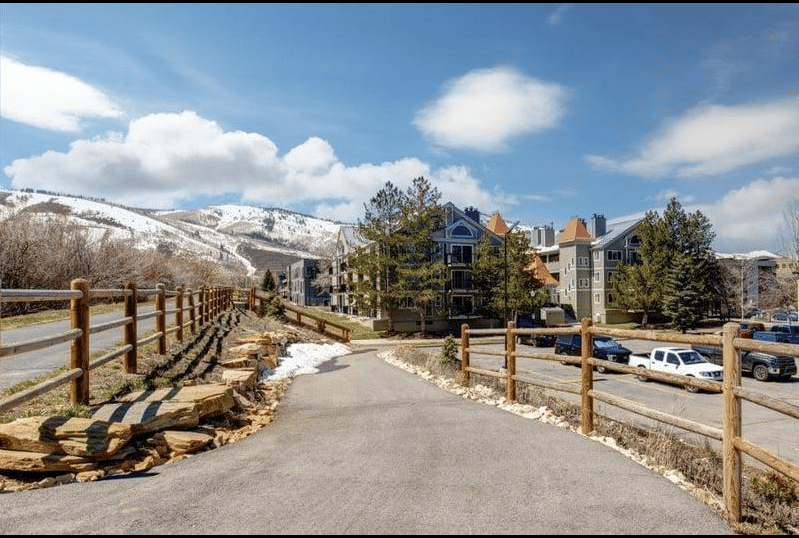
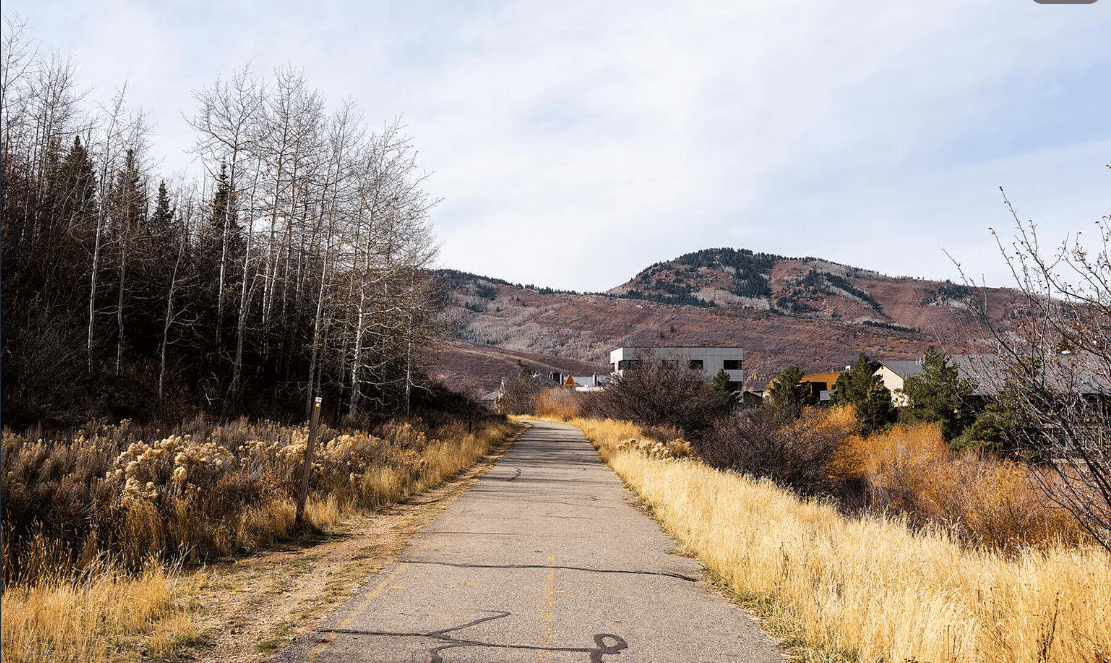
The Historic Union Pacific Rail Trail runs directly through the area.
The Lost Prospector trail network climbs immediately above it.
Round Valley lies just beyond the neighborhood.
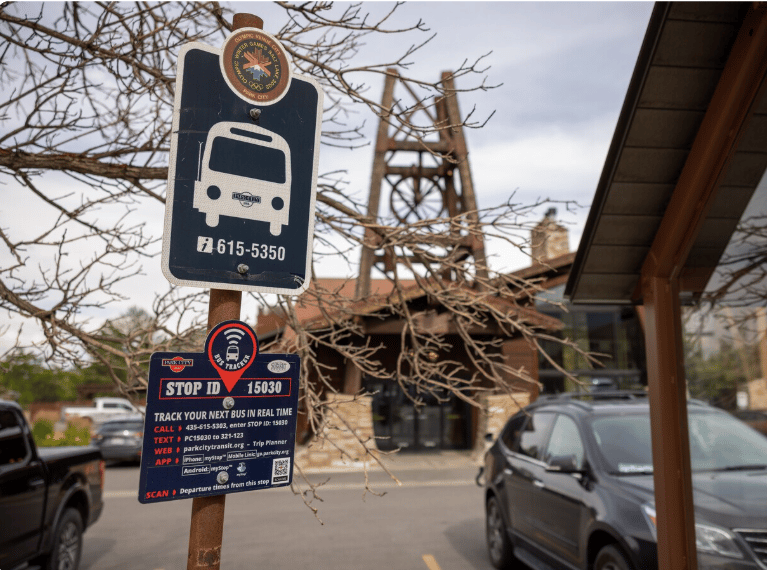
Park City Transit serves the district.
McPolin Elementary and Park City High School sit along the Kearns Boulevard corridor.
Restaurants, professional offices and everyday services are incorporated into Prospector Square itself.
Prospector therefore offers something many resort neighborhoods do not:
the ability to participate in Park City without having every aspect of daily life organized around the resort.
Prospector should never be reduced to Prospector Square alone.
The larger neighborhood contains several distinctly different residential environments.
Along Sidewinder Drive and Prospector Avenue, the character becomes denser and more mixed-use, with condominiums, lodging properties, commercial spaces and smaller residential units.
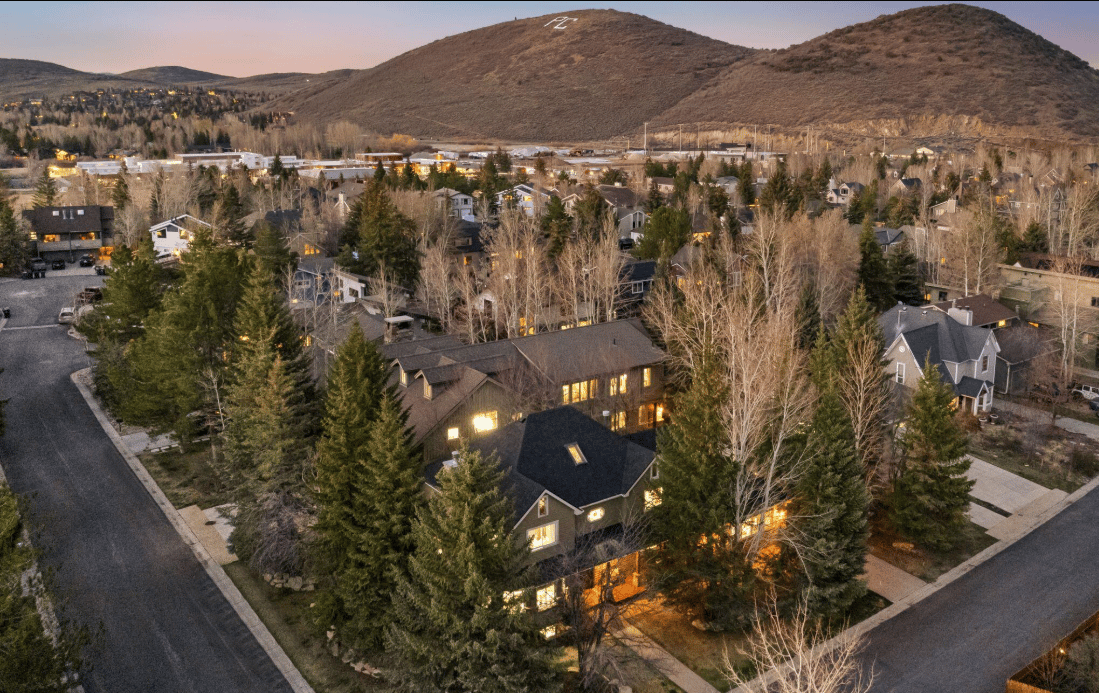
Move into the residential streets and cul-de-sacs around Prospector Park, Comstock, Wyatt Earp and surrounding roads, and the experience becomes much more traditionally neighborhood-oriented, with established single-family homes, mature landscaping and quieter streets.
Other portions of the broader Prospector MLS area include attached homes, townhomes and newer residential communities, producing one of the most varied collections of housing in central Park City. Current market inventories identify everything from studios and compact condominiums to townhomes and multimillion-dollar single-family residences within the broader Prospector area.
That range is important.
Prospector is not one price point.
It is not one architecture.
And it is certainly not one lifestyle.
It is one of the few places in Park City where entry-level in-town ownership, investment property, primary residences and substantial luxury homes can exist within the same neighborhood ecosystem.
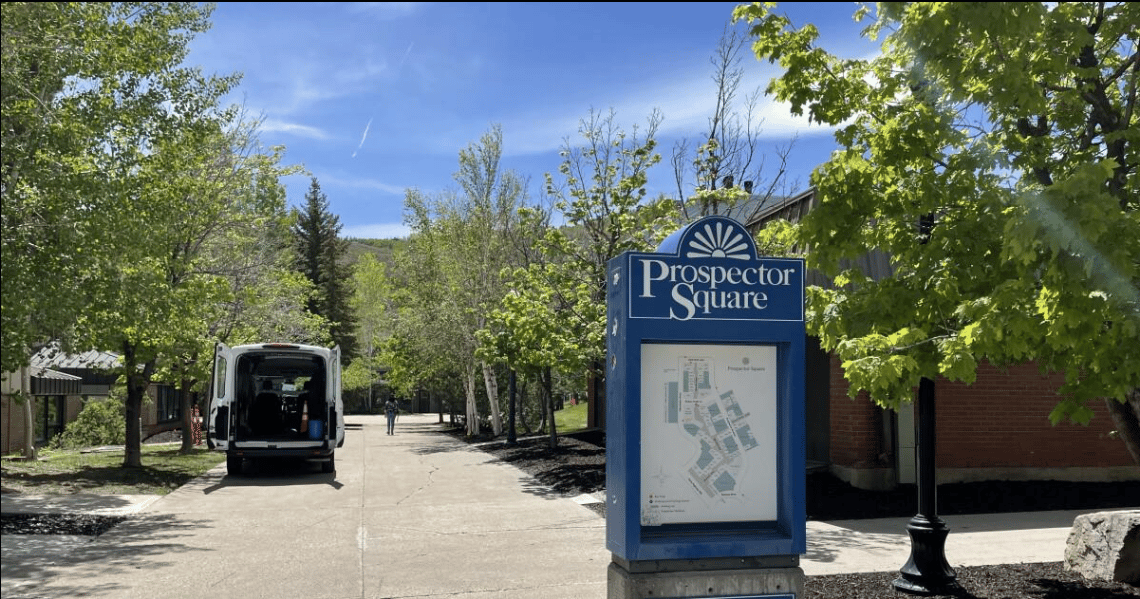
At the center of the area's commercial identity is Prospector Square, a long-established collection of residential, lodging, restaurant, office and commercial properties centered around Prospector Avenue and Sidewinder Drive.
Park City planning documents explicitly distinguish Prospector from neighboring Bonanza Park, noting that Prospector contains both single-family housing and local mixed-use commercial activity and possesses its own independent neighborhood character. The city's current planning goals call for preserving a vibrant Prospector commercial district, improving pedestrian and bicycle connectivity, enhancing outdoor spaces and supporting neighborhood businesses.
This mixture gives Prospector Square an everyday usefulness that is often underestimated.
There are places to eat.
Professional offices.
Lodging.
Residential condominiums.
Transit stops.
Walking connections.
Access to the Rail Trail.
And businesses used by both residents and visitors.
It is not a polished resort plaza in the style of Deer Valley or Canyons Village.
That is part of its authenticity.
Prospector Square feels more like working Park City.
Prospector is extremely central without being part of Park City's historic tourist core.
That distinction is one of its greatest strengths.
Historic Main Street is close enough for dinner, galleries, nightlife and events, but Prospector residents do not live directly within Main Street's density, steep streets or peak visitor activity.
Park City Mountain is nearby, but the neighborhood is not built around a ski base.
Deer Valley is readily accessible, but Prospector is not controlled by a resort identity.
The result is a neighborhood that remains connected to nearly every major Park City experience while retaining a more practical residential rhythm.
It is in town without being in the middle of the spectacle.
No description of Prospector is complete without the Historic Union Pacific Rail Trail.
The trail begins in the Park City area and follows the former railroad corridor for nearly 30 miles toward Echo Reservoir, passing through Silver Creek Canyon, Wanship and Coalville. Utah State Parks identifies it as Utah's first non-motorized rail trail, formally dedicated as a state park in 1992 after Union Pacific abandoned the railway corridor.
Historically, the railroad itself was deeply connected to Park City's mining economy. Rail lines were developed in the nineteenth century to move coal and other materials between the mines, Coalville and Park City.
Today, the infrastructure serves an entirely different purpose.
Residents use the Rail Trail for walking, running, cycling, cross-country skiing and everyday non-motorized transportation.
For Prospector, that is a major lifestyle advantage.
The trail does not sit several miles from the neighborhood.
It runs through it.
Park City's outdoor culture often revolves around trails, but Prospector enjoys an especially strong relationship with them because the trail system functions as both recreation and transportation.
The Rail Trail provides the primary east-west corridor.
The Lost Prospector trail system rises immediately above the neighborhood and offers winding singletrack through Gamble oak with views across Park City. Mountain Trails notes that the Lost Prospector area connects back to the Rail Trail, which in winter is groomed for Nordic use and provides further access toward Round Valley.
Prospector therefore creates multiple levels of recreation.
A resident can take an easy walk along the relatively level Rail Trail.
A mountain biker can climb into Lost Prospector.
A trail runner can head into hillside terrain.
A cyclist can continue east toward Round Valley.
A commuter can use parts of the pathway network instead of driving.
This is not simply proximity to outdoor recreation.
It is integration with outdoor recreation.
The Lost Prospector trail area climbs along the hills immediately south and east of the neighborhood.
Mountain Trails describes it as a local escape from the activity of Old Town, with singletrack winding through Gamble oak and offering expansive views. The area also connects toward PC Hill and the Rail Trail network below.
That location gives Prospector an unusual dual personality.
At street level, it feels comparatively urban for Park City.
There are businesses, traffic, transit stops, condominiums and schools.
Minutes later, a resident can be on dirt singletrack above town.
Few neighborhoods illustrate Park City's unusual compression of city and mountain as clearly.
Continue east from Prospector and the landscape opens into Round Valley, one of Park City's most important year-round recreation areas.
Mountain Trails identifies Round Valley as approximately 2,100 acres of rolling high-desert terrain with more than 50 miles of trail, currently mapping roughly 56 miles of routes for hiking, biking and other trail uses.
The Rail Trail helps connect the Prospector area toward this larger recreation network, creating a progression from neighborhood pathway to expansive open-space trail system.
For residents who bike or run regularly, this changes the meaning of location.
Round Valley is not an occasional destination.
It can become part of an ordinary weekday.
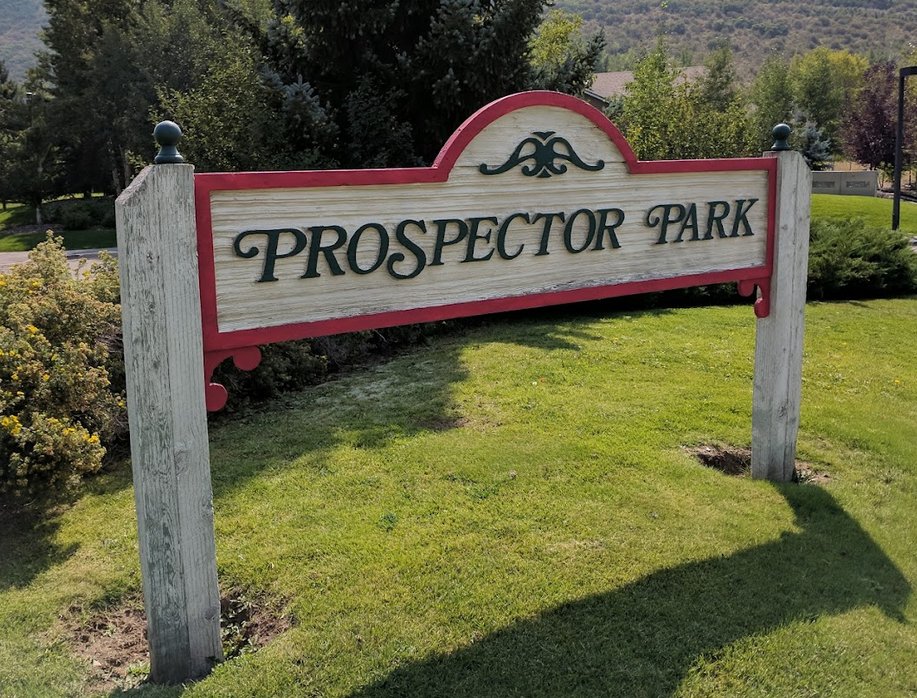
Prospector also includes Prospector Park, one of Park City's protected neighborhood parks.
In 2020, Park City created an Urban Park zoning district specifically intended to provide additional protection for several city parks, including Prospector Park.
The presence of a neighborhood park contributes to Prospector's primary-residence character and provides a softer counterpoint to the commercial activity around Prospector Square.
Park City School District has even used Prospector Park as a neighborhood gathering point for community bike-to-school events, reflecting how naturally it fits into the neighborhood's pedestrian and cycling network.
Park City has spent years improving bicycle and pedestrian connectivity between Prospector, Park Meadows and the city's larger trail system.
The city's Comstock/Sidewinder walkability improvements were designed to complete a key connection through Park Meadows and Prospector between the McLeod Creek Trail and the Rail Trail.
The city's current General Plan continues that emphasis, recommending better pedestrian and bicycle connections within Prospector and between neighboring districts.
This matters because Prospector is relatively unusual for Park City.
Large portions of the neighborhood have comparatively manageable grades.
Sidewalks and pathways exist alongside a mixture of residences and businesses.
The Rail Trail provides a dedicated non-motorized spine.
And transit provides another alternative to driving.
For a mountain town famous for steep streets and winding roads, relative ease of movement is an underrated luxury.
Prospector is integrated into Park City Transit's free municipal bus network.
Park City's current transit operation runs nine fixed routes year-round and serves residents, visitors and employees throughout the city. City budget documents continue to identify Prospector Square and Prospector service as part of both summer and winter operations.
That provides straightforward connections toward central Park City and other major destinations without requiring a car for every trip.
For visitors staying in Prospector Square, this is convenient.
For full-time residents, it can be much more valuable.
Parking in Park City's busiest areas can be complicated during ski season and major events.
Living on a transit-served corridor gives owners another option.
Prospector sits directly along Kearns Boulevard, State Route 248, one of Park City's most important east-west transportation corridors.
This provides quick access east toward Quinn's Junction and U.S. 40 and west toward central Park City.
The location can therefore work especially well for people whose lives extend beyond the historic core.
A resident can head toward Heber, Kamas, the Jordanelle corridor or U.S. 40 without first navigating Old Town.
Likewise, access toward Park City's resorts and commercial districts remains close.
This is one reason Prospector can feel exceptionally functional as a full-time neighborhood.
Prospector lies within the Park City School District, and the district's current elementary boundary information specifically identifies Prospector within the McPolin Elementary School attendance area. McPolin Elementary is located at 2270 Kearns Boulevard, immediately along the Prospector corridor.
Park City High School is also located nearby at 1750 Kearns Boulevard.
That proximity reinforces Prospector's identity as a genuine primary-residence neighborhood.
Schools are not remote amenities somewhere across the basin.
They are part of the immediate urban fabric.
As always, school boundaries and enrollment policies can change, so buyers should confirm the assignment for a specific address directly with Park City School District. The district itself cautions that its boundary map is informational rather than a legal survey.
Prospector contains perhaps one of the widest real-estate spectrums inside Park City proper.
Current inventory includes compact studio condominiums, one- and two-bedroom units, larger condominiums, townhomes, traditional single-family residences and substantial custom homes.
That diversity is significant in a market often associated exclusively with multimillion-dollar resort property.
Prospector provides multiple entry points into an 84060 Park City address.
At one end of the spectrum are smaller condominiums concentrated along Sidewinder Drive and Prospector Avenue.
At another are established residential enclaves with detached homes.
And toward the upper end are larger remodeled and newer residences offering contemporary interiors, mountain views and considerably more living space.
That range is one reason Prospector attracts such a diverse ownership profile.
Primary residents.
Second-home owners.
Investors.
First-time Park City buyers.
Downsizers.
People who value convenience over resort ceremony.
They can all find a version of Prospector that makes sense.
The smaller condominium properties concentrated around Sidewinder Drive and Prospector Avenue form one of the most recognizable pieces of Prospector's housing stock.
Studios and compact one-bedroom units in this area can offer a considerably lower point of entry than most detached housing in Park City while maintaining an in-town location near transit, trails, skiing and Main Street. Current market listings continue to show studio residences in the roughly 300- to 500-square-foot range alongside larger condominium units.
This is one reason Prospector Square occupies a distinctive position in the Park City market.
A buyer can own a very small mountain base without being pushed far out into the Snyderville Basin or neighboring communities.
For second-home owners, solo travelers or investors, efficiency can itself be valuable.
Prospector requires particularly careful language regarding nightly rental eligibility.
There is no accurate blanket statement that applies to the entire neighborhood.
Certain lodging-oriented and condominium properties within Prospector Square have historically been operated as nightly rentals, and Park City's broader planning framework permits nightly rentals only where the underlying zoning and property approvals allow them.
At the same time, the city's 2025 General Plan specifically identifies Prospector Park and Chatham Crossing subdivisions as areas where nightly rentals are prohibited.
Therefore, rental potential must always be verified at the individual property level through Park City zoning, the applicable HOA or governing documents, existing entitlements and current licensing requirements.
This is especially important for buyers comparing two Prospector properties that may appear nearly identical geographically but carry entirely different use rights.
For the correct property, Prospector can be compelling from an investment perspective because of its central Park City location, proximity to public transportation, recreational access and diverse housing stock.
But investment value here should not be reduced to nightly rentals alone.
Some buyers may prioritize long-term rental demand.
Others may value a compact second home.
Others may seek a property with legal nightly-rental potential.
Still others may purchase a residence primarily for personal use because it provides Park City access without the pricing structure of a slopeside luxury project.
The neighborhood accommodates different strategies.
That flexibility is part of its strength.
Prospector's architecture reflects multiple eras of Park City development.
The single-family sections contain homes ranging from modest established residences to extensively remodeled and larger custom properties.
Some properties display traditional mountain forms.
Others incorporate Victorian-inspired details associated with Park City's late-twentieth-century interpretation of historic architecture.
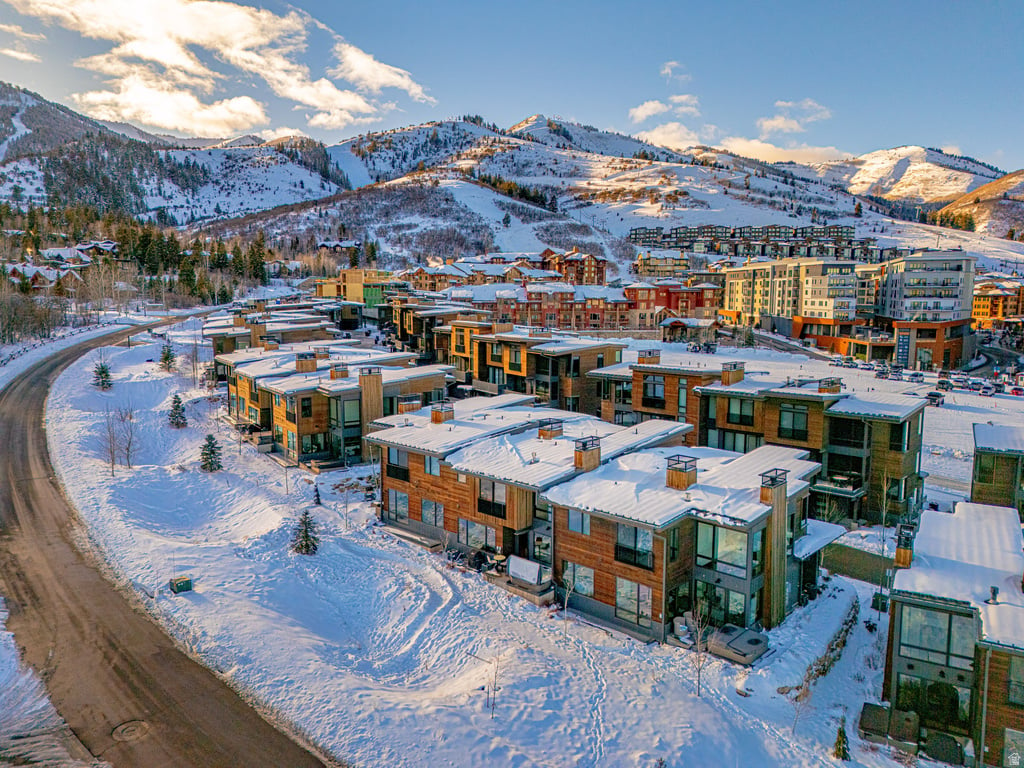
More contemporary homes increasingly use cleaner lines, broad glazing, updated stonework and modern mountain interiors. Current Prospector market guides specifically note this architectural diversity across the neighborhood's single-family and attached inventory.
The condominium and lodging districts have their own character, with low- and mid-rise buildings concentrated around Prospector Square and Sidewinder.
There is no single Prospector aesthetic.
The neighborhood grew in layers.
And visually, it shows.
One of the most appealing surprises within Prospector is how quickly the atmosphere can change when one leaves the commercial corridor.
The established residential streets include mature trees, conventional yards and cul-de-sacs that feel dramatically quieter than Kearns Boulevard or Prospector Avenue.
Local descriptions of Prospector emphasize this combination of relatively flat streets and established residential enclaves alongside the mixed-use district.
This is one reason buyers should experience Prospector from the inside rather than simply drive past it on Highway 248.
The main road does not tell the whole story.
Winter demonstrates Prospector's central location particularly well.
Park City Mountain and Deer Valley are close enough for frequent ski days, while Park City Transit provides an alternative to driving and parking at the resort.
The Rail Trail also changes seasonally, with portions groomed for Nordic skiing and connections toward Round Valley.
After skiing, residents return not to a resort village but to a mixed residential neighborhood.
Restaurants and businesses remain nearby.
Main Street is easily accessible.
And the neighborhood itself remains more functional than ceremonial.
For someone who actually lives in Park City, that can be highly attractive.
Summer may reveal Prospector's strongest lifestyle advantages.
The Rail Trail becomes a major cycling, walking and running route.
Lost Prospector opens into mountain biking and hiking terrain.
Round Valley provides more than 50 miles of additional trail recreation nearby.
Residents can leave home on foot or bicycle and move into Park City's recreational network without first driving to a mountain resort.
Restaurants and local services remain close.
And the relatively central location makes Park City's summer concerts, markets, festivals and Main Street activity readily accessible.
Prospector is not merely tolerable when the snow melts.
It arguably becomes more useful.
Autumn brings a different texture.
The Gamble oak covering the hills around Lost Prospector shifts toward amber and rust.
Aspens and neighborhood trees turn gold.
Temperatures cool.
Trail conditions become ideal.
The ski mountains remain visible without winter's visitor intensity.
For homeowners along the quieter residential streets, fall can feel especially local.
It is Park City between seasons, when the neighborhood's residential identity becomes particularly clear.
Spring is when Prospector's lower elevation within Park City can become an advantage.
While higher mountain trails remain buried under snow or mud, portions of the Rail Trail and lower pathways often become usable earlier.
The neighborhood shifts gradually back toward cycling and walking while snow remains visible on the mountains above.
It is a season of transition rather than shutdown.
And Prospector's blend of indoor amenities, transit and lower-elevation recreation makes that transition easier to navigate.
Old Town and Prospector are close geographically but very different in character.
Old Town emphasizes historic architecture, Main Street walkability, steep streets, resort activity and immediate connection to Park City Mountain.
Prospector offers flatter terrain in many sections, a broader spectrum of housing, easier access toward Highway 40, the Rail Trail, schools, local businesses and a more conventional residential environment.
Old Town is Park City's historic heart.
Prospector is one of its most functional residential centers.
A buyer who loves being close to Old Town but wants easier parking, different housing options or direct Rail Trail access may find Prospector particularly compelling.
Park Meadows generally sits higher in Park City's residential hierarchy, with larger single-family homes, golf-course frontage and the private Park Meadows Country Club forming a major part of its identity.
Prospector is denser and considerably more varied.
It offers compact condominiums and mixed-use properties alongside single-family homes.
Park Meadows is primarily residential.
Prospector blends residential, commercial, lodging and recreation.
Park Meadows provides space.
Prospector provides connectivity.
The two neighborhoods sit beside one another but solve very different buyer priorities.
Aerie rises dramatically above Park City with large luxury homes and panoramic views.
Prospector sits below it.
Aerie offers elevation and privacy.
Prospector offers accessibility and ease.
Aerie is principally a luxury single-family neighborhood.
Prospector provides one of Park City's broadest selections of property types.
A buyer choosing between them is often deciding between the view over Park City and the ability to move easily through Park City.
Deer Valley is fundamentally resort-driven.
Luxury residences.
Ski access.
Hospitality.
Branded communities.
Mountain services.
Prospector is the opposite.
Its strength lies in independence from any single resort.
Residents can ski Deer Valley one day and Park City Mountain the next.
They can bike Round Valley in summer.
They can walk the Rail Trail.
They can use Main Street without living there.
Prospector provides Park City itself rather than one resort's interpretation of Park City.
Kimball Junction offers modern commercial infrastructure, interstate access, Newpark, Redstone and contemporary attached housing.
Prospector occupies a much more central location inside Park City proper.
Both are highly functional.
But Prospector offers greater immediacy to Main Street, central Park City schools, Park City Mountain and the historic urban core.
Kimball Junction feels like Park City's northern gateway.
Prospector feels like the practical middle of town.
Canyons Village is resort-centered and heavily oriented toward skiing, lodging and vacation ownership.
Prospector is neighborhood-centered.
Skiing is nearby rather than beneath the building.
Visitors stay here, but people also live here year-round.
Schools, offices, local businesses and residential streets exist alongside the visitor accommodations.
For buyers who want a residence to function beyond their ski vacation, that distinction matters enormously.
Prospector may be at its best as a primary-residence neighborhood.
Its greatest amenities are things people actually use repeatedly:
schools,
transit,
trails,
restaurants,
parks,
manageable access,
proximity to work,
and multiple routes out of town.
These are not the glamorous features that dominate luxury brochures.
They are the features that determine whether living somewhere is easy.
Prospector is easy in ways many mountain neighborhoods are not.
At the same time, the neighborhood can work exceptionally well for second-home buyers—particularly those who prefer simplicity over resort formality.
A compact Prospector condominium can provide:
an in-town Park City address,
quick ski access,
free transit,
the Rail Trail,
nearby restaurants,
and relatively low-maintenance ownership.
For someone who comes to Park City to use Park City, rather than to remain within one luxury resort complex, that can be an excellent equation.
Prospector does not sell luxury in the conventional sense.
There is no gate.
No private golf club.
No grand arrival road.
No resort concierge attached to the neighborhood.
Instead, Prospector offers something increasingly scarce:
centrality without dependence on a resort.
Everything radiates outward from here.
Old Town to the west.
Park Meadows to the north.
Aerie above.
Round Valley to the east.
The Rail Trail through the neighborhood.
Park City Mountain nearby.
Deer Valley beyond town.
Highway 40 within easy reach.
Prospector sits almost at the hinge between them.
That geographical usefulness is difficult to reproduce.
Perhaps Prospector's most underestimated asset is choice.
Choice in housing.
Choice in price point.
Choice in transportation.
Choice in recreation.
Choice in whether to own a primary home, second home or qualifying investment property.
Choice between condominium convenience and single-family privacy.
Choice between walking the Rail Trail and heading into the mountains.
Choice between Main Street and staying close to home.
Prospector does not force one interpretation of Park City living.
It provides several.
Prospector makes particular sense for buyers who value location and functionality as much as prestige.
It appeals to people who want to be in Park City proper.
People who want trail access.
People who use public transportation.
People who prefer a neighborhood with restaurants and services.
People seeking compact lock-and-leave ownership.
People seeking established single-family homes.
People looking for qualifying rental opportunities.
And people who simply want Park City to be convenient.
For those buyers, Prospector can be one of the smartest locations in town.
For buyers searching for Prospector Park City real estate, Prospector Square condos, Sidewinder Drive condominiums, Park City homes near the Rail Trail, in-town Park City investment property or primary residences near Main Street, Prospector deserves considerably more attention than its understated reputation often receives.
The Historic Union Pacific Rail Trail begins here and continues nearly 30 miles toward Echo Reservoir.
Lost Prospector rises immediately above the neighborhood and connects into Park City's trail culture.
Round Valley's 2,100 acres and more than 50 miles of trail lie just beyond.
Park City Transit serves the district year-round.
Prospector sits within the McPolin Elementary boundary and beside the central Park City school corridor.
And its housing inventory ranges from compact condominiums to substantial single-family homes.
Prospector is not trying to be Deer Valley.
It is not trying to be Old Town.
And it is not trying to be a private mountain enclave.
Its value is far more practical—and perhaps more enduring:
Prospector is where Park City becomes exceptionally easy to live in.
Contact Paula Higman at 435-602-8228 if you are interested in real estate in the Prospector Area.
2,652 people live in PROSPECTOR IN PARK CITY, UTAH, where the median age is 36 and the average individual income is $58,363. Data provided by the U.S. Census Bureau.
Total Population
Median Age
Population Density Population Density This is the number of people per square mile in a neighborhood.
Average individual Income
There's plenty to do around PROSPECTOR IN PARK CITY, UTAH, including shopping, dining, nightlife, parks, and more. Data provided by Walk Score and Yelp.
Explore popular things to do in the area, including Grub Steak Restaurant, Freshies Lobster - Park City, and Prospector Park.
| Name | Category | Distance | Reviews |
Ratings by
Yelp
|
|---|---|---|---|---|
| Dining · $$$ | 0.4 miles | 916 reviews | 4.2/5 stars | |
| Dining · $$ | 0.54 miles | 666 reviews | 4.2/5 stars | |
| Active | 0.25 miles | 1 review | 4/5 stars | |
| Active | 0.35 miles | 54 reviews | 4.2/5 stars | |
| Active | 0.35 miles | 68 reviews | 3.6/5 stars | |
| Active | 0.4 miles | 5 reviews | 5/5 stars | |
| Active | 0.47 miles | 2 reviews | 5/5 stars | |
| Active | 0.52 miles | 2 reviews | 3/5 stars | |
| Active | 0.53 miles | 2 reviews | 5/5 stars | |
| Beauty | 0.26 miles | 3 reviews | 5/5 stars | |
| Beauty | 0.35 miles | 1 review | 5/5 stars | |
| Beauty | 0.35 miles | 0 reviews | 0/5 stars | |
| Beauty | 0.35 miles | 0 reviews | 0/5 stars | |
| Beauty | 0.35 miles | 0 reviews | 0/5 stars | |
| Beauty | 0.35 miles | 0 reviews | 0/5 stars | |
| Beauty | 0.36 miles | 7 reviews | 4.6/5 stars | |
| Beauty | 0.45 miles | 12 reviews | 4.7/5 stars | |
| Beauty | 0.46 miles | 3 reviews | 3.7/5 stars | |
| Beauty | 0.47 miles | 10 reviews | 4.2/5 stars | |
| Beauty | 0.5 miles | 2 reviews | 5/5 stars | |
| Beauty | 0.5 miles | 0 reviews | 0/5 stars | |
| Beauty | 0.5 miles | 0 reviews | 0/5 stars | |
| Beauty | 0.5 miles | 11 reviews | 5/5 stars | |
| Beauty | 0.53 miles | 0 reviews | 0/5 stars | |
|
|
||||
|
|
||||
|
|
||||
|
|
||||
|
|
||||
|
|
PROSPECTOR IN PARK CITY, UTAH has 684 households, with an average household size of 3. Data provided by the U.S. Census Bureau. Here’s what the people living in PROSPECTOR IN PARK CITY, UTAH do for work — and how long it takes them to get there. Data provided by the U.S. Census Bureau. 2,652 people call PROSPECTOR IN PARK CITY, UTAH home. The population density is 10,577 and the largest age group is Data provided by the U.S. Census Bureau.
Total Population
Population Density Population Density This is the number of people per square mile in a neighborhood.
Median Age
Men vs Women
Population by Age Group
0-9 Years
10-17 Years
18-24 Years
25-64 Years
65-74 Years
75+ Years
Education Level
Total Households
Average Household Size
Average individual Income
Households with Children
With Children:
Without Children:
Marital Status
Blue vs White Collar Workers
Blue Collar:
White Collar: